4.27 PSSA Review: Matter, Energy, Forces and Waves
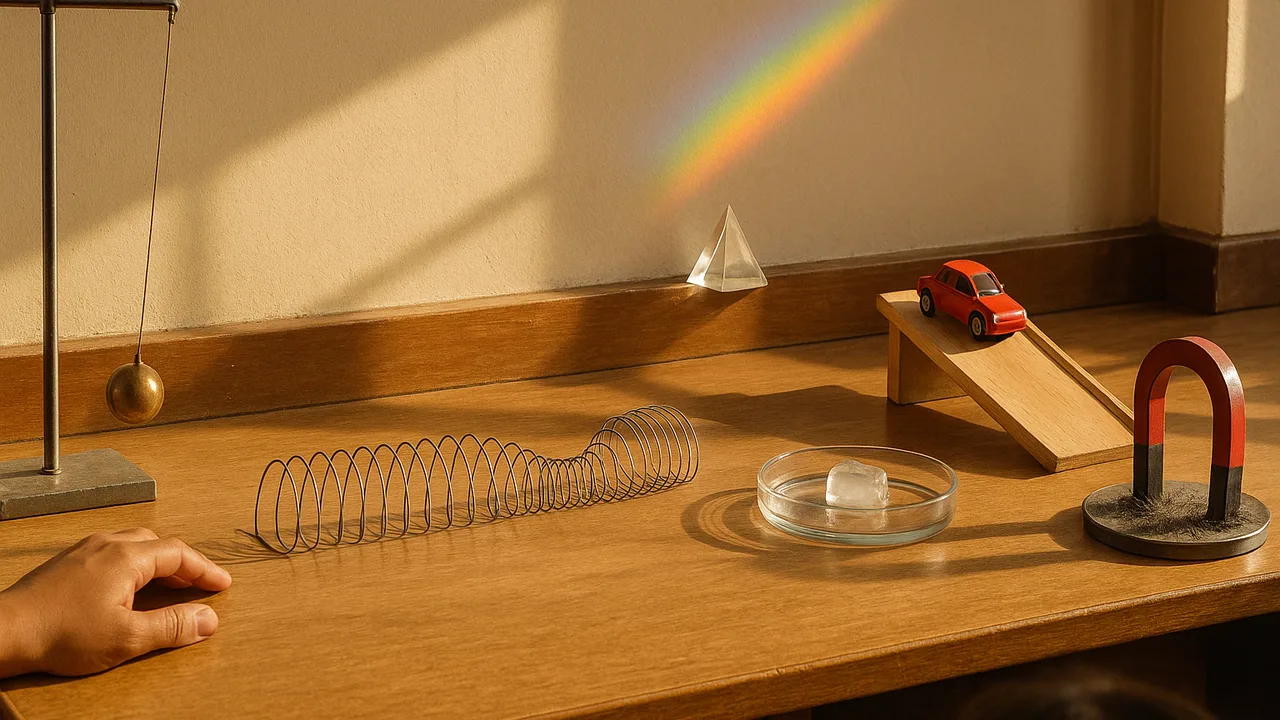
review grades 6–8 physical science with PSSA-style items and connect energy and matter to human resource use.
- I can explain, using reasoning, how increases in human population or per-person resource use lead to more natural resource consumption.
- I can explain how using more natural resources causes changes in Earth’s systems.
- I can describe how human population growth affects natural resource use, which then causes changes in Earth’s systems.
- I can use my model to generate data that shows how my proposed solution works and how it changes when I modify its parts.
Phase 5: Prove It
Warm-Up ~5 min
Do Now. List three things you remember about matter, forces or waves from grades 6 and 7. Put a star by the one you feel least sure about. That is your focus station today.
How confident are you that you can I can use particle models, forces, energy and waves to explain what I observe.
Instruction ~10 min
PSSA review, part 1. The spring PSSA science test covers grades 6–8. Today we review physical science in four stations, with PSSA-style items: multiple choice with data, a scenario and short answers scored 0–2.
Station 1: matter and particles. Remember from grade 6: all matter is made of particles that are always moving. Adding thermal energy makes particles move faster, which raises temperature or changes state. Remember from grade 7: atoms join into molecules; a water molecule has 2 hydrogen atoms and 1 oxygen atom. When properties such as density or melting point change, a new substance formed in a chemical reaction.
Station 2: forces and motion. Balanced forces do not change motion. Unbalanced forces do. The same push changes the motion of a less massive object more than a more massive one.
Station 3: energy. From this year: kinetic energy grows with mass and with speed. Doubling the mass doubles kinetic energy; doubling the speed makes it 4 times as large.
Station 4: waves. Waves carry energy, not matter. Light can be reflected, absorbed or transmitted. Sound needs a medium, such as air or water, to travel.
Worked example 1: a kinetic energy data item. Sample data. A cart at 1 m/s has 2 J of kinetic energy. Jamal predicts the same cart at 2 m/s: “Speed doubled, so kinetic energy is 2 × 2 = 4 times as large: 8 J.”
Worked example 2: tying it to Unit 4. Burning a fossil fuel is a chemical reaction: fuel and oxygen rearrange into carbon dioxide and water, releasing energy. Diego reasons: “If a town’s population doubles and each person uses the same energy, about twice as much fuel burns, so about twice as much carbon dioxide enters the air.” Matter, energy and human impact connect.
Guided Exercises ~15 min
Station items. Answer on your own, then check with your station partner.
Independent Practice ~10 min
Short constructed responses, scored 0–2.
(2 points) A dark shirt and a white shirt sit in the sun. Explain which warms faster, using the words reflect and absorb.
(2 points) Explain how burning more fuel, because of a growing population, changes both matter and energy in Earth's systems.
Closure ~5 min
Strong review, scientists. Next class, life, Earth and space science.
Exit ticket: which station's idea do you still want to practice? Write one question you would ask about it.
How confident are you that you can I can answer PSSA-style questions about matter, energy, forces and waves.
Teacher notes
Materials: four station signs, item cards, a few demo items (ice in a cup, two toy cars with and without a load, a flashlight with mirror, black and white paper).
Setup: run as a choice board: students start at their starred station, then rotate. Grade 6–7 codes are tagged in the footer; the Unit 4 items give a light review of MS-ESS3-4 and MS-ETS1-4. All numbers are sample data.
Scoring (0–2): shirts: 2 = dark absorbs more light, white reflects more, so dark warms faster; 1 = correct claim, no reasoning. Fuel: 2 = names the reaction making carbon dioxide (matter) and releasing energy, tied to more people; 1 = one part.
Support / stretch: pair readers; formula-free kinetic energy ratio card. Stretch: write a new PSSA-style data item for a classmate.