4.01 Where Did the Frogs Go?
Impact Monitor: Measuring and Shrinking Our Footprint
How do growing populations and our use of resources change Earth, and how can we monitor and reduce our own impact?
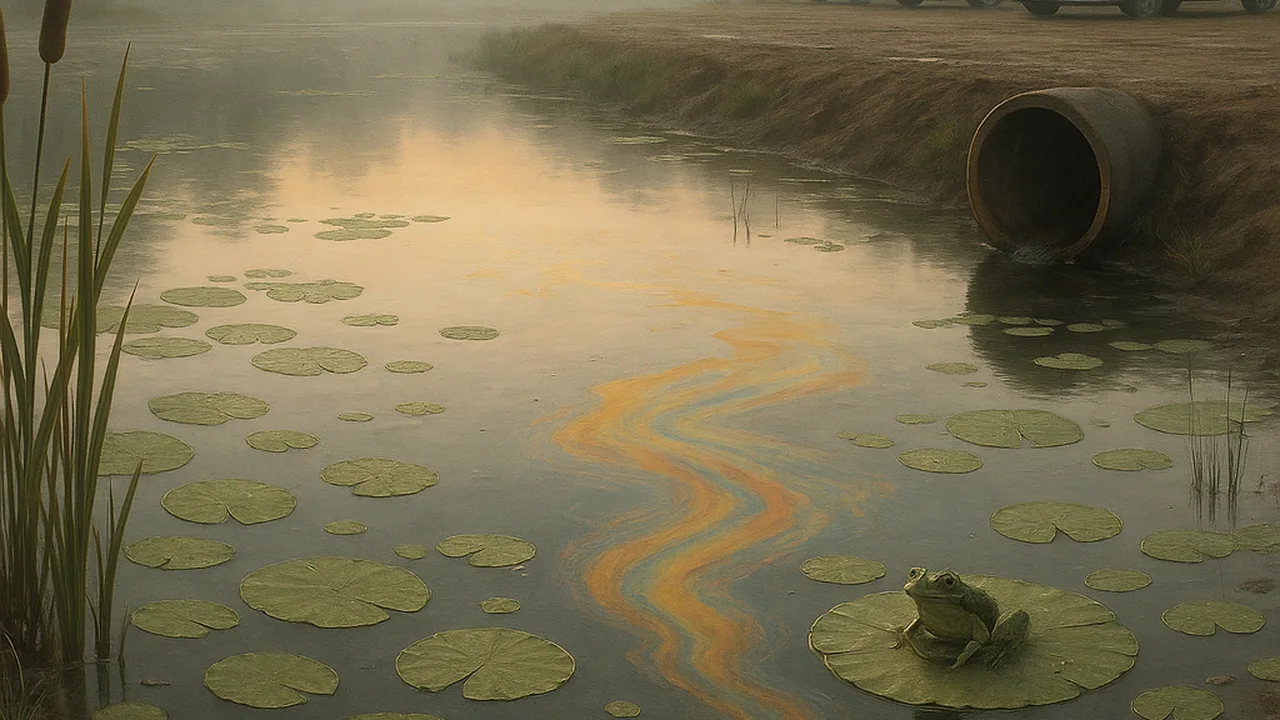
The mystery: Over the past century, the number of people on Earth has grown several times over, and so has the use of water, land and energy. Average temperatures have risen. A local wetland that once had many kinds of frogs now has only a few.
Questions we will figure out together in this unit:
- How much water does our school use in one week?
- Why does pavement make flooding worse than grass?
- Is it the number of people or how much each person uses that matters more?
- How do scientists know Earth is warmer than 100 years ago?
- Can plants and soil really clean dirty water?
- Which is better for frogs: a rain garden or a strip of native plants?
- How can we prove our action actually cut an impact?
- What can a monitor measure in under 10 minutes a week?
explain how one human activity near a wetland could cause a negative effect on the environment, and describe our clients’ request.
- I can explain how a human activity causes negative effects on the environment using scientific principles.
- I can tell the difference between a cause-and-effect relationship and a correlation when I design a solution to an environmental problem.
Phase 1: Spark
Warm-Up ~5 min
Do Now. Two photos of the same wetland are on the screen. In the older photo, tall grasses and shrubs line the water. In the newer photo, a parking lot and a road sit right at the edge. Write two things that changed.
A wetland that once had many kinds of frogs now has only a few. What is the most likely kind of cause?
Instruction ~10 min
Two clients, one request. Our school’s green team wants to know how much water, energy and trash the school uses each week. A local watershed group monitors the creek and wetland downhill from us. They have watched the number of frog species fall. Together they asked us one question: can you design an impact monitor that measures our school’s footprint and helps us shrink it?
The phenomenon. Over the past century, the number of people on Earth has grown several times over, and so has our use of water, land and energy. Average temperatures have risen. Close to home, a wetland that once had many kinds of frogs now has only a few. Our driving question links the big picture to our own building.
Impact engineers, here is your mission. We will investigate how population and consumption change Earth, measure our own school, test runoff and soil, ask good questions about climate data and compare ways to protect biodiversity. Then we will design the monitor.
Worked example 1: tracing a cause. Mei traced one chain. A new parking lot replaces grass, so rain cannot soak in. More water rushes off the pavement, carrying oil and warm water into the wetland. Frog eggs need clean, cool water, so fewer survive. Each arrow is a cause linked to an effect.
Worked example 2: a clear problem statement. Diego wrote, “We should help the planet.” That is kind, but it is not testable. Priya wrote, “Our school needs a weekly way to measure its water use and runoff and to cut at least one impact, so the wetland downhill stays healthy.” Priya names who, what and why, and something we can measure.
Our teams. Teams of four rotate roles every lesson. The Materials Manager handles supplies. The Recorder keeps the data table. The Tester runs procedures and reads instruments. The Reporter and Safety Lead checks safety and shares the team’s thinking.
Guided Exercises ~15 min
Work through these cards with your team. Discuss each card before you lock in an answer.
Independent Practice ~10 min
Add to the class Wonder Board.
Write two questions on sticky notes: one about how people change Earth on a big scale, and one about our own school's footprint.
How confident are you that you can I can explain how one human activity could harm a wetland.
Closure ~5 min
Next time, we map our school as a system of inputs and outputs, so we know what a monitor could measure.
Exit ticket: write a cause-and-effect chain of at least three steps that connects one human activity to a change in the wetland.
Teacher notes
Materials: two generic photos or drawings of a wetland edge (vegetated vs paved), sticky notes, chart paper for the Wonder Board, a roles chart. If possible, invite a member of a local green team or watershed group, or read the request as a letter.
Setup: post the driving question; it stays up all unit. Keep the Wonder Board visible for revisits in 4.10 and 4.14.
Listen for: “it’s hopeless” or blame aimed at classmates’ families. Steer toward measurable causes and things we can change. Do not quote statistics about frog declines; keep the wetland as our generic case.
Support / stretch: offer the frame “___ causes ___, which leads to ___.” Stretch: add a second chain that starts with a different activity, such as mowing right to the water’s edge.