3.05 Then and Now: Fossil and Modern Anatomy
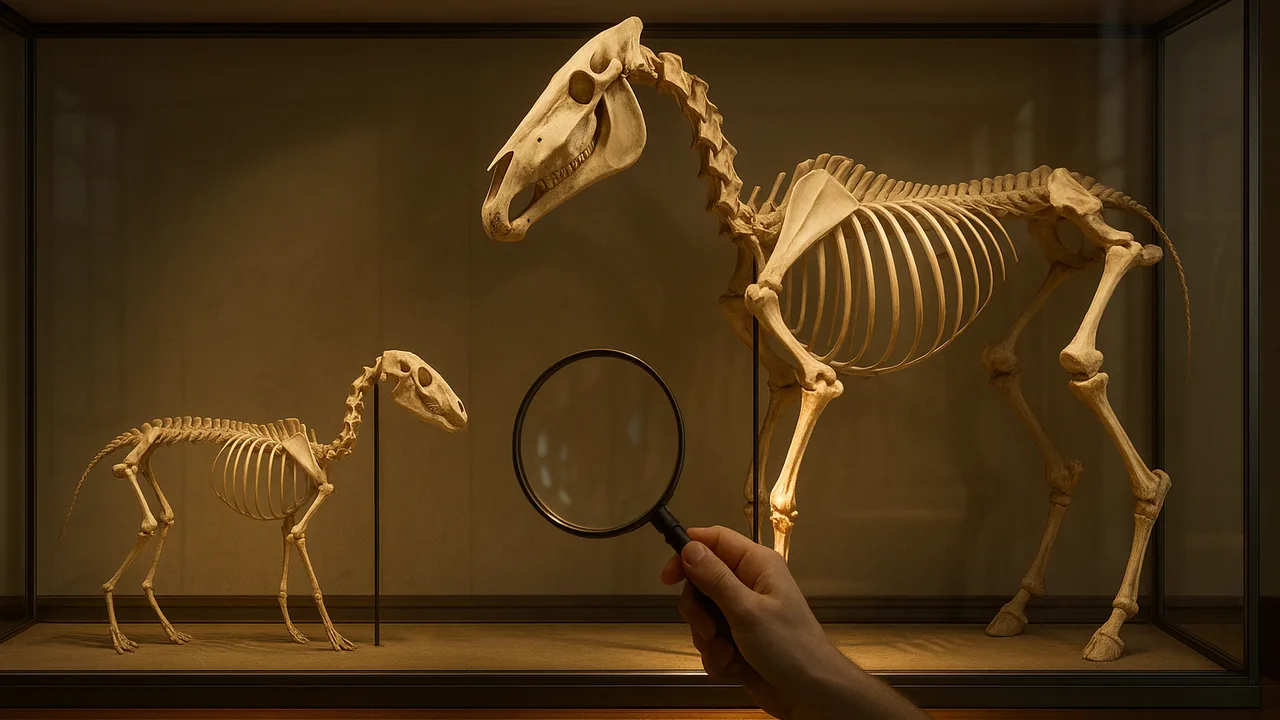
compare skeletons of modern animals with fossil skeletons and describe which features stayed the same and which changed across rock layers.
- I can identify and describe evidence about anatomical patterns in modern living organisms, like their skeletons or skulls.
- I can identify and describe evidence about anatomical patterns in fossilized organisms, like their skeletons or skulls.
- I can use reasoning to show that organisms with similar anatomical features are likely to be more closely related because of their genetic makeup.
- I can explain how changes in anatomical features seen in fossils can help scientists trace evolutionary relationships between extinct and living organisms.
Phase 2: Investigate
Warm-Up ~5 min
Do Now. Look at two skulls side by side: a modern dolphin skull with the nostril opening on top, and a sketch of a land mammal skull with the nostrils at the tip of the snout. List two differences and one similarity.
Fossils of early whale relatives come from layers of different ages. What would you expect in the oldest of those layers?
Instruction ~10 min
Explore first. Each team gets three card sets. Each set holds a modern skeleton and fossil skeleton sketches, each marked with the layer it came from. Set 1: a modern whale and three fossil whale relatives. Set 2: a modern horse leg and three fossil horse-relative legs. Set 3: a modern bird and a feathered dinosaur fossil. Arrange each set from oldest to youngest layer, then compare.
| Set | Feature we tracked | Oldest fossil | Middle fossil | Youngest fossil | Modern animal | What stayed the same? |
|---|---|---|---|---|---|---|
| 1 Whale | Back legs; nostril position | |||||
| 2 Horse | Number of toes touching the ground | |||||
| 3 Bird | Feathers; teeth; bony tail | — | — |
Name the ideas. Fossils let us compare anatomy across time, not just across living species. When a fossil shares many features with a modern group but also has features of an older group, it helps scientists trace how the two are related. Such fossils are often called transitional fossils. The more features two organisms share, the more closely related they are likely to be, because those features were inherited.
Worked example 1: the whale series. These sketches are a simplified teaching series. In the oldest layer, the animal has four working legs and nostrils near the snout tip. In the middle layer, the back legs are smaller. In the youngest fossil, the back legs are tiny and the nostrils sit higher. Modern whales keep only small hip bones. The series fits the explanation from lesson 3.01.
Worked example 2: the bird and the feathered fossil. Malik listed what the feathered dinosaur fossil shares with a modern bird: feathers, a wishbone and hollow bones. Then he listed what it shares with other dinosaurs: teeth, clawed fingers and a long bony tail. A mix like this is strong evidence that birds are related to dinosaurs. In fact, scientists group birds as living dinosaurs.
A caution. Change is not a straight ladder. Many related species lived side by side, and many branches ended in extinction. A card series picks a few fossils to show a pattern.
Guided Exercises ~15 min
Use your sorted cards and your table.
Independent Practice ~10 min
Build an explanation.
Write a short explanation for why modern whales have tiny hip bones. Use at least two observations from the fossil series as evidence.
Pick one set. Name one feature that stayed the same through every card and one that changed. What does each suggest?
Closure ~5 min
Fossils link living animals to their past. Next time, we look at a different kind of evidence: how animals look before they are born or hatched.
Exit ticket: explain why a fossil with feathers AND teeth helps scientists understand how birds are related to other animals.
Teacher notes
Materials: three printed card sets (whale relatives, horse relatives, bird and feathered dinosaur), each card marked with a relative layer; optional resin casts on felt pads. Sketches are simplified teaching drawings, not scale reconstructions; say so to students.
Setup: shuffle each set. Do not label species names; names are not required knowledge.
Listen for: “humans came from monkeys” or a ladder picture of change. Reframe as branching: related species share ancestors. Avoid “missing link” language.
Support / stretch: give one set already sorted as a model. Stretch: describe what new evidence would make scientists rethink where a fossil belongs.