3.06 The Embryo Picture Sort
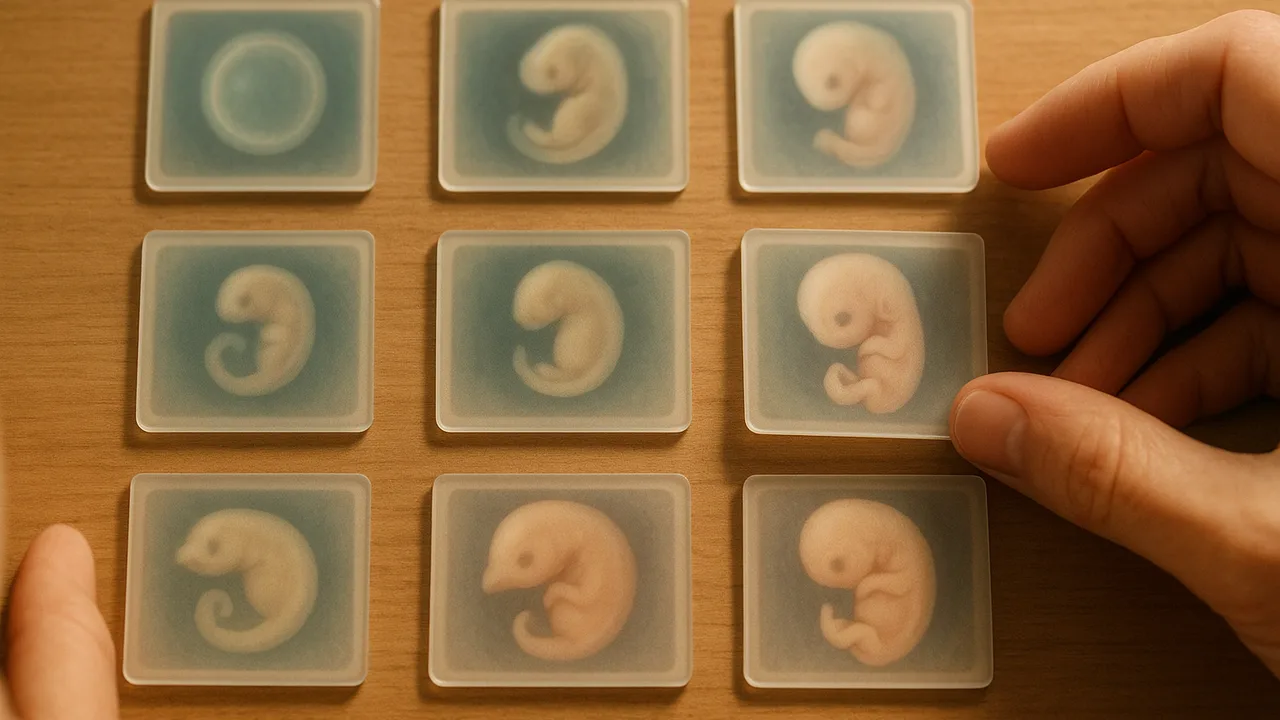
sort embryo pictures by stage and by organism, then describe the patterns of similarity and difference across species.
- I can organize pictures of embryos by their stage of development and by which organism they belong to.
- I can analyze organized embryo pictures to find patterns of similarities between different species.
- I can identify how the appearance of embryos changes as they develop.
Phase 2: Investigate
Warm-Up ~5 min
Do Now. Look at four unlabeled pictures of very young embryos. One is a fish, one a chicken, one a mouse and one a human. Guess which is which and rate how confident you are, from 1 to 5.
How easy will it be to tell these early embryos apart?
Instruction ~10 min
Explore first. Each team gets twelve picture cards: a fish, a chicken, a mouse and a human, each at an early, middle and late stage. The organism names are on the back. First, sort the cards by stage using only what you see. Then flip them and sort by organism. Record features in the table.
| Organism | Early stage: features | Middle stage: features | Late stage: features | Tail? (E / M / L) | Throat folds? (E / M / L) |
|---|---|---|---|---|---|
| Fish | |||||
| Chicken | |||||
| Mouse | |||||
| Human |
Name the ideas. An embryo is an organism in its earliest stage of development. Embryology compares how embryos develop. Early embryos of fish, birds and mammals share a body plan: a tail, a row of folds near the throat called pharyngeal folds, and a large head compared with the body. As they develop, the folds become gill structures in fish but parts of the jaw, ear and throat in mammals. A human embryo’s tail mostly disappears, leaving the tailbone.
Worked example 1: sorting by stage. Ava placed the cards with tiny limb buds and the most obvious tails first. She placed cards with clear fins, beaks or fingers last. Her stage clues were limb shape, eye size and how much the body looks like the adult.
Worked example 2: describing the pattern. Jamal wrote, “At the early stage, all four have a tail and throat folds. By the late stage, only the fish keeps gill structures, and only the chicken has a beak.” Similar early, more different later: scientists find that pattern across many species.
Why it matters. Similar early development suggests these species inherited the same basic developmental plan from a common ancestor. Embryos add a third line of evidence to fossils and adult anatomy.
Guided Exercises ~15 min
Use your sorted cards and your table.
Independent Practice ~10 min
Describe the pattern carefully.
Describe how the embryos changed from early to late. Name two features that were shared early and two differences that appeared later.
Explain how a visitor who cannot see could explore this evidence. What could they hear or touch?
Closure ~5 min
We now have three lines of evidence: rock layers, adult anatomy and embryos. Next time, we turn to the visitors themselves and test how our senses work.
Exit ticket: explain how you sorted the cards by stage, then by organism. Name the two clues you trusted most.
Teacher notes
Materials: twelve embryo picture cards per team (fish, chicken, mouse, human at three stages) printed from modern photographs or accurate modern illustrations, with names on the back. Pictures only: no specimens.
Setup: avoid the famous 1800s embryo drawings, which exaggerated the similarities. Modern photographs show the real pattern and make a good lesson in checking sources. Print cards at similar sizes so size is not a clue.
Listen for: “humans have gills as embryos.” Human embryos have throat folds, not working gills. Keep the comparison to gross appearance; no stage names or molecular detail. Some students may find embryo pictures sensitive; keep the tone factual and calm.
Support / stretch: sort only by stage first, with a stage-clue card. Stretch: add a turtle set and predict where it fits before checking.