3.03 The Fossil Dig: Layers in a Sediment Column
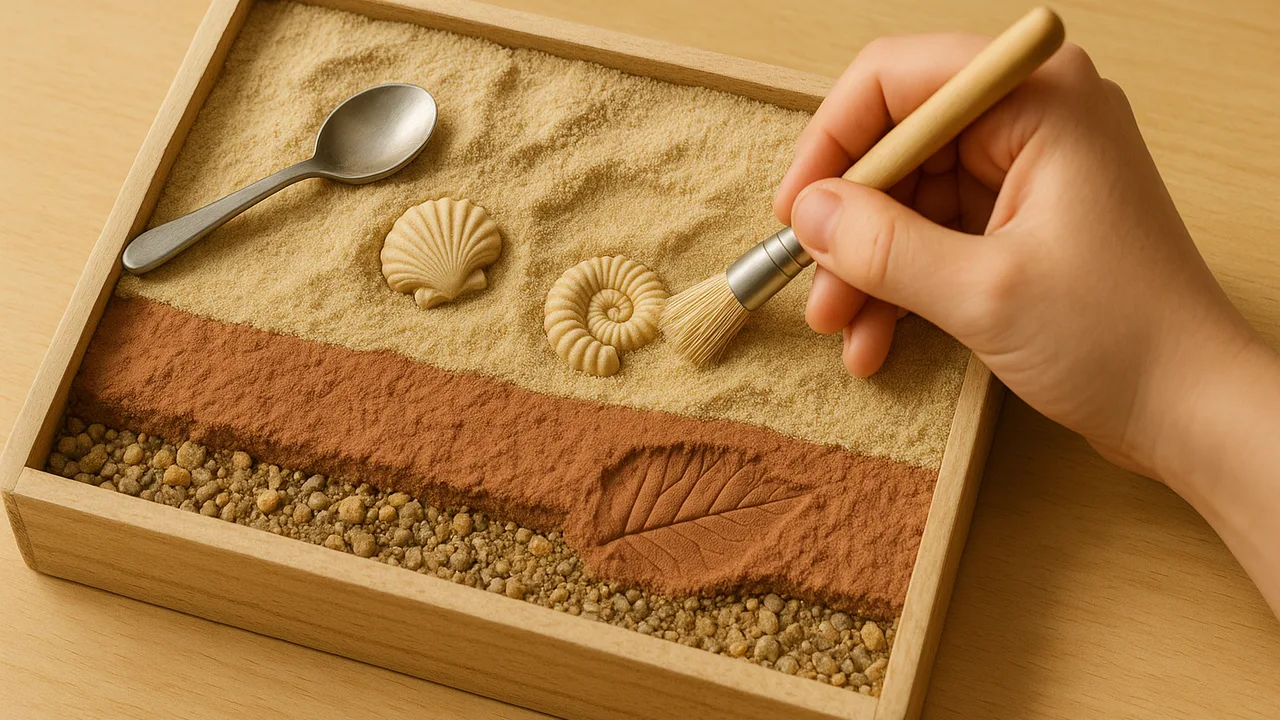
excavate a model sediment column and organize the fossil data to show which fossils appear, persist and disappear in which layers.
- I can organize fossil data by creating tables, graphs, charts, or drawings that show when different types of fossilized organisms appeared, based on where they are found in rock layers or how old the rocks are.
- I can organize fossil data so that I can easily find and compare similarities and differences between the fossils.
- I can identify patterns between sedimentary rock layers and their relative ages.
- I can find out when a certain fossil organism appears in the fossil record.
- I can identify times when there are big changes in the number or types of organisms in the fossil record, such as layers with many fossils next to layers with few fossils.
Phase 2: Investigate
Warm-Up ~5 min
Do Now. A stack of newspapers sits in a corner. Nobody has moved it for a year, and each day’s paper was dropped on top. Which paper is the oldest? How do you know without reading the dates?
In a column of rock layers that has not been flipped or folded, where will the oldest fossils be?
Instruction ~10 min
Explore first. Each team gets a clear sediment column with six layers. Dig from the top down, one layer at a time. Brush each “fossil” clean, match it to the fossil-type key, and record it before you dig deeper.
| Layer (1 = top) | Sediment (color, grain size) | Fossil types found | Number of each type | Notes |
|---|---|---|---|---|
| 1 | ||||
| 2 | ||||
| 3 | ||||
| 4 | ||||
| 5 | ||||
| 6 |
Now reorganize the same data as a range chart. List each fossil type down the side and the layers across the top, then shade every layer where that type appears.
| Fossil type | Layer 6 (oldest) | Layer 5 | Layer 4 | Layer 3 | Layer 2 | Layer 1 (youngest) |
|---|---|---|---|---|---|---|
| A | ||||||
| B | ||||||
| C | ||||||
| D | ||||||
| E |
Name the ideas. Layers of sedimentary rock form as sediment settles and hardens. In undisturbed layers, lower layers are older: this gives each layer a relative age. All the fossils in all the layers make up the fossil record. The record shows when a type of organism first appears, how long it lasts, and when it disappears. A type that disappears for good is extinct.
Worked example 1: reading a column. Sample data. Jamal’s team found small shells (type A) in layers 6, 5 and 4 only. They found leaf prints (type D) in layers 3, 2 and 1 only. Claim: type A lived earlier than type D. The layers, not the fossils’ size, tell us the order.
Worked example 2: a sudden change. Sample data. Layer 4 held five fossil types. Just above it sat a thin dark band, and layer 3 held only two types. Many types vanished at the same boundary. In real rock, scientists read patterns like this as a mass extinction, where many kinds of life die out in a short time.
Same rules then and now. Sand, mud and ash settle in layers today in lakes and oceans. Scientists assume the same natural processes worked the same way in the past. That is why rock layers can be read like pages of a history book.
Guided Exercises ~15 min
Use your dig table and your range chart. Talk with your team before you answer.
Independent Practice ~10 min
Make sense of your own team’s dig.
Using your range chart, name the fossil type that appeared earliest and the one that appeared latest. Cite the layers as evidence.
Did your column show a boundary where many types disappeared at once? Describe it, and compare the number of types above and below.
Closure ~5 min
Our columns show that fossils follow patterns through the layers. Next time, we look closely at the bones themselves.
Exit ticket: organize this sample data into a quick range chart, then state one pattern. Type X: layers 5–3. Type Y: layers 6–4. Type Z: layers 2–1.
Teacher notes
Materials (per team): goggles, a clear tub or a cut-off 2-liter bottle, a tray, plastic spoons, a soft brush, sand, potting soil, gravel and a little cocoa powder or dark sand for one thin band, and “fossils” made from shells, dried pasta shapes or laminated picture cards labeled A–E.
Setup: build columns the day before from one key so patterns show: one type in the bottom three layers only, one in every layer, two that vanish at the dark band, and one that appears only near the top. Make several columns with the same key so teams can compare data.
Listen for: “bigger fossils are older” and “fossils sink to the bottom.” Redirect to layer order. Stay with relative age; do not ask students to name eras or periods or specific species.
Support / stretch: give a partly filled range chart. Stretch: explain how a folded or overturned column could fool a scientist, and what clue might reveal it.