3.18 Prototype Station 1: Reading the Fossil Layers
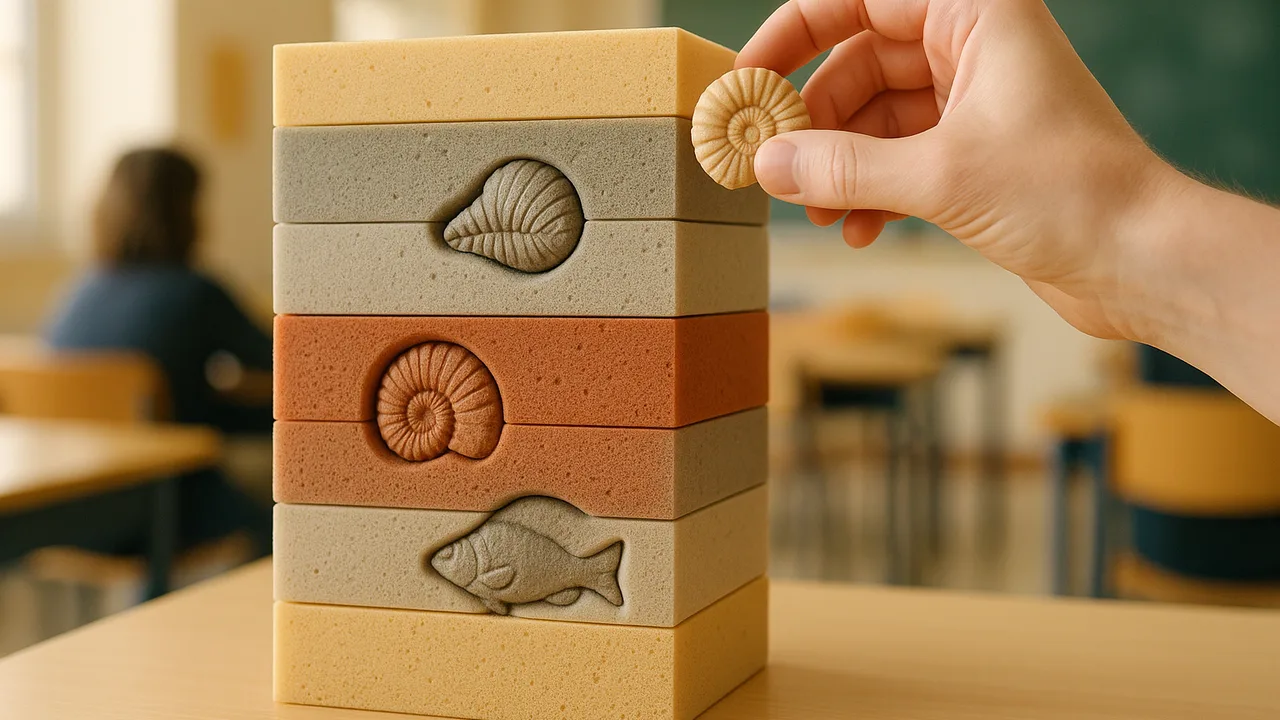
build a fossil-layers station that shows how the order of rock layers reveals when life forms appeared, changed and disappeared.
- I can identify patterns between sedimentary rock layers and their relative ages.
- I can find out when a certain fossil organism appears in the fossil record.
- I can identify times when there are big changes in the number or types of organisms in the fossil record, such as layers with many fossils next to layers with few fossils.
- I can analyze and interpret fossil data to find evidence for the existence, diversity, extinction, and changes in life forms throughout Earth’s history, using the idea that natural laws work the same way now as in the past.
- I can use patterns in the fossil record to give evidence for when mass extinctions happened.
- I can use similarities and differences in fossil patterns to show when types of organisms appeared, disappeared, or changed over time.
- I can organize fossil data by creating tables, graphs, charts, or drawings that show when different types of fossilized organisms appeared, based on where they are found in rock layers or how old the rocks are.
Phase 4: Build
Warm-Up ~5 min
Do Now. A stack of mail sits on a table. Nobody has moved it. Which letter arrived first, the one on top or the one on the bottom? Explain how you know.
In undisturbed sedimentary rock, which layer is usually the oldest?
Instruction ~10 min
Designers, our first station starts at the bottom of the story. Visitors will touch a column of rock layers and discover what changed as they move up.
The science. Sedimentary rock forms in layers. In undisturbed layers, the deeper a layer is, the older it is. Fossils inside each layer show what lived when it formed. Scientists assume the same natural processes that lay down mud and sand today worked the same way in the past. Earth is about 4.6 billion years old, so the record is very long.
Patterns in the fossil record. 1. The deepest, oldest layers hold only simple, single-celled or small soft-bodied life. 2. Higher layers hold more kinds of organisms and more complex bodies. 3. Some fossil types appear, last for many layers, then disappear: those organisms went extinct. 4. In a few places, a layer packed with many kinds of fossils sits under a layer with very few. That sudden drop is evidence of a mass extinction. For example, the dinosaurs (except birds) died out about 66 million years ago, after an asteroid impact.
Worked example 1: reading a sample column.
| Layer (bottom = 1) | Fossils found | Number of fossil types |
|---|---|---|
| 5 (top) | shells, fish, small mammal teeth | 9 |
| 4 | a few shells | 2 |
| 3 | shells, fish, large reptile bones | 12 |
| 2 | shells, simple fish | 6 |
| 1 (bottom) | tiny single-celled fossils | 1 |
Sample data. Kofi’s reading: “Life gets more varied and more complex as we go up. Large reptiles appear in layer 3 and are gone by layer 4. The drop from 12 types to 2 suggests a mass extinction. Mammal teeth first appear in layer 5.”
Worked example 2: turning it into a station. Priya’s team stacks five layers of colored sand and clay in a clear box, with fossil casts pressed into each. Visitors run their fingers up a raised timeline on the side. A button at each layer plays a 15-second clue, with the words printed beside it. Two senses, touch and hearing, plus sight.
Guided Exercises ~15 min
Use the sample column to plan your station. Record answers in your notebook.
Independent Practice ~10 min
Build version 1 of the fossil-layers station.
Draw your station plan: the layers, the fossils in each, what a visitor touches, hears and sees, and your materials list with sample costs.
Write the three clues a visitor will hear or read, under 30 words each: one about layer order, one about changing complexity and one about a mass extinction.
Closure ~5 min
Version 1 of the first station is underway. Next class: the limbs and embryos stations.
Exit ticket: what is ONE piece of evidence a visitor should be able to explain after your fossil station? Write it the way a visitor would say it.
How confident are you that you can I can identify patterns between rock layers and the fossils in them.
Teacher notes
Materials: clear plastic boxes or bottles, colored sand, modeling clay, shells or plaster fossil casts, a cheap recordable button or a phone, index cards, tape, a materials price sheet.
Setup: MS-LS4-1 boundary: no era or period names, and no species to memorize. The 66-million-year asteroid example is the one well-established date used. Point out that real layers can be folded or tilted; scientists check for that.
Listen for: “each layer is one year”; “all life started complex”; “fossils in the same layer must be the same species.”
Support / stretch: give a pre-labeled column drawing to fill in. Stretch: explain how a layer of volcanic ash could help date the layers above and below it.