3.13 Arguing From Data: Why the Wetland Populations Shifted
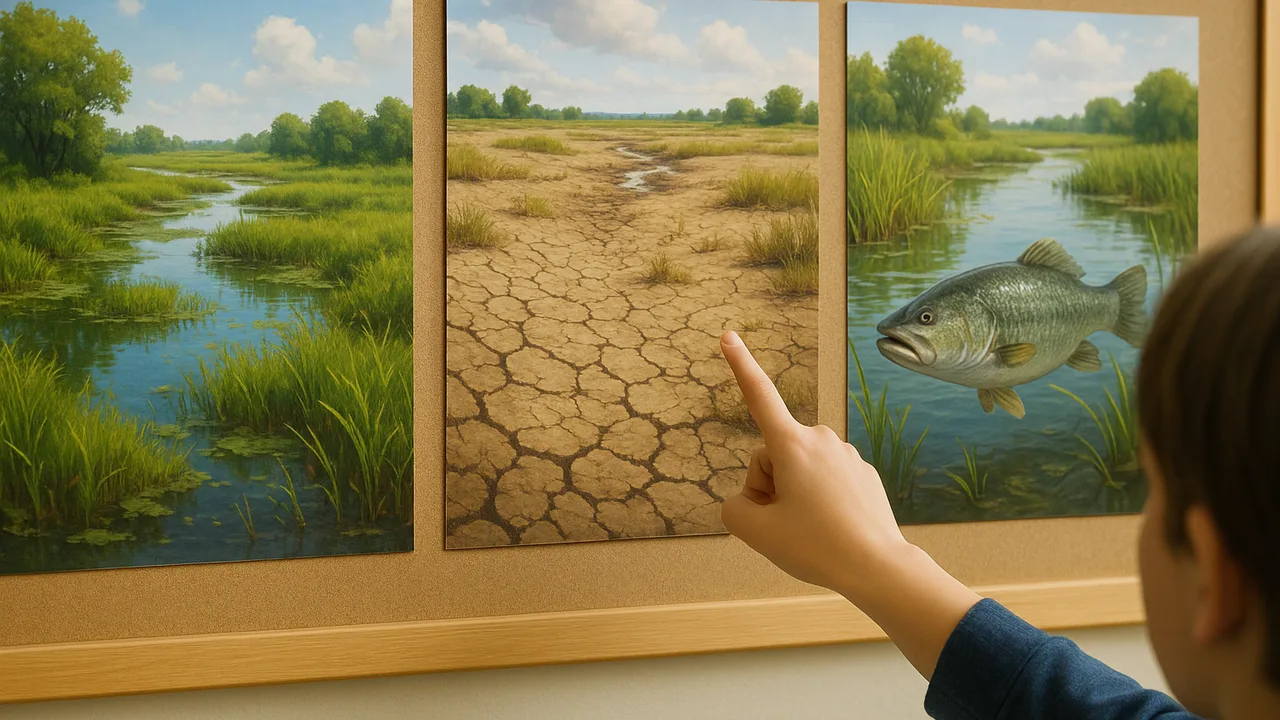
construct an argument from evidence that changes to physical and biological parts of an ecosystem caused population changes, and weigh other interpretations.
- I can use reasoning to connect evidence to my claim and construct an argument about how changes in physical or biological parts of an ecosystem can cause changes in populations.
- I can explain how specific changes in an ecosystem can affect the survival and reproduction of organisms, and how these factors can change populations.
- I can describe patterns in evidence that show many types of changes in ecosystem parts are linked to changes in populations, including how small changes can lead to big effects.
- I can evaluate evidence to decide which pieces are necessary and enough to support my claim.
- I can identify other ways to interpret the evidence and explain why the evidence best supports my claim.
Phase 3: Make Sense
Warm-Up ~5 min
Do Now. A classmate says, “The frogs dropped because the herons ate them all.” Look at data set A from 3.08. Write one piece of evidence that supports this idea and one that challenges it.
Heron sightings fell along with frogs during the drought. Does that fit “herons ate all the frogs”?
Instruction ~10 min
Reading: from data to argument. An argument has a claim, evidence and reasoning, and it answers rival explanations. Good evidence is necessary (it is needed to make the case) and sufficient (there is enough of it). Strong arguments draw on several sources that agree, describe the size of changes, and explain how a change affects survival and reproduction.
Evidence bank (sample data). Data set A: water cover fell from 78% to 35%; adult frogs fell from 230 to 80; dragonfly larvae fell from 11 to 4 per sweep; heron sightings fell from 10 to 4. Data set B: tadpoles fell from 40 to 6 per sweep in the pond with the new fish, but stayed near 40 in the pond without it. Extra source: aerial photos show the wetland’s open water shrinking in years 3 and 4. Extra source: water-gauge readings match the rainfall drop.
Worked example 1: a strong CER for the drought. Claim: the drought, a change to a physical part of the wetland, caused frog, dragonfly and heron populations to fall. Evidence: water cover fell by more than half between years 2 and 4, while frogs fell by about two thirds; aerial photos and gauge readings agree; populations climbed again once water returned. Reasoning: frogs and dragonflies need water to reproduce, so fewer young survived; herons had less food. A small change in rainfall led to a big change across the food web.
Worked example 2: answering a rival. Rival claim: “Tadpoles in the new-fish pond fell because of the drought.” Response: the drought affected both ponds, but tadpoles fell only in the pond with the new fish. So the fish, a change to a biological part, is the better explanation.
Connection to life’s story. The same idea scaled up over long times helps explain the fossil record. When environments changed greatly, some populations shrank or vanished, and new types appeared in later layers.
Sentence starters. “The evidence that is necessary is…” “This is sufficient because…” “Someone might argue…, but the comparison pond shows…”
Guided Exercises ~15 min
Use the evidence bank and your 3.08 graphs.
Independent Practice ~10 min
Write the argument.
Write a full argument: how did changes to physical and biological parts of the wetland change its populations? Include the size of at least two changes, two sources, and a response to one rival explanation.
Sketch an exhibit station that lets visitors hear or feel the wetland change, for example a soundscape where frog calls fade as the water drops.
Closure ~5 min
We can argue from data about living populations. Next time, we put all our evidence to work and brainstorm exhibit stations.
Exit ticket: name the piece of evidence you think is most necessary in your argument and explain why the argument would be weaker without it.
Teacher notes
Materials: the evidence bank, graphs from 3.08, CER and argument organizers, sample aerial-photo sketches.
Setup: pair students to swap arguments and write one rival explanation for each other’s claim. All data are sample data.
Listen for: one-cause thinking and arguments with no sizes. Push for “how much” and “compared with what.”
Support / stretch: give a filled-in claim and ask students to choose the evidence. Stretch: predict the populations in year 7 if a second drought struck while the new fish spread to the second pond, and justify it.