3.15 Three Ways to Tell the Story: Competing Exhibit Designs
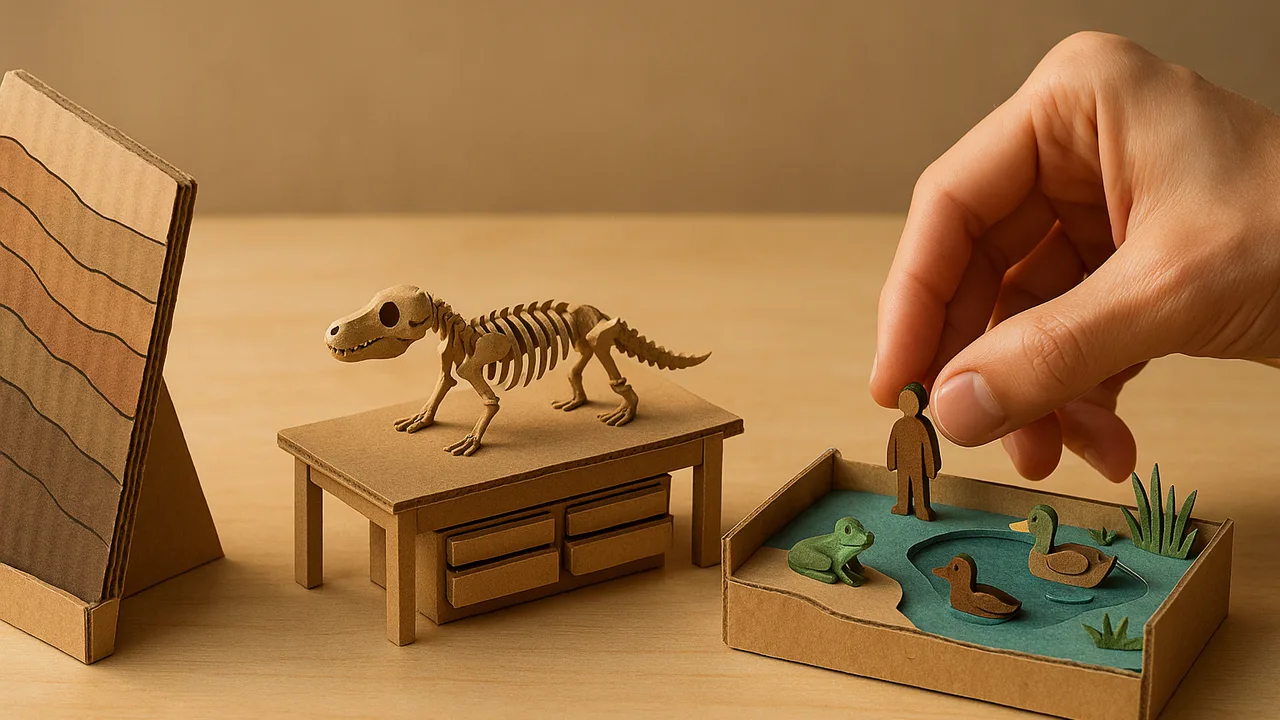
describe three competing exhibit designs and explain how each one could meet the museum’s criteria and constraints.
- I can explain how each design solution could solve the problem.
- I can identify scientific ideas that relate to the problem and each possible solution.
- I can define the criteria for a solution that meet the needs of the people or groups affected by the problem.
- I can explain who the solution is meant to help and use criteria to compare different solutions, including using numbers when needed.
Phase 4: Build
Warm-Up ~5 min
Do Now. Think of the last museum, zoo or science center you visited, in person or online. Which exhibit do you still remember? Write two sentences: what you did there, and which senses you used.
The museum asked for an exhibit visitors can see, hear and touch. Which first idea fits that request best?
Instruction ~10 min
Exhibit designers, welcome to the Build phase. In Make Sense you explained the evidence that life has changed over time: patterns in rock layers, matching bones in different bodies, look-alike embryos, and populations that rise and fall when ecosystems change. Now you will turn that science into an exhibit for our client, a natural history museum.
Restate the problem. Visitors of all ages and abilities walk past evidence for evolution without noticing it. The museum needs short, hands-on stations that help any visitor see, hear and touch that evidence, and explain it afterward.
Our class criteria, from 3.09:
- every station uses at least 2 senses;
- a visitor can finish a station in under 3 minutes;
- at least 8 of 10 test visitors can explain one piece of evidence afterward;
- it is accessible to a visitor who cannot see or cannot hear;
- it stays within the sample materials budget.
Constraints, also from 3.09: the sample materials budget and the build periods; each station fits on one table, reachable from a seated height; casts, models and pictures only, never real fossils or animal parts; every touch surface survives wiping.
The system. Inside the system are the four stations, their labels and sounds, and the path between them. Outside it are the visitors, the museum’s noise and lighting, and the museum staff who keep it running. A good design works with the parts outside the system too.
Three competing designs.
Worked example 1: the Touch Table. Priya’s team puts all four stations on one long table: fossil casts in a layered box, limb bone models, embryo picture tiles with raised outlines, and a population board with sliding tokens. Strength: visitors handle real-feeling objects. Risk: a visitor who cannot see needs audio or braille help to know what the objects mean.
Worked example 2: the Audio Tour. Diego’s team writes a short spoken clip for each station that visitors play on a button or phone. Strength: great for a visitor who cannot see, and cheap to make. Risk: a visitor who cannot hear gets nothing unless every clip also has captions or a printed script.
Worked example 3: the Flip-Panel Timeline. Mei’s team builds a wall timeline with panels that lift to reveal answers. Strength: visitors predict, then check, and the timeline shows order clearly. Risk: it uses mostly sight, so it may fail the 2-senses criterion unless panels have textures or sounds.
| Design | Senses used | How it shows the evidence | Who it might leave out | Biggest risk |
|---|---|---|---|---|
| Touch Table | ||||
| Audio Tour | ||||
| Flip-Panel Timeline |
Guided Exercises ~15 min
Work with your team. After each block, add a note to the design table.
Independent Practice ~10 min
Make the designs your own.
Sketch one of the three designs as it would look in the museum. Label each station, the senses it uses, and where a visitor starts and ends.
For each design, explain in one or two sentences how it could help a visitor understand ONE piece of evidence, such as matching limb bones.
Closure ~5 min
Good start, designers. Next class you will choose a design with a decision matrix, not a vote.
Exit ticket: name one group of visitors the museum must not leave out, and one criterion that protects them.
How confident are you that you can I can explain how each design solution could solve the problem.
Teacher notes
Materials: the class criteria and constraints poster from 3.09, chart paper, colored pencils, a few sample objects to pass around (a fossil cast or shell, a textured fabric square, a phone or recorder).
Setup: if Part 1 set a dollar figure for the budget, post it now and use it in every lesson in this part. Give teams 12 minutes to fill the design table.
Listen for: “accessible means wheelchair ramps only” (it also means sight and hearing); designs that are the same idea twice; teams that forget the 3-minute limit.
Support / stretch: give a design-table sentence frame (“This design uses ___ and ___, so ___”). Stretch: invent a fourth design that combines the best part of two others.