3.19 Prototype Stations 2 and 3: Matching Bones and Look-Alike Embryos
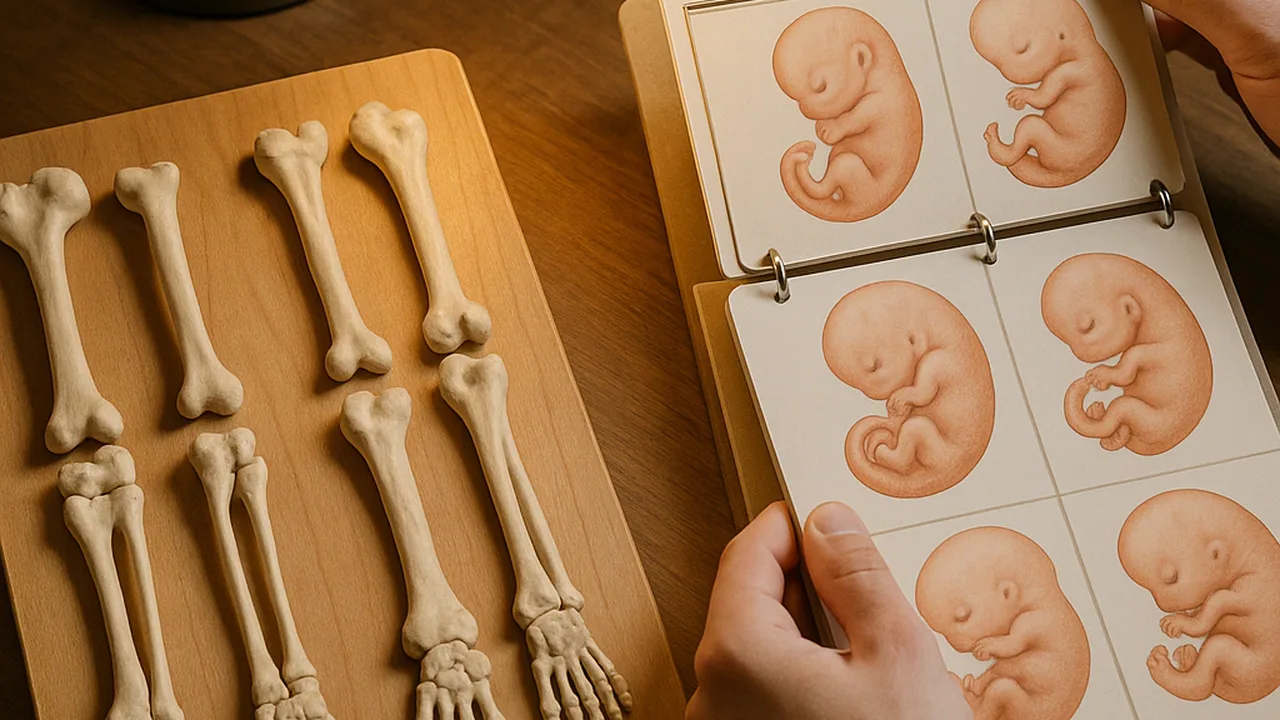
build two stations that let visitors compare limb bones and embryo pictures, and explain what the similarities say about relatedness.
- I can explain how anatomical similarities and differences among organisms help scientists figure out how they are related, including comparing modern organisms and comparing modern and fossil organisms.
- I can analyze organized embryo pictures to find patterns of similarities between different species.
- I can identify how the appearance of embryos changes as they develop.
- I can use patterns in embryo development to explain how different species are related, even if they look very different as adults.
Phase 4: Build
Warm-Up ~5 min
Do Now. Hold out your arm. Touch your upper arm, your forearm, your wrist and your fingers. Now picture a bat’s wing. Which of those four parts do you think a bat’s wing has?
A bat's wing, a cat's front leg, a whale's flipper and your arm do very different jobs. What will we find inside them?
Instruction ~10 min
Designers, two stations today. Both ask visitors to compare bodies and find a pattern.
Station 2: Comparing Limbs. When different organisms share the same bone plan, scientists call those parts homologous structures. The best explanation is that the organisms inherited that plan from a common ancestor, then the shapes changed over many generations. The more features two organisms share, the more closely related they are likely to be. Differences matter too: a bird’s wing and an insect’s wing do the same job but are built in completely different ways, so they are not evidence of close relatedness.
Fossils join the comparison. Fossils of early whales show back legs that are larger than the tiny hip bones modern whales still carry. Comparing fossil and modern skeletons lets scientists trace how a structure changed over time.
Worked example 1: a limb table (sample observations).
| Limb | Upper arm bone | Forearm bones | Finger bones | Job |
|---|---|---|---|---|
| Human arm | 1 | 2 | medium, flexible | grasping |
| Bat wing | 1 | 2 | very long, hold skin | flying |
| Whale flipper | 1 | 2 | short, inside a paddle | swimming |
| Cat front leg | 1 | 2 | short, with claws | walking |
Lena’s explanation: “All four share the same bone plan, so they likely share a common ancestor. The finger bones changed shape to fit each job.”
Station 3: Embryos. An embryo is an organism in its earliest stage of development. Look at pictures of early embryos of a fish, a chicken, a pig and a human. At the earliest stage they look surprisingly alike: each has a tail and a row of folds in the neck region. As they develop, they look more and more different.
Worked example 2: reading embryo pictures. Jamal sorts picture cards into a grid: species across the top, early to late stage down the side. “In the top row they are hard to tell apart. By the bottom row each looks like its adult form. Shared early features suggest these species are related, even though the adults look very different.”
Guided Exercises ~15 min
Use the limb table and the embryo picture cards.
Independent Practice ~10 min
Build version 1 of stations 2 and 3.
Plan the limbs station: which limbs (modern and fossil) a visitor compares, how the bones are color-matched or texture-matched, and the one-sentence explanation a visitor should leave with.
Plan the embryos station: the picture grid (species and stages), the senses it uses, and a 30-word clue explaining what the pattern shows about relatedness.
Closure ~5 min
Three stations started. Next class: the fourth station, where ecosystems change populations.
Exit ticket: explain to a museum visitor, in two sentences, why your arm and a bat's wing are evidence that the two species are related.
How confident are you that you can I can use patterns in embryo development to explain how different species are related.
Teacher notes
Materials: limb diagrams or 3D-printed models (human, bat, whale, cat, plus one fossil whale skeleton picture), colored stickers to match bones, embryo picture cards (use modern photographs), cardboard, puffy paint or yarn for raised outlines.
Setup: MS-LS4-3 boundary: compare the gross appearance of embryos from pictures only. Some older 1800s embryo drawings exaggerated the similarities, so use modern photographs. Species named here are examples, not required knowledge.
Listen for: “humans came from bats” (they share an ancestor; neither came from the other); “human embryos have gills” (they have folds in the same region, which develop into other structures).
Support / stretch: give pre-colored bone diagrams. Stretch: add a modern horse leg and explain what its single large toe suggests.