3.04 Bones Compared: Limbs Across Species
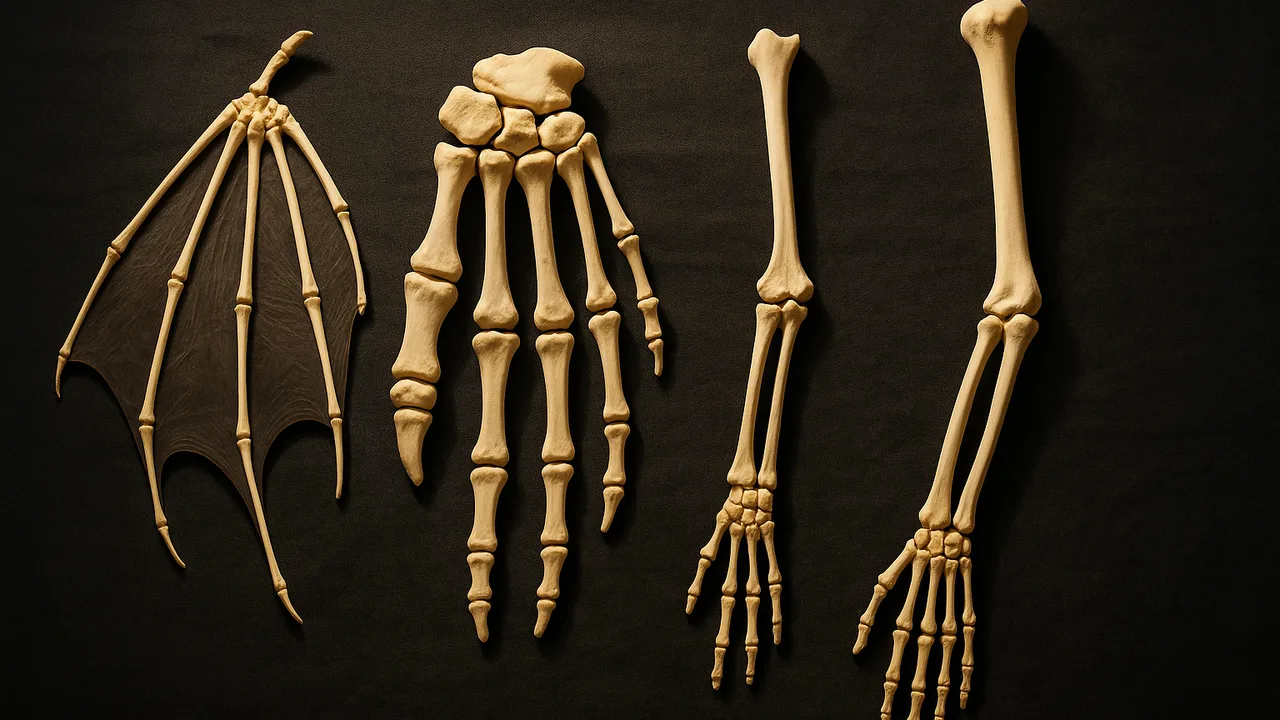
compare the forelimb bones of several modern animals and describe the pattern of shared bones beneath different shapes and jobs.
- I can identify and describe evidence about anatomical patterns in modern living organisms, like their skeletons or skulls.
- I can identify and describe evidence about anatomical patterns in fossilized organisms, like their skeletons or skulls.
- I can explain how anatomical similarities and differences among organisms help scientists figure out how they are related, including comparing modern organisms and comparing modern and fossil organisms.
Phase 2: Investigate
Warm-Up ~5 min
Do Now. Bend your elbow and wiggle your wrist and fingers. Feel your upper arm: how many long bones are there? Now feel your forearm near the wrist. Write your counts.
A bat flies, a whale swims and a cat walks. What will we find when we compare the bones inside their front limbs?
Instruction ~10 min
Explore first. Each team gets five forelimb diagrams or 3D-printed models: a human arm, a cat’s front leg, a whale’s flipper, a bat’s wing and a bird’s wing. Color every upper bone red, both lower bones blue, the wrist bones green and the hand or finger bones yellow. Then fill in the table.
| Animal | Job of the limb | Upper bone (number, shape) | Lower bones (number, shape) | Wrist bones | Finger bones (length, number) |
|---|---|---|---|---|---|
| Human | |||||
| Cat | |||||
| Whale | |||||
| Bat | |||||
| Bird |
Name the ideas. Anatomy is the study of body structures. Structures that share the same basic bones and arrangement, even when they do different jobs, are called homologous structures. Scientists explain the shared pattern this way: these animals inherited the basic limb plan from a common ancestor, and over many generations the shapes changed.
Worked example 1: the bat’s wing. Priya colored the bat wing. The upper bone and two lower bones were easy to find. The yellow finger bones were surprisingly long, stretching out to hold up the thin wing skin. Same bones, different proportions, a new job: flying.
Worked example 2: same job, different plan. Diego compared a bird’s wing with an insect’s wing. Both are used for flying. But the insect wing has no bones at all; it is a thin sheet supported by veins. Structures that share a job but not a basic plan are analogous structures. They do not point to a close shared ancestor the way homologous structures do.
Remember from grade 7. Bones are part of the skeletal system, and their shape fits their function. Today we compare that structure across species to look for patterns.
Guided Exercises ~15 min
Use your colored diagrams and your table.
Independent Practice ~10 min
Describe the evidence in your own words.
Choose two animals from your table. Describe one similarity and one difference in their forelimb bones, and connect each to the limb's job.
Sketch how a touch station could let a visitor who cannot see feel the shared bones in two limbs. What would they touch?
Closure ~5 min
Modern animals share a hidden limb plan. Next time, we compare modern skeletons with fossil ones.
Exit ticket: describe the anatomical pattern you found in all five forelimbs, and give one example of how a bone's shape fits its job.
Teacher notes
Materials: printed forelimb diagrams or 3D-printed models of human, cat, whale, bat and bird limbs; red, blue, green and yellow markers; a picture of an insect wing. Use diagrams and models only; no dissection.
Setup: print diagrams at about the same total length so students notice proportion, not size. A raised-line or 3D-printed set also models an accessible touch station.
Listen for: “the bat needed long fingers so it grew them.” Individuals do not change their bones by need; populations change over many generations. Keep natural selection light here; Science 8 I, Unit 2 covered it. Bird wrist and finger bones are reduced and partly fused, so students may find them hard to color; that is fine.
Support / stretch: give a pre-colored human arm as a key. Stretch: add a frog or lizard forelimb and decide whether it fits the pattern.