3.12 From Sense to Memory: Modeling the Visitor’s Brain
model how sensory receptors lead to immediate actions and memories, and evaluate sources of information about senses and behavior.
- I can use information I have gathered to show how sensory receptors cause immediate behaviors or create memories that affect behavior later.
- I can evaluate the credibility, accuracy, and possible bias of sources and methods used to collect information about sensory receptors and behavior.
- I can analyze whether the information supports the idea that sensory receptors send signals to the brain, leading to immediate actions or stored memories.
- I can decide if the information is enough to predict how an organism will respond to different stimuli based on cause and effect relationships.
Phase 3: Make Sense
Warm-Up ~5 min
Do Now. Recall a time you touched something hot or heard a sudden loud noise. What did you do immediately? Did it change what you did the next time? Write both parts.
A visitor touches a cool, ridged fossil cast and hears a short audio clip about it. Later, they see a photo of the same fossil. What is most likely?
Instruction ~10 min
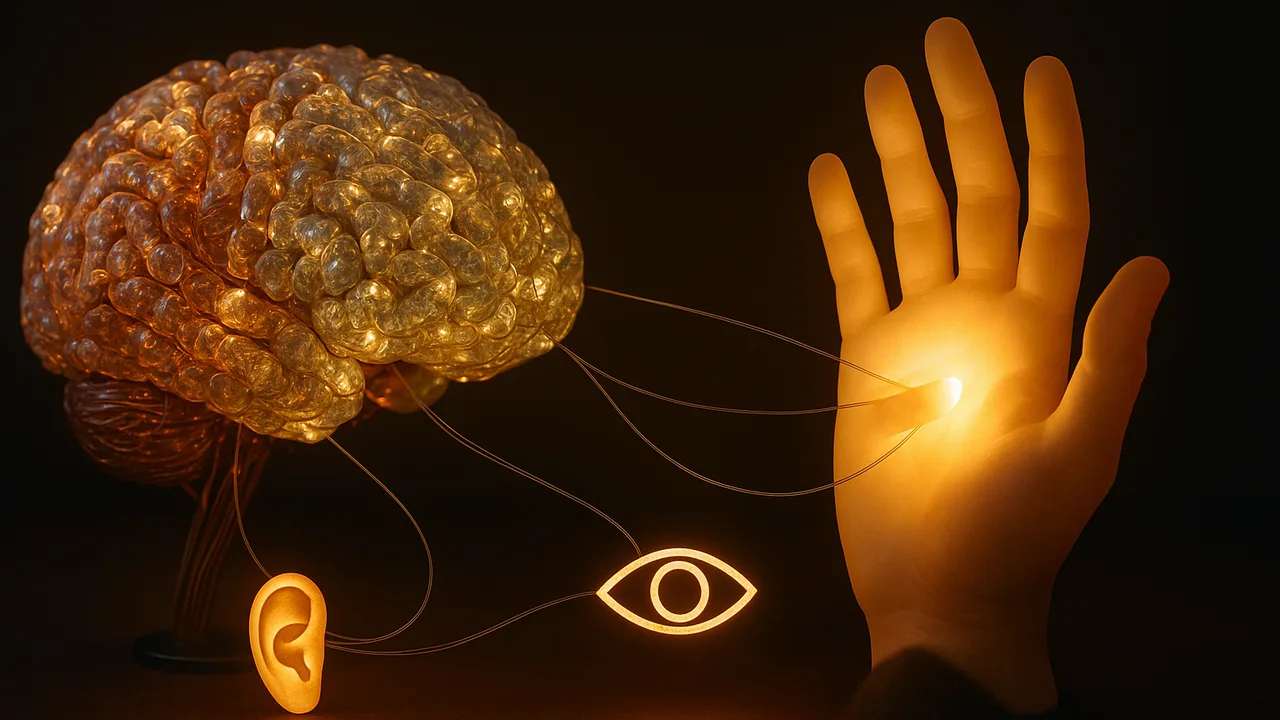
Reading: two paths from the senses. Every sensory experience starts at receptors. Light reaches receptors in the eyes; sound waves reach receptors in the ears; pressure and temperature reach receptors in the skin; chemicals reach receptors in the nose and tongue. Each receptor sends a message to the brain. The brain can respond at once, like pulling a hand back from heat. It can also store the experience as a memory, which may change behavior later, like testing a pan’s handle before grabbing it next time.
Worked example 1: a cause-and-effect model. Malik modeled a visitor at a bone station: stimulus (ridges on a cast) → receptor (skin of the fingertips) → brain (compares it with the arm bones felt earlier) → immediate response (says “this feels like my forearm!”) and memory (later explains homologous bones to a friend). Arrows show cause and effect.
Worked example 2: judging a source. Two sources describe senses and memory. Source A is a science museum’s page that explains how researchers tested reaction times, with numbers of participants. Source B is an ad that says “Our game makes your reactions twice as fast in one day!” with no data. Source A is more credible: it describes its method and has no product to sell. Source B may be biased because it wants a sale.
Enough to predict? Our 3.07 data showed that people react to touch, sound and sight, and that practice changed reaction distances. That supports the receptor-to-brain model. But a few trials from one class cannot predict every visitor. Our exhibit test in part 2 adds better evidence.
A design caution. Some people believe each person learns only through one “best” sense. Research has not supported that idea. Using two or more senses at each station gives every visitor more ways in, including visitors who cannot see or cannot hear.
Guided Exercises ~15 min
Use your 3.07 data and today’s model.
Independent Practice ~10 min
Model and evaluate.
Draw a model of one visitor at one station you might design. Show the stimulus, receptors, brain, an immediate response and a memory that could change later behavior.
Find or imagine two sources about senses or memory. Rate each for credibility and bias, and explain your ratings.
Closure ~5 min
We now understand both the evidence and the visitor. Next time, we argue about the wetland data and connect it to life’s story.
Exit ticket: use evidence from the senses lab to explain how a sensory experience can cause both an immediate action and a memory. Name one limit of our evidence.
Teacher notes
Materials: class reaction-time data from 3.07, two printed sample sources (one method-based, one an ad), model templates.
Setup: the sources are teacher-written samples; label them as such. Keep the model at receptor, brain, response and memory; do not teach how messages travel along nerves.
Listen for: the “learning styles” idea (that each person learns through only one sense). Gently note that research does not support it; the reason for multi-sensory stations is access and engagement for everyone.
Support / stretch: provide a model with labeled boxes and blank arrows. Stretch: compare a reflex (pulling back from heat) with a learned behavior (checking a pan handle) and explain the role of memory in each.