3.26 Unit 3 Checkpoint: Life’s Changing Story
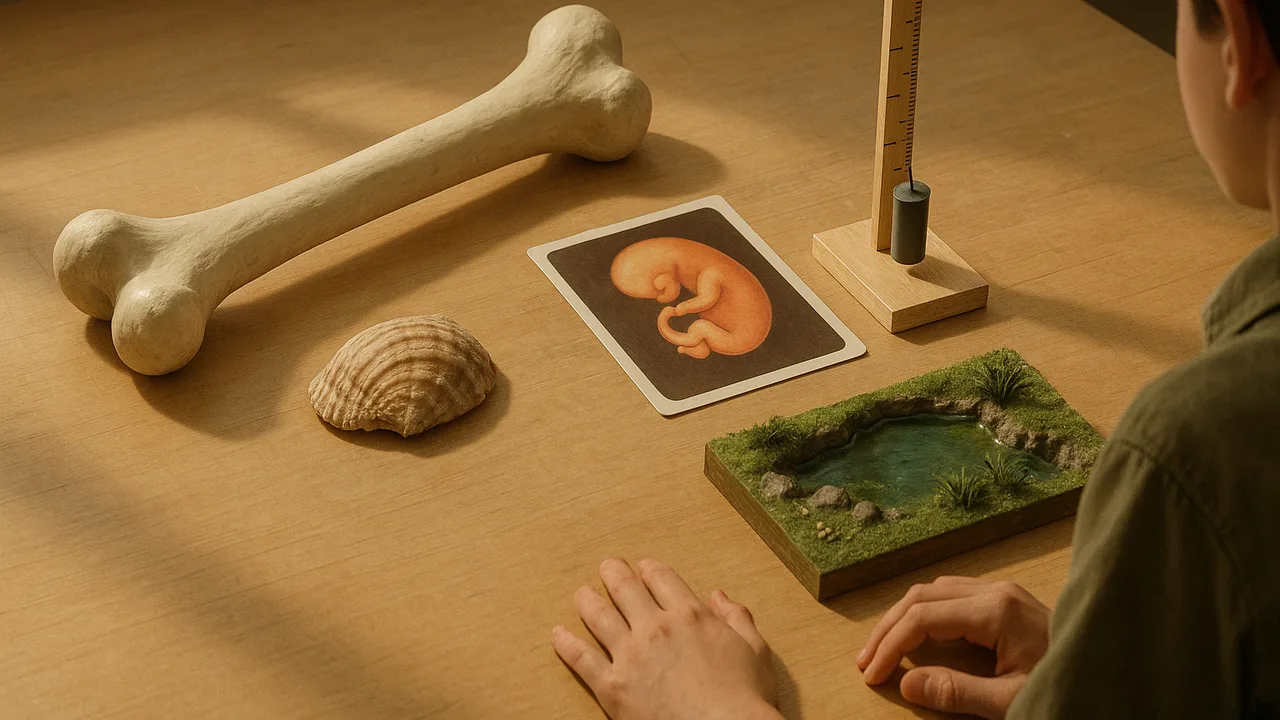
show what I learned about the fossil record, anatomy, embryos, senses, ecosystem change and engineering design, using PSSA-style questions.
- I can analyze and interpret fossil data to find evidence for the existence, diversity, extinction, and changes in life forms throughout Earth’s history, using the idea that natural laws work the same way now as in the past.
- I can use patterns in the fossil record to give evidence for when mass extinctions happened.
- I can use similarities and differences in fossil patterns to show when types of organisms appeared, disappeared, or changed over time.
- I can use reasoning to connect evidence to my claim and construct an argument about how changes in physical or biological parts of an ecosystem can cause changes in populations.
- I can explain how specific changes in an ecosystem can affect the survival and reproduction of organisms, and how these factors can change populations.
- I can describe patterns in evidence that show many types of changes in ecosystem parts are linked to changes in populations, including how small changes can lead to big effects.
- I can use a systematic method, like a decision matrix, to find the strengths and weaknesses of each solution.
- I can evaluate each solution using the criteria and constraints we defined.
- I can compare the solutions based on how well they meet the criteria and constraints.
Phase 5: Prove It
Warm-Up ~5 min
Do Now. Back to our phenomenon: a whale skeleton has tiny leftover hip bones. In two sentences, explain what that suggests about the history of whales.
In undisturbed rock layers, fossils in lower layers are generally older than fossils in higher layers.
Instruction ~10 min
Designers, this is the unit checkpoint. It looks like the spring PSSA science test: multiple choice with data, a scenario set with several questions about one situation, and short constructed responses scored 0, 1 or 2. Read each question twice and use the data.
How short answers are scored. 2 points: a correct claim with evidence from the data AND reasoning that uses science. 1 point: a correct claim with only evidence or only reasoning. 0 points: incorrect or missing.
Worked example 1: a strong data answer. Question: “A fossil type appears in layers 3 to 8 and is missing above layer 8. What happened?” Kofi wrote: “The organism appeared by the time layer 3 formed and went extinct after layer 8 formed, because it is missing from every younger layer above it.” He used the data and layer order.
Worked example 2: a 2-point short answer. Question: “Why did the deer population fall after a hard winter?” Lena wrote: “The deer count fell from 200 to 90 after a winter with deep snow (evidence). Deep snow buries food plants, so fewer deer survive and reproduce (reasoning).”
Guided Exercises ~15 min
Part A: answer on your own. Your teacher reviews answers after everyone finishes.
Independent Practice ~10 min
Part B: extended response.
Define the museum's problem as an engineer would: who needs it solved, the system, two criteria and two constraints, and one way the solution could affect people or the environment.
Sample data: a stream's summer temperature rose 4 °C over ten years, and the count of a cold-water insect fell from 300 to 120 per sample. Write a CER about the cause. Name one other explanation and the evidence you would need to rule it out.
Closure ~5 min
Checkpoint complete. Next: two catch-up and stretch days built from your results.
Exit ticket: which question felt most like the real PSSA? Which idea do you want to practice before spring?
How confident are you that you can I can use evidence from fossils, bodies, embryos and ecosystems to explain how life changes.
Teacher notes
Materials: printed checkpoint (or online quiz), scratch paper, calculators, scoring guide.
Scoring: short answers use the PSSA-style 0–2 scale: 2 = correct claim, evidence and reasoning; 1 = claim with only one of evidence or reasoning; 0 = incorrect or blank. All numbers are sample data.
Setup: about 40 minutes. Sort results by evidence id (fossil record, anatomy, embryos, senses, ecosystems, design) to build the 3.27 and 3.28 choice-board groups.
Listen for: top-layer-is-oldest errors; same-job confusion; correlation without reasoning; criteria and constraints mixed up.
Support / stretch: read items aloud on request; allow glossary cards for students with IEPs. Stretch: write a new scenario set for classmates.