3.17 How Museums Do It: Hands-On Exhibits for Every Visitor
use what museums have learned about hands-on, accessible exhibits, and explain how our senses carry an exhibit’s message to the brain.
- I can describe what I need to know about how similar problems have been solved before.
- I can identify what evidence I need about how each solution might affect people and the environment.
- I can identify scientific ideas that relate to the problem and each possible solution.
- I can gather information from at least two sources about how different types of sensory receptors respond to specific stimuli, like light, sound, or chemicals.
- I can explain how sensory information travels from receptors to the brain and how the brain uses this information for immediate actions or stores it as memories.
Phase 4: Build
Warm-Up ~5 min
Do Now. Close your eyes for 20 seconds while your teacher passes around a mystery object. Without looking, write three words that describe it. Which sense did you rely on?
You touched the object and could describe it without seeing it. What made that possible?
Instruction ~10 min
Designers, good engineers learn from people who solved similar problems first. Museums have been designing hands-on exhibits for a long time. Today you will borrow their best ideas.
Senses carry the message. Every sense starts with sensory receptors, special cells that respond to one kind of stimulus. Receptors in the eyes respond to light. Receptors in the ears respond to sound. Receptors in the skin respond to touch, pressure and temperature. Receptors in the nose and tongue respond to chemicals. Each receptor sends messages along nerves to the brain. The brain uses them for an immediate action, like pulling your hand back, or stores them as a memory.
Why that matters for an exhibit. If a station reaches a visitor through two senses, the brain gets two paths to the same idea. And if a visitor cannot use one sense, the other still carries the message.
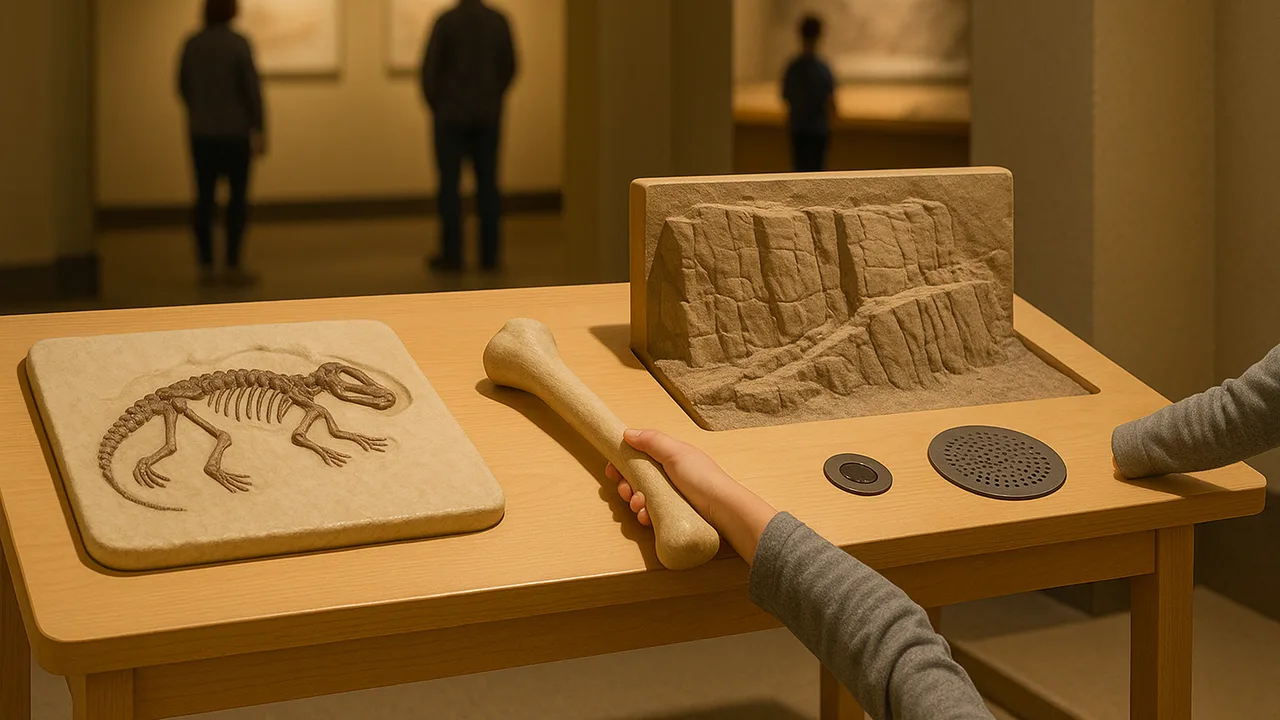
Worked example 1: one fossil, two senses. Malik’s team places a fossil cast in a visitor’s hand and plays a 20-second clip: “Feel the ridges? This shell lived in a shallow sea.” Touch receptors send the shape; ear receptors send the words. A visitor who cannot hear still feels the ridges and reads the caption.
Worked example 2: a design idea borrowed. Ava read that many museums put labels at a height a seated visitor can read, and add large print and braille. Her team adds a low, slanted label with raised letters to every station. That idea cost little and helps many visitors.
Guided Exercises ~15 min
Read the case study below, then work through these with your team.
Independent Practice ~10 min
Apply the case study to your design.
Make a two-column table: “What museums do well” and “How we will use it.” List at least three ideas in each column.
For each of your four stations, name the scientific idea it teaches and the two senses it will use.
🔎 Mini case study: Mini case study: how museums build hands-on, accessible exhibits ~8 min
Many natural history museums and science centers have moved from “look, don’t touch” toward exhibits that invite visitors to handle objects. Real fossils are often too rare to touch, so museums use casts, exact copies made from molds. Visitors can run their fingers over a cast tooth or bone without risking the original.
Exhibit teams often follow universal design. Labels are placed where seated visitors and children can read them. Many museums add large print and braille, audio descriptions for visitors who cannot see, and captions or sign-language video for visitors who cannot hear. Some offer quieter, sensory-friendly hours.
Designers also test early versions with real visitors. They watch where people stop, how long they stay and what they can explain afterward. Then they revise. Our class criteria, from “under 3 minutes” to “8 of 10 can explain,” follow the same idea.
Think about it: Which criteria and constraints did these museum teams seem to care about most? Which of their ideas fits our budget, and which would be too costly for us?
Closure ~5 min
Strong research, designers. Next class we start building, beginning at the bottom of the story: the fossil layers.
Exit ticket: name one museum idea you will copy and explain which visitors it helps and which senses it uses.
How confident are you that you can I can describe how similar problems have been solved before.
Teacher notes
Materials: a mystery object in a bag (a shell, pine cone or fossil cast), the case study printed, sample braille or large-print labels if you have them.
Setup: the case study takes about 8 minutes. Keep it general; if your class has visited a museum, invite students to add what they noticed there. MS-LS1-8 boundary: receptors send messages to the brain for behavior or memory; do not teach how nerve signals travel.
Listen for: “the eyes see, the brain does nothing”; “accessible means a separate exhibit for disabled visitors” (universal design serves everyone together).
Support / stretch: give a receptor-stimulus matching card set. Stretch: research one accessibility feature (audio description, tactile maps) and report how it works for visitors.