3.21 Mid-Build Checkpoint: Fossils, Bodies, Embryos and Ecosystems
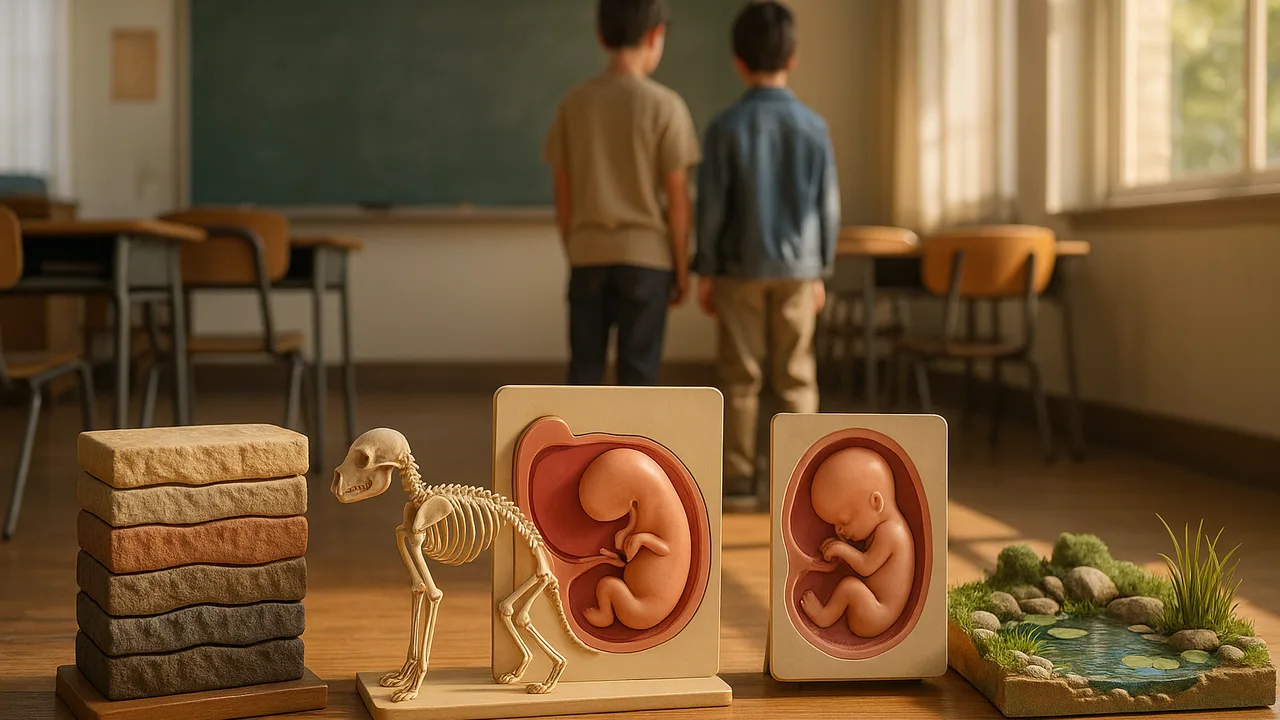
show what I understand about the evidence our four stations teach before we test them with visitors.
- I can analyze and interpret fossil data to find evidence for the existence, diversity, extinction, and changes in life forms throughout Earth’s history, using the idea that natural laws work the same way now as in the past.
- I can use patterns in the fossil record to give evidence for when mass extinctions happened.
- I can use similarities and differences in fossil patterns to show when types of organisms appeared, disappeared, or changed over time.
- I can use reasoning to show that organisms with similar anatomical features are likely to be more closely related because of their genetic makeup.
- I can explain how changes in anatomical features seen in fossils can help scientists trace evolutionary relationships between extinct and living organisms.
- I can evaluate evidence to decide which pieces are necessary and enough to support my claim.
Phase 4: Build
Warm-Up ~5 min
Do Now. Without notes, write one sentence for each station: what evidence does it show?
How confident are you that you can I can explain the evidence at all four stations.
Instruction ~10 min
Designers, a quick check before Visitor Test Day. If we cannot explain the evidence, our visitors will not be able to either. Answer on your own; your teacher uses the results to plan who needs help before testing.
Quick review. Fossil layers: deeper is older, life grows more varied and complex upward, sudden drops mark mass extinctions. Limbs: the same bone plan in different jobs points to a common ancestor. Embryos: early embryos look alike, then differ as they develop. Ecosystems: changes to physical or biological parts shift populations.
Worked example 1: a data question. “A fossil type is found in layers 2 through 6, but not in layers 7 to 10. What does that show?” Priya wrote: “The organism appeared by the time layer 2 formed and went extinct before layer 7 formed.”
Worked example 2: a short answer scored 2 of 2. “Why are similar embryos evidence of relatedness?” Malik wrote: “Fish, chicken and human embryos all have a tail and neck folds early on (evidence). Shared developmental features are best explained by a common ancestor (reasoning).” A 1-point answer gives only one of those parts.
Guided Exercises ~15 min
Answer on your own. Show your reasoning on paper.
Independent Practice ~10 min
Use your results to fix your station.
Which question was hardest for you? Rewrite the clue at your team's station so a visitor would not make the same mistake.
Closure ~5 min
Checkpoint done. Next class: we test whether the stations work for visitors who cannot see or cannot hear.
Exit ticket: which station's evidence do you feel strongest explaining, and which do you want to review?
How confident are you that you can I can analyze fossil, anatomy, embryo and ecosystem data to support a claim.
Teacher notes
Materials: printed checkpoint, scratch paper, the 0–2 scoring guide: 2 = correct claim with evidence and reasoning; 1 = correct claim with only evidence or only reasoning; 0 = incorrect or missing.
Setup: about 25 minutes for the checkpoint. Sort results by station so each team gets a short re-teach before 3.22.
Listen for: “the top layer is oldest”; confusing same job with same structure; correlation treated as proof.
Support / stretch: read items aloud on request; allow a glossary card. Stretch: write one new PSSA-style data question for classmates.