3.28 Catch-up and Stretch: Senses, Ecosystems and Design
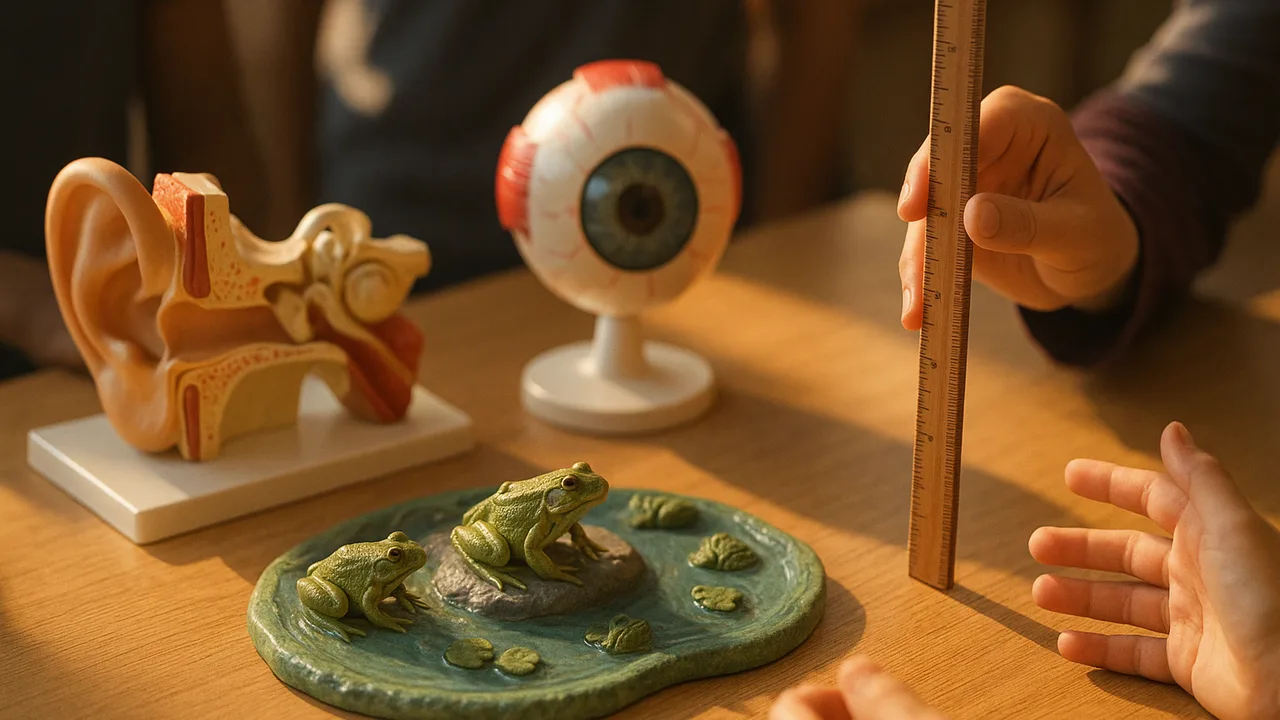
practice the senses, ecosystem and design ideas I found hardest, and stretch my thinking with a simulation challenge.
- I can describe evidence about changes in the physical or biological parts of an ecosystem, including how big those changes are.
- I can describe evidence about changes in populations, including how big those changes are and what types of species are present.
- I can identify evidence that shows whether changes in ecosystem parts are related to changes in populations, including both cause-and-effect and patterns.
- I can use information I have gathered to show how sensory receptors cause immediate behaviors or create memories that affect behavior later.
- I can use a systematic method, like a decision matrix, to find the strengths and weaknesses of each solution.
- I can evaluate each solution using the criteria and constraints we defined.
- I can compare the solutions based on how well they meet the criteria and constraints.
Phase 5: Prove It
Warm-Up ~5 min
Do Now. Circle one checkpoint question about senses, ecosystems or the decision matrix that you want to fix today.
How confident are you that you can I can argue from data how an ecosystem change affects a population.
Instruction ~10 min
Designers, last choice board of the unit. Everyone starts with the simulation, then picks a station.
Re-teach: ecosystem change in three steps. 1. What changed: a physical part (water, temperature) or a biological part (predators, food, disease)? 2. How does that change survival or reproduction? 3. What happens to the population over several generations? Then check: is there another explanation?
Worked example 1: the simulation. In the Natural Selection simulation, Priya starts a bunny population with plenty of food. It grows quickly. Then she adds limited food. “The population graph levels off and drops, because fewer bunnies get enough food to survive and reproduce. A biological part of the ecosystem changed, and the population changed with it.”
Worked example 2: receptor to behavior. In the same simulation, wolves hunt bunnies. Jamal links it to our senses unit: “A real rabbit’s ear receptors detect a sound, the brain gets the message, and the rabbit runs at once. That immediate behavior can decide whether it survives.”
Choice board. Catch-up A: graph sample pond data and write a CER. Catch-up B: match stimuli, receptors and responses (behavior or memory). Catch-up C: redo a decision matrix with new weights. Stretch A: in the sim, design a test of two environmental factors and predict the result first. Stretch B: write a museum label explaining how small ecosystem changes can lead to big effects.
| Station | What I did | What I learned | Question I still have |
|---|---|---|---|
Guided Exercises ~15 min
Run the simulation, then try these.
Independent Practice ~10 min
Show your growth.
Write a CER from your simulation run: what ecosystem part changed, what happened to the population (use numbers from the graph), and why. Name one other explanation.
Unit reflection: what is the strongest piece of evidence that life on Earth has changed over time, and how would you help a museum visitor see, hear and touch it?
Closure ~5 min
That wraps up Life’s Changing Story, designers. Next: your 3DX field trip to Museum Opening Night.
Exit ticket: name one physical and one biological change that could shift a population, and one way your exhibit helped a visitor remember evidence.
How confident are you that you can I can use reasoning to connect ecosystem changes to population changes.
Teacher notes
Materials: devices for the PhET Natural Selection sim (HTML5), sample pond data sheets, stimulus-receptor-response cards, blank matrices.
Setup: the sim is used here for MS-LS2-4 (environment changes shift populations); keep trait and mutation discussion brief, since that is a different unit. Group by checkpoint results.
Listen for: “the bunnies chose to have fewer babies”; one-cause thinking; mixing up criteria and constraints.
Support / stretch: give a CER frame with blanks for numbers. Stretch: Stretch A, testing two factors with a prediction first.