4.11 Modeling the Greenhouse Effect: Sharpening Our Climate Questions
use a model of the greenhouse effect and the carbon cycle to ask clearer questions about how human activities and natural processes changed global temperatures.
- I can ask questions to help clarify how human activities and natural processes may have affected changes in global temperatures over the past century.
- I can ask questions to better understand how human activities and natural processes have influenced gradual or sudden changes in natural systems, like glaciers or animal migrations, because of changes in global temperatures.
- I can ask questions to clarify how human activities and natural processes have changed the amount of carbon dioxide and other greenhouse gases in the atmosphere over the past century.
- I can ask questions about patterns in data that connect natural processes and human activities to changes in global temperatures over the past century.
- I can ask questions about patterns in data that connect changes in human activities or natural processes related to greenhouse gas production to changes in the amounts of carbon dioxide and other greenhouse gases in the atmosphere.
Phase 3: Make Sense
Warm-Up ~5 min
Do Now. On a sunny day, a closed car gets hotter inside than the air outside. Explain why in one or two sentences.
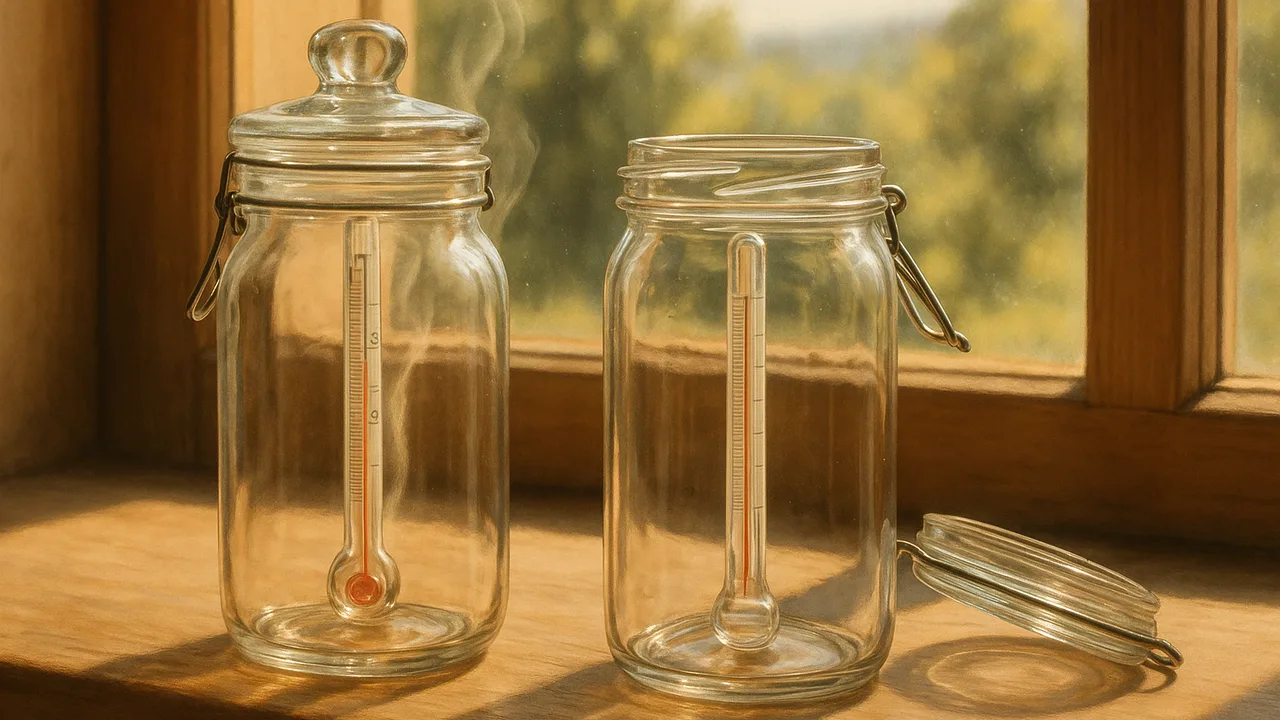
In our two-jar model, one jar has a plastic cover and one is open. Both sit under the same lamp. What will happen?
Instruction ~10 min
Reading: Earth’s energy balance. Sunlight reaches Earth and warms the surface. The warm surface gives off energy as infrared radiation, which we feel as heat. Greenhouse gases absorb some of that energy and send part of it back toward the surface. Without them, Earth would be far too cold for most life. Carbon moves between air, oceans, plants, soil and rock in the carbon cycle. Plants take in CO2; living things and decay release it. Burning fossil fuels moves carbon that was stored underground for millions of years into the air quickly. Cutting forests removes some of the plants that take CO2 back out. As CO2 builds up, more energy is held near the surface and average temperatures rise. That is why scientists conclude that human activities, mainly burning fossil fuels, are the main cause of recent warming.
Model it. Draw a two-panel model: Earth around 1900 and Earth today. Show sunlight in, heat out, and greenhouse gases as a layer. Use arrow thickness to show how much energy escapes.
Worked example 1: a model raises questions. Mei drew more CO2 in the “today” panel and a thinner “heat out” arrow. Her model raised a new question: “How much of the extra CO2 do the oceans absorb, and does that change the ocean?” Models help us find what we still need to know.
Worked example 2: questions about natural systems. Jamal connected warming to a natural system. He asked, “Are the dates when birds arrive in spring changing as average temperatures rise?” That question is testable with long-term bird records and temperature records from the same places.
Guided Exercises ~15 min
Run the two-jar model for 10 minutes and record temperatures every 2 minutes. Then work through these cards.
| Time (min) | 0 | 2 | 4 | 6 | 8 | 10 |
|---|---|---|---|---|---|---|
| Open jar (°C) | ||||||
| Covered jar (°C) |
Independent Practice ~10 min
Revise the class question bank from 4.06.
Pick two questions from the 4.06 bank. Use your model to make each one sharper and more testable. For each, name the human activity or natural process involved and the data that would answer it.
Write one new question about a natural system, such as glaciers, sea ice or migration timing, that changes as global temperatures change.
Closure ~5 min
Global questions have local answers too. Next time we model our own watershed and how biodiversity holds it together.
Exit ticket: ask one question that helps clarify how a human activity has changed the amount of CO2 in the atmosphere. Explain how your model helped you write it.
Teacher notes
Materials (per team): two identical clear jars, plastic wrap and a rubber band, two thermometers, a desk lamp with an incandescent or halogen bulb (or a sunny window), dark paper for the jar bottoms, a stopwatch.
Setup: place the lamp at equal distance from both jars. Start both thermometers at room temperature.
Listen for: “the ozone hole causes global warming” (a separate issue) and “greenhouse gases block sunlight.” Address the jar model’s limits openly. Keep the tone calm and focused on evidence and questions.
Support / stretch: give a labeled model template with arrows to color. Stretch: add the ocean as a carbon sink and a heat store to your model, and write a question about it.