4.25 Green Team Showcase: Presenting the Impact Monitor
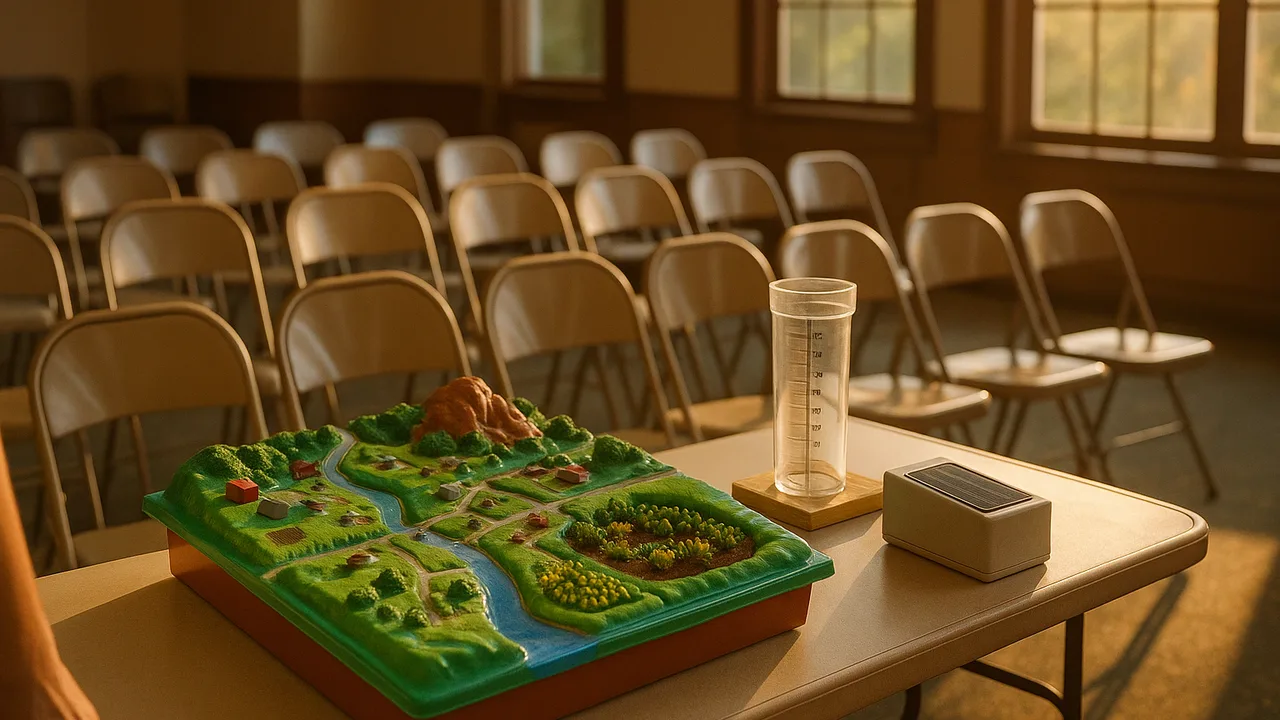
present our impact monitor to the green team and watershed group, defending it with test data, science and an honest list of limits.
- I can describe how well my solution meets the needs and limits I identified, including how it monitors or reduces a human impact based on scientific ideas about Earth systems.
- I can make a claim, supported by evidence, that increases in human population and per-person use of natural resources affect Earth’s systems.
- I can use scientific evidence to compare how well each design solution maintains ecosystem stability and biodiversity.
- I can explain the strengths and weaknesses of each design solution based on different criteria and constraints, such as scientific, social, and economic factors.
- I can assess possible side effects that each design solution might have on other parts of the ecosystem, including how a small change in one part could lead to big changes elsewhere.
Phase 5: Prove It
Warm-Up ~5 min
Do Now. Your audience has five minutes for your team. Write the one sentence you most want them to remember.
What does the watershed group care about MOST?
Instruction ~10 min
Showcase day. Members of the green team and the watershed group, or staff playing them, visit each team’s station. You have five minutes to pitch, then questions.
The pitch in five parts. 1. The problem and why it matters: more people and more use per person put pressure on water and habitat. 2. How the monitor works: the data-log model, inputs to outputs. 3. The test results against every criterion. 4. The biodiversity add-on and the ecosystem services it supports. 5. Limits and next steps.
Worked example 1: a strong opening. Kofi: “Our school is like a small town. Total impact equals people times use per person. We can’t change how many students come here, but our monitor showed we can cut food waste per student by 15% in one week (sample data).” He connects the school to the bigger idea from Make Sense.
Worked example 2: answering a tough question. A visitor asks, “Isn’t a native strip just weeds?” Priya answers: “Native plants feed local insects and birds and their roots hold soil, which protects the creek. In our plot data, the native strip had 15 plant species and 14 pollinator visits in ten minutes, compared with 3 and 1 for lawn (sample data). We trim the front edge so it looks cared for.” Evidence, science, and respect for the visitor’s concern.
Calm and accurate. If visitors ask about climate, stay with the evidence: Earth is warming, mainly because of burning fossil fuels, and communities are taking many actions. Our monitor is one of them.
Guided Exercises ~15 min
Rehearse with another team, then present.
Independent Practice ~10 min
After the showcase.
What did a visitor ask or suggest? Name one idea from another team you would borrow, and explain why.
Write a one-paragraph recommendation to the green team: should the school keep running the monitor? Use data from at least two teams and name one limit.
Project task: Impact Monitor: Measuring and Shrinking Our Footprint
Design, test and present an impact monitor for the school’s green team and a local watershed group. It must measure at least 2 impacts weekly, include 1 action that cuts an impact by at least 10% in a 2-week sample test, take students under 10 minutes a week, cost under the $150 sample budget and support local biodiversity. Defend it with a data-log model, your 2-week test data and the science of human impact.
Submission workflow
- Define the problem: how population and per-person use affect Earth’s systems, which school impacts to measure, and the five criteria.
- Test competing monitor designs, organize their data, and combine the best features with a weighted decision matrix.
- Build a data-log model with inputs, calculations and outputs; stress-test it and fix its weak parts.
- Evaluate competing biodiversity add-ons, take peer critique, and build version 2.
- Run the 2-week sample test, score every criterion, and present to the green team and watershed group with honest limits.
How it is scored
| Criterion | What proficient looks like |
|---|---|
| Science of human impact | Explains, with evidence, how population growth and per-person use increase pressure on water, land and habitat, and how the measured school impacts affect the creek and wetland; separates cause from correlation. |
| Design and model | Competing designs are compared with organized data; the combined monitor and its data-log model show inputs, calculations and outputs, with tests that changed the design. |
| Biodiversity and ecosystem services | The add-on is chosen by comparing competing designs with data; it names the ecosystem services supported and one possible side effect with a plan to prevent it. |
| Testing and communication | 2-week data is graphed and compared with all five criteria, including the $150 sample budget; limits of the tools and test are named; every member speaks; the recommendation is clear, calm and honest. |
Closure ~5 min
You built a tool that real people can use, monitor builders. Next: the unit checkpoint, then two PSSA review days.
Exit ticket: which question from our Wonder Board can you now answer? Write the question and your answer.
How confident are you that you can I can defend a design that monitors and reduces a human impact, using data and science.
Teacher notes
Materials: team posters or slides with graphs, the data-log model printed or on screen, rubric copies for visitors, timer.
Setup: invite green-team members, a facilities or cafeteria staff member, and a volunteer from a local watershed or conservation group; a video call works, or staff can role-play. Visitors can score the “Testing and communication” row.
Listen for: pitches that skip the data; overclaiming (“we saved the creek”); fearful or dismissive climate talk; one student doing all the talking.
Support / stretch: give a five-box pitch frame and allow note cards. Stretch: prepare a one-page handout the green team could use to train next year’s students.