3.07 Senses Lab: Touch, Sound and Sight Reaction Times
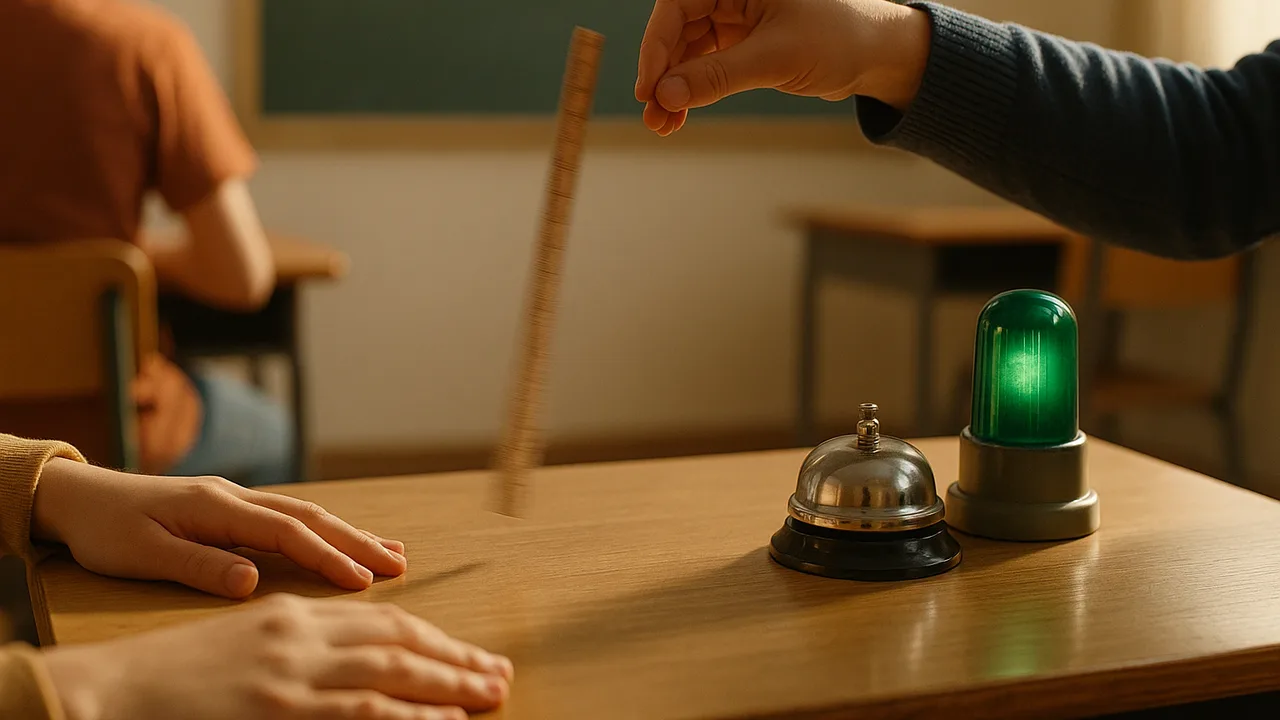
measure reaction times to touch, sound and sight cues and use the data to describe how receptors, the brain and practice shape a response.
- I can gather information from at least two sources about how different types of sensory receptors respond to specific stimuli, like light, sound, or chemicals.
- I can explain how sensory information travels from receptors to the brain and how the brain uses this information for immediate actions or stores it as memories.
- I can use information I have gathered to show how sensory receptors cause immediate behaviors or create memories that affect behavior later.
Phase 2: Investigate
Warm-Up ~5 min
Do Now. Your partner holds a ruler just above your open fingers and lets go without warning. You catch it as fast as you can. Think about every step between the ruler moving and your fingers closing. List them in order.
Which cue will you react to fastest: seeing the ruler drop, hearing “now,” or feeling a tap on your shoulder?
Instruction ~10 min
Explore first: the ruler drop. The catcher rests a forearm on the table edge with the hand open. The dropper holds a 30 cm ruler with the 0 mark between the catcher’s fingers and lets go at a random moment. Record the cm mark where the catcher’s fingers close, then convert it with the chart.
Three cues. Sight: the catcher watches the ruler. Sound: the catcher closes their eyes, and the dropper says “now” at the moment of release. Touch: the catcher closes their eyes, and the dropper taps the catcher’s shoulder with their free hand at release. Do five trials for each cue, then switch roles.
| Cue | Trial 1 (cm) | Trial 2 | Trial 3 | Trial 4 | Trial 5 | Mean (cm) | Mean time (s) |
|---|---|---|---|---|---|---|---|
| Sight | |||||||
| Sound | |||||||
| Touch |
Conversion chart (from the physics of falling objects): 5 cm = 0.10 s; 10 cm = 0.14 s; 15 cm = 0.17 s; 20 cm = 0.20 s; 25 cm = 0.23 s; 30 cm = 0.25 s. A shorter catch distance means a faster reaction.
Name the ideas. A stimulus is a change the body can detect. Sensory receptors are cells that respond to particular stimuli: receptors in the eyes respond to light, in the ears to sound, in the skin to touch, pressure and temperature, and in the nose and tongue to chemicals. Receptors send messages along nerves to the brain. The brain processes the message and either sends a response right away, stores it as a memory, or both. Remember from grade 7: the nervous system links every other body system.
Worked example 1: comparing means. Sample data. Mei’s sight trials averaged 20 cm, about 0.20 s. Her sound trials averaged 17 cm and her touch trials 16 cm, both about 0.18 s. Claim: for Mei, sound and touch cues led to faster catches than sight. Five trials is a small sample, so the class pools data before drawing a stronger conclusion.
Worked example 2: practice and memory. Sample data. Diego’s first sight trial was 26 cm; his fifth was 18 cm. His brain stored information from earlier trials, such as how the ruler moves and when to close his hand. Memory changed his later behavior.
Judging the method. A human tap or voice may not happen at exactly the moment of release. That is a source of error. Good scientists name their errors and decide how much they matter.
Guided Exercises ~15 min
Pool your data with your team, then answer.
Independent Practice ~10 min
Use your data and the conversion chart.
Convert your three mean distances to times. Rank the cues from fastest to slowest, and state whether your data matched your prediction.
Draw a flow model for one cue: stimulus → receptor → brain → response. Add a side arrow to “memory” and give one example of how that memory could change a later trial.
Closure ~5 min
Visitors to our exhibit will use these same receptors. Next time, we look at living communities and how they change.
Exit ticket: name the receptors used in each of your three cues and the stimulus each one detected. Then explain what the brain did in the touch trial.
Teacher notes
Materials (per pair): a 30 cm plastic ruler, the data table, the conversion chart, a calculator for means.
Setup: model the grip and the forearm-on-table position so the hand does not move down to chase the ruler. Collect a class data table on the board so pooled means can be compared.
Listen for: “the eyes decide to catch it.” Receptors detect; the brain processes and decides. Do not teach how signals travel along nerves; the boundary stops at receptor, brain, response and memory. Results vary; do not promise that sound or touch will win.
Support / stretch: give a filled-in model flow chart with blanks. Stretch: design a fairer touch cue that removes the human timing error, and explain why it is fairer.