4.25 Showcase: The Grow Lab and Garden-to-Body Exhibit
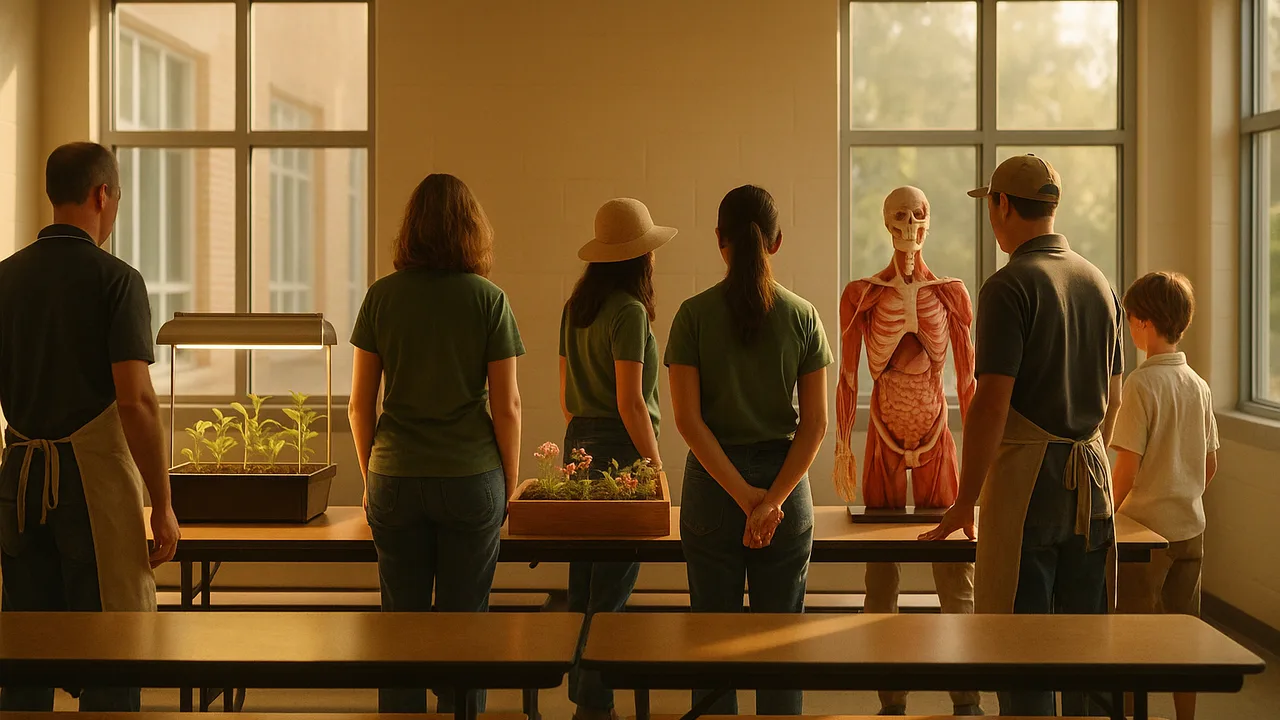
present our grow lab, pollinator plan and garden-to-body exhibit to the cafeteria and garden club, and defend them with data and science.
- I can use data to identify the best features from each design that could be combined to create a better solution.
- I can use my model to explain that the number of each type of atom stays the same before and after chemical reactions, showing that matter is conserved as it moves through an organism.
- I can describe how all the matter an organism uses for growth comes from the products of chemical reactions involving the food it takes in.
- I can explain that food molecules are broken down and rearranged to become the molecules that make up the organism, and that energy is released to support other processes.
- I can use reasoning to connect my evidence to my claim by explaining how cells form tissues, tissues form organs, organs form organ systems, and these systems interact to keep the body alive.
Phase 5: Prove It
Warm-Up ~5 min
Do Now. The cafeteria manager has two minutes to decide if our grow lab is worth a counter in the kitchen. What is the single most convincing fact you can tell them?
Which opening best fits our clients?
Instruction ~10 min
Grow-lab engineers, the clients are here. Cafeteria staff and garden club members visit in person or by video. They will decide which grow-lab design to keep running and which exhibit panels to hang in the cafeteria.
Your seven-minute showcase. 1. The problem and the criteria. 2. The three designs you compared and the features you combined. 3. Your model, and what harvest day showed about it. 4. Your pollinator bed plan. 5. Your garden-to-body exhibit: photosynthesis, body systems and cellular respiration. 6. An honest recommendation.
Worked example 1: explaining the science simply. Lena said: “The lamp gives energy. The lettuce uses it to turn carbon dioxide and water into sugar, and builds leaves from that sugar. When you eat the leaves, your digestive system breaks the sugar out, your blood carries it with oxygen to your cells, and your cells release the energy. The atoms are the same ones, just rearranged.”
Worked example 2: an honest trade-off. Kofi said: “Hydroponics grew fastest, but it needs nutrient mixing every week. Our wick hybrid was a little slower but almost no work. If the cafeteria has little staff time, pick the wick hybrid.” Clients trust honest data.
Guided Exercises ~15 min
Rehearse with your team before the clients arrive.
Independent Practice ~10 min
After all presentations, reflect.
What did the clients ask or suggest? Name one feature from another team's grow lab you would combine with yours, and the data that supports it.
Write a one-paragraph recommendation to the cafeteria and garden club: which grow lab should they keep, and why? Name one limitation of the model behind your recommendation.
Project task: The Grow Lab: Feeding Plants and People
Design, build, test and present a classroom grow lab that produces greens for the cafeteria within 4 weeks, fits on one shelf unit, uses under 2 liters of water a day and costs under $40. Add a pollinator-friendly plan for an outdoor bed and a “garden to body” exhibit that traces food from photosynthesis, through the body’s systems, to energy and growth in our cells.
Submission workflow
- Compare three grow-lab designs with organized data and choose the best features to combine.
- Model the hybrid grow lab: parts, inputs, outputs and photosynthesis; use it to predict growth.
- Build, test growth rate, take critique and build version 2.
- Plan a pollinator-friendly bed and build the garden-to-body exhibit.
- Run the harvest test against every criterion and compare it with the model.
- Present to the cafeteria and garden club with data, science and an honest recommendation.
How it is scored
| Criterion | What proficient looks like |
|---|---|
| Comparing and optimizing designs | Data from three or more designs is organized in tables or graphs; the claim about which features to combine is backed by numbers; the hybrid meets or is tested against every criterion and constraint. |
| Modeling and testing | The model shows the problem, parts, inputs and outputs; it generates a growth prediction; harvest data is compared with it; a limitation and a next change are named. |
| Science of growth, food and the body | Photosynthesis and cellular respiration are traced in matter and energy terms; environmental and genetic growth factors are argued from data; body systems are shown working together; flower structures and animal behaviors are linked to the chance of reproduction. |
| Communication | Every member speaks; evidence is from reliable sources and is cited; the recommendation names a trade-off and is honest about results. |
Closure ~5 min
You grew real food for real people, grow-lab engineers. Next: the unit checkpoint, then two catch-up and stretch days.
Exit ticket: which question from our Wonder Board can you now answer? Write the question and your answer.
How confident are you that you can I can defend a design and a science model to a client with data.
Teacher notes
Materials: grow labs, harvest data posters, pollinator bed plans, exhibit panels, rubric copies for visitors, a timer.
Setup: invite cafeteria staff and garden club members; a video call works. Visitors can score the Communication row. Ask the cafeteria where exhibit panels may hang.
Listen for: “plants get food from soil”; “energy becomes matter”; talks that skip the data.
Support / stretch: give a six-box presentation frame and allow note cards. Stretch: ask teams to estimate how many grow labs would be needed to supply one salad bar each week, stating every assumption.