4.02 Garden to Body: Mapping the System
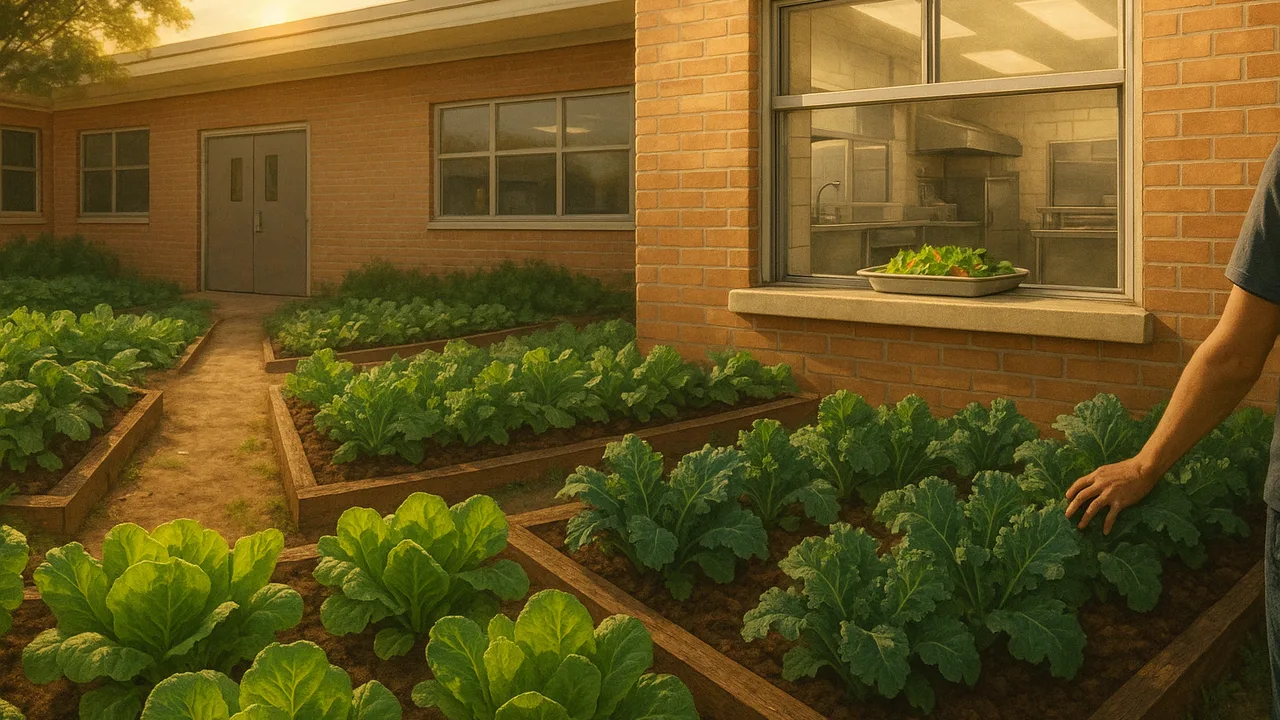
The Grow Lab: Feeding Plants and People
How do plants turn light, air and water into food, and how do our bodies turn that food into growth and energy?
The mystery: A tiny seed grows into a plant thousands of times heavier, mostly from air and water. Two seeds from the same packet, grown in different spots, end up very different sizes. A runner eats a banana and keeps going.
map how matter and energy flow from the grow lab to the cafeteria to the cells of the body, and describe the body as subsystems built from cells.
- I can make a claim that the body is made up of interacting subsystems, and each subsystem is formed from groups of cells.
- I can describe how plants, algae, and photosynthetic microorganisms need sunlight, carbon dioxide, and water to survive.
- I can explain how energy from sunlight is used to make food molecules (like sugar) and oxygen from carbon dioxide and water.
- I can describe how animals get energy and materials for growth and survival by eating food and breathing oxygen, and how some animals eat plants or other animals that have eaten plants.
Phase 1: Spark
Warm-Up ~5 min
Do Now. Look at the photo of a school salad bar. Trace one lettuce leaf backward and forward in time. Where was it a month ago? Where will its matter be tomorrow?
After you eat a lettuce leaf, where does most of its useful matter end up?
Instruction ~10 min
One system, many parts. In grade 6 you described Earth and ecosystems as systems: parts that interact and affect each other. Our project is also a system. It has a grow lab, plants, a cafeteria, students and the body systems inside each student. Matter and energy move through all of it.
Worked example 1: inputs and outputs of a lettuce plant. Mei drew a box for one lettuce plant. Arrows going in showed light energy, water, carbon dioxide from the air and a few minerals from the soil. Arrows going out showed oxygen and, at harvest, leaves full of stored food. Every arrow is a claim we will test in the Investigate phase.
| Part of the system | Matter in | Matter out | Energy in | Energy out |
|---|---|---|---|---|
| Grow lab plant | ||||
| Cafeteria salad bar | ||||
| A student’s body | ||||
| A muscle cell |
Worked example 2: levels inside the body. In Unit 3 you saw with a microscope that living things are made of cells. Your body organizes cells in levels. Heart muscle cells group into heart muscle tissue. Several tissues build an organ, the heart. The heart and blood vessels together form an organ system, the circulatory system. All the systems together make one organism: you.
The six systems in our exhibit. We will study the digestive, respiratory, circulatory, excretory, muscular and nervous systems. Each one is a subsystem of the body: a smaller system inside a larger one. We will focus on what each system does and how they work together, not on every detail inside them.
Why this matters for our clients. Growing food locally connects a school to bigger food systems. Fresh greens travel a few steps instead of many miles. Our exhibit can show that whole path in one picture.
Guided Exercises ~15 min
Fill in your team’s system map as you go. Each card tests one piece of the map.
Independent Practice ~10 min
Make your own garden-to-body map.
Draw a four-box map: grow lab plant, salad bar, your body, one of your cells. Label at least two matter arrows and one energy arrow between the boxes.
How confident are you that you can I can describe my body as subsystems built from cells and map matter moving from a plant to my cells.
Closure ~5 min
Our map is full of claims we have not tested yet. Next phase we investigate: seedlings, elodea, plant mass, flowers, and our own pulse and breathing.
Exit ticket: explain why your body can be called a system of interacting subsystems. Use the words cell, organ and organ system.
Teacher notes
Materials: a salad bar photo, chart paper and markers, a printed system map table per team, a body outline poster for the exhibit wall.
Setup: keep each team’s map; teams update it at the end of each Investigate lesson, and it becomes a draft of the exhibit.
Listen for: “the heart is a system” (it is an organ) and “food goes to the stomach and stays there.” Keep system descriptions at the whole-system level; the assessment boundary excludes mechanisms inside a single system.
Support / stretch: give a word bank for arrows (water, carbon dioxide, oxygen, light, food). Stretch: add a decomposer box that returns matter from food scraps to the garden soil.