3.04 Light Meets Matter: Reflect, Absorb, Transmit
test how light and sound interact with different materials and classify each material as mostly reflecting, absorbing or transmitting the wave.
- I can develop a model that shows the type of wave (mechanical or light), its amplitude and frequency, and the position of the wave’s source.
- I can include different materials in my model to show how waves interact with them.
- I can identify and describe what happens to a wave’s frequency, amplitude, or wavelength after it interacts with a material.
- I can use my model to explain what happens when light or mechanical waves are reflected, absorbed, or transmitted by different materials.
Phase 2: Investigate
Warm-Up ~5 min
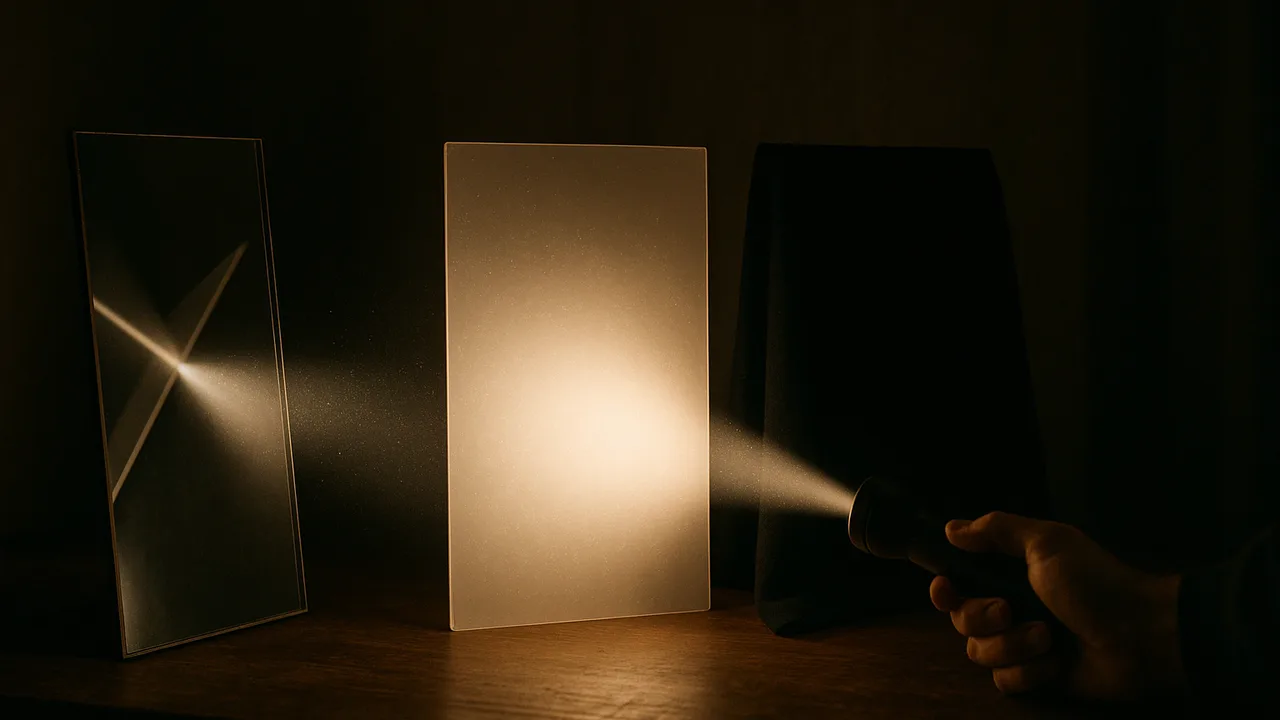
Do Now. Your teacher shines a flashlight at a window, at a mirror and at a black T-shirt. Notice where the light ends up each time. Then predict.
A slide for the microscope must let light reach the camera. Which material would work best for a slide?
Instruction ~10 min
Part A: light test. In a darkened room, shine a flashlight straight at each material held 20 cm in front of a white card. Look at the card behind the material and at the wall in front of it. Feel each material after one minute under a desk lamp. Then rate each one.
| Material | Light on the card behind? (none / some / most) | Light bounced back? | Warmer after 1 min? | Mostly reflects, absorbs or transmits? |
|---|---|---|---|---|
| Clear plastic | ||||
| Wax paper | ||||
| Mirror | ||||
| Aluminum foil | ||||
| Black paper | ||||
| Colored cellophane |
Part B: sound test. Play a steady tone on a phone at low volume inside a cup. Cover the cup with foam, then cardboard, then a hard plastic lid. Rate how loud it sounds from 1 meter away.
Naming what you saw. When a wave hits a material, it can be reflected (bounced back), absorbed (taken in, often warming the material) or transmitted (passed through). Most materials do some of all three. Light travels in straight lines until it meets something. Light can cross empty space, which is how sunlight reaches Earth. Sound is a mechanical wave: it needs a material, like air or water, to travel through.
Worked example 1: classifying. Priya’s team saw a bright spot behind clear plastic, almost none behind foil, and a bright spot on the wall in front of the foil. Clear plastic mostly transmits. Foil mostly reflects. Black paper sent no light behind or back and felt warmest, so it mostly absorbs.
Worked example 2: a wave model. Diego drew one arrow for the light from the flashlight. At wax paper he split it into three arrows: a thin one bouncing back, a thin one ending in the paper and a medium one passing through, spread out. He wrote, “Less light got through, so the wave behind has a smaller amplitude: dimmer.” Arrows of different thickness show how much of the wave does each thing.
Guided Exercises ~15 min
Use your data table as evidence for each card.
Independent Practice ~10 min
Connect the results to our station.
Choose a material for (a) the slide, (b) the inside of a light shield around the camera, and (c) a reflector under the sample. Explain each choice with reflect, absorb or transmit.
How confident are you that you can I can use a model to show how light is reflected, absorbed or transmitted.
Closure ~5 min
Clear materials transmit light. But some clear materials do something more: they bend it. Next time, a single drop of water becomes a lens.
Exit ticket: the clinic's room has bright windows that make the screen hard to see. Which kind of material would you put over the windows, and what would it do to the light?
Teacher notes
Materials (per team): flashlight, white index card, clear plastic sheet, wax paper, small mirror, aluminum foil, black paper, colored cellophane, a desk lamp to share; for Part B, a phone tone app, a paper cup, foam, cardboard and a plastic lid.
Setup: dim the room. Run Part A for 15 minutes and Part B for 8. Teams rotate through the lamp warm-up check.
Listen for: “each material does only one thing.” Stress that “mostly” matters. Also “black paper makes heat”: the light’s energy is absorbed and becomes thermal energy. Keep the explanation at wave level, with no photons or electromagnetic theory.
Support / stretch: give a sorting mat with three columns. Stretch: predict what red cellophane does to green light and test it.