3.14 Ideate: Brainstorming the Microscope Station
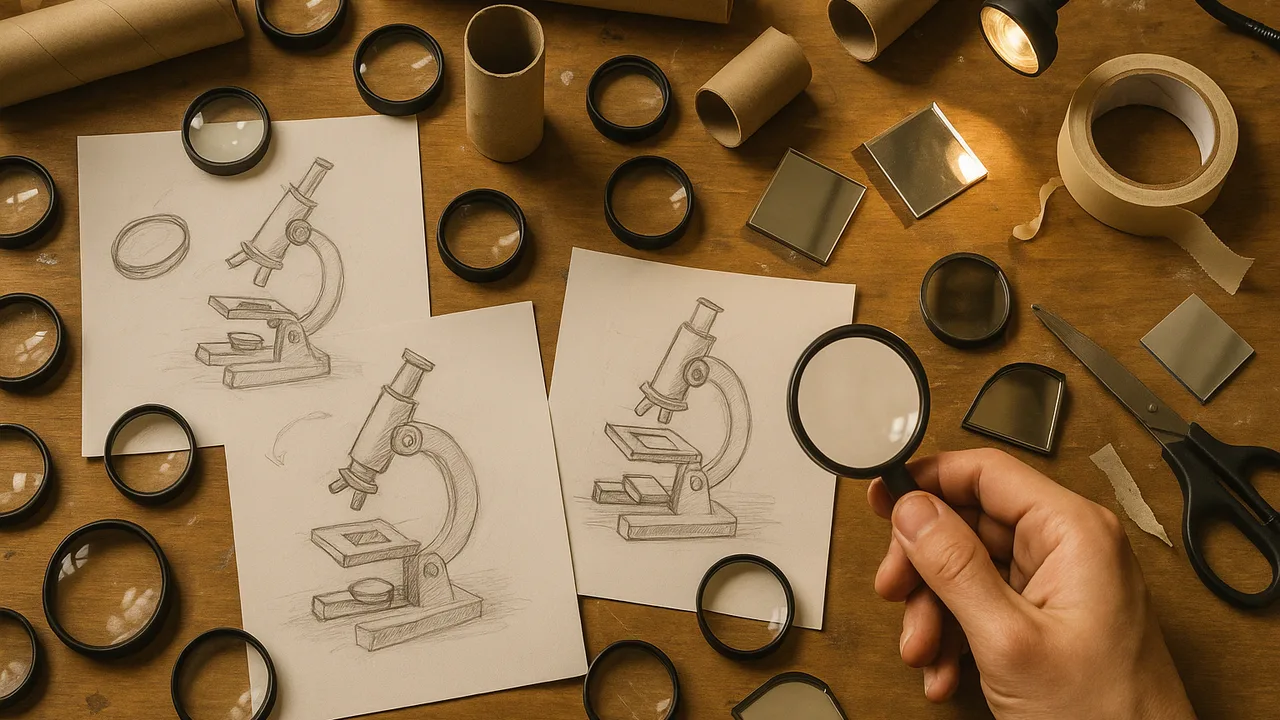
brainstorm at least three microscope station designs grounded in wave, light, lens and digital science and check each against our criteria and constraints.
- I can define the criteria for a solution that meet the needs of the people or groups affected by the problem.
- I can explain who the solution is meant to help and use criteria to compare different solutions, including using numbers when needed.
- I can define the constraints for a solution, including time, materials, costs, and scientific or other important issues.
- I can explain how the needs and wants of people involved, safety, and effects on others limit possible solutions.
- I can analyze how solutions or not solving the problem could negatively affect the environment.
- I can use my model to explain why certain materials are chosen for specific uses, like mirrors, lenses, sound barriers, or light filters.
Phase 3: Make Sense
Warm-Up ~5 min
Do Now. Reread your design brief from 3.09. Circle the criterion you think is hardest to meet. Then predict.
Which idea uses the most science we have learned?
Instruction ~10 min
Ideate means many ideas first. Engineers generate lots of ideas before judging them. Today you sketch quietly, then build on teammates’ ideas with “Yes, and…” Every idea must name the science that makes it work.
Science menu.
- Lenses: curved, clear lenses bend light to magnify; two lenses multiply magnification (3.05).
- Light and materials: mirrors reflect light up through the slide; dark shields absorb stray light; foam absorbs vibrations (3.04, 3.10).
- Digital images: pixels and binary make exact copies that can be stored and sent (3.08, 3.13).
- Cells: the station must show cells and parts such as the nucleus and chloroplasts, so it needs at least 100× (3.06–3.07).
Worked example 1: a science-grounded idea. Jamal’s team sketched a cardboard holder that keeps a donated phone’s camera lined up over a school microscope’s eyepiece. A cable or wireless link shows the image on a monitor. A black paper sleeve absorbs room light. Their notes: “Microscope lenses give 100–400×. The phone turns the image into pixels. Families get exact digital copies by email.”
Worked example 2: checking an idea against the brief. Mei suggested a drop of water placed right on the phone’s camera lens as a tiny magnifier. It is very cheap and fun to try. But in her team’s test it gave far less than 100× and the drop slid off, so it fails the magnification criterion. Her team kept the science, a strongly curved lens, and suggested a small clip-on lens instead.
| Idea | Sketch | Science it uses | Criteria it should meet | Constraints it might break | Effects on people or environment |
|---|---|---|---|---|---|
| Idea 1 | |||||
| Idea 2 | |||||
| Idea 3 |
Not yet! Do not pick a winner today. In the Build phase, we compare these ideas fairly with a decision matrix, then prototype and test.
Guided Exercises ~15 min
Warm up your thinking with these cards, then sketch your ideas.
Independent Practice ~10 min
Complete the idea table for your team.
Sketch three different station ideas. For each one, name the science it uses, the criteria it should meet, any constraint it might break and one effect on people or the environment.
How confident are you that you can I can generate design ideas grounded in science and check them against criteria and constraints.
Closure ~5 min
We have a science-backed idea bank. Next, the Build phase: compare our ideas fairly, build a prototype and test it. First, a 3DX field trip inside a plant cell.
Exit ticket: pick your strongest idea. Explain how it meets two criteria and stays within two constraints, and name one material in it chosen for how it reflects, absorbs, transmits or bends light.
Teacher notes
Materials: the class design brief and system map, idea table, sticky notes, sketch paper, sample parts to handle (a hand lens, clip-on phone lens if available, black paper, foam, a small mirror, cardboard).
Setup: run a 5-minute silent sketch, then a 6-minute “Yes, and” round. Teams keep all three ideas; part 2 compares them systematically (MS-ETS1-2).
Listen for: ideas with no science named, ideas that use lasers, and ideas that would photograph people. Redirect to the brief. Magnification of a water-drop phone lens varies widely; treat Mei’s result as one team’s test, not a fixed fact.
Support / stretch: give a menu of station parts with the science each uses. Stretch: add a feature that helps a visitor with low vision use the station.