3.27 Catch-up and Stretch: Waves, Light and Signals
practice the wave, light and signal ideas I found hardest, and stretch my thinking with a new lens challenge.
- I can predict how the energy of a wave will change if I change its amplitude, frequency, or wavelength.
- I can use my model to describe how waves can be reflected, absorbed, or transmitted when they hit different materials.
- I can explain that light travels in straight lines but bends when it passes from one material to another.
- I can describe that light can travel through empty space, but mechanical waves need a material to move through.
- I can explain specific features that make digital transmission of signals more reliable than analog transmission, such as how digital information can be recorded reliably, stored for future recovery, and transmitted over long distances without significant degradation.
- I can describe at least one technology that uses digital encoding and transmission, and explain how digitization has helped advance science or scientific investigations.
Phase 5: Prove It
Warm-Up ~5 min
Do Now. Look at your checkpoint. Circle one wave, light or signal question you missed or felt unsure about. That is your focus today.
How confident are you that you can I can explain how light bends when it passes from one material into another.
Instruction ~10 min
Today is a choice board. Your teacher will point you to a Catch-up station or a Stretch station. Everyone starts with the simulation below.
Re-teach: the three wave measurements. Wavelength is crest to crest. Amplitude is the middle line to a crest. Frequency is waves per second. Bigger amplitude means more energy: brighter light or louder sound.
Worked example 1: predicting energy. A ripple tank wave has amplitude 1 cm. A student makes it 3 cm. Energy becomes about 3 × 3 = 9 times as much. If the frequency also doubles, twice as many waves arrive each second, so even more energy arrives in the same time.
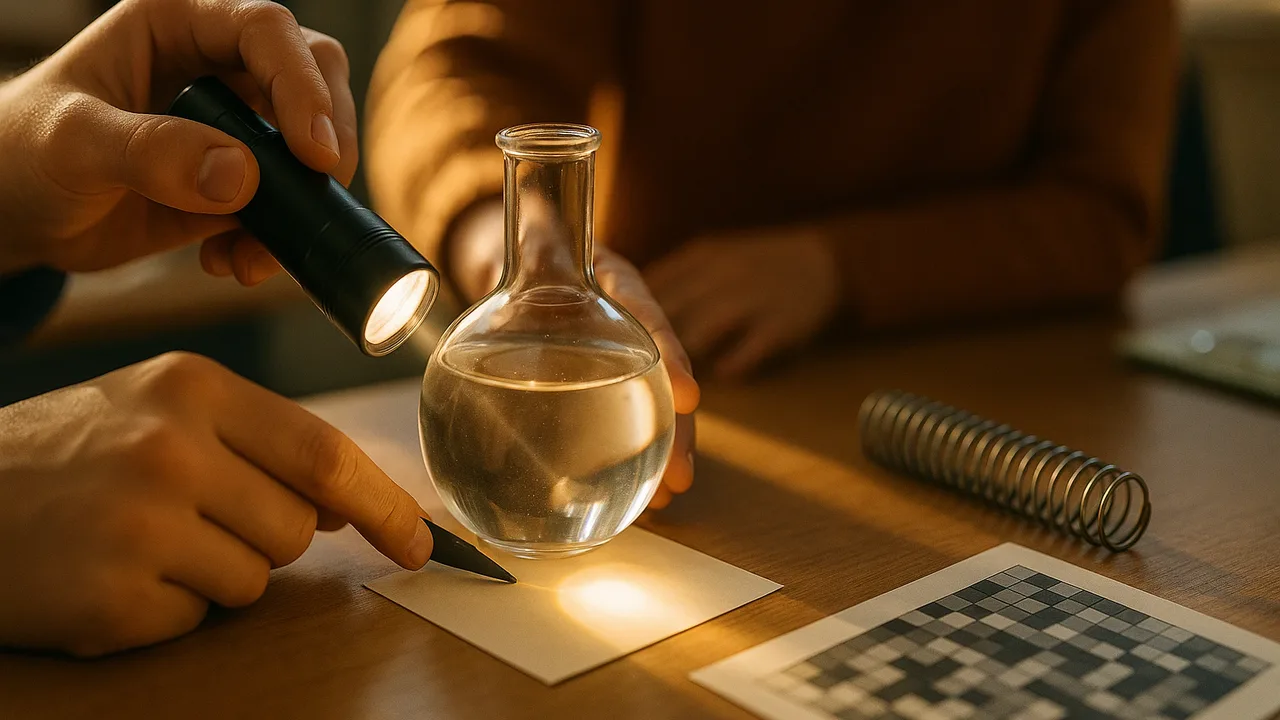
Worked example 2: why light bends. Light travels at different speeds in different materials. When a ray enters glass or water at an angle, one side of the beam slows first, so the beam turns, like a wagon whose wheel rolls onto grass. A curved lens turns rays by different amounts, which brings them together or spreads them out.
Re-teach: digital vs analog. Digital = numbers, read as 0 or 1, copied exactly. Analog = smooth changes, where noise becomes part of the signal.
Guided Exercises ~15 min
Everyone: do the simulation, then your station’s blocks. Catch-up = blocks 2–5. Stretch = blocks 6–7.
Independent Practice ~10 min
Show your growth.
Redo the checkpoint question you circled. Explain what you understand now that you did not before.
Gather evidence from two sources (today's lesson, the case study, or the simulation) that digital signals are more reliable than analog ones.
Closure ~5 min
Nice work. Tomorrow: cells and better designs.
Exit ticket: draw one light ray bending as it enters a lens and label where it bends.
How confident are you that you can I can predict how a wave's energy changes when amplitude changes.
Teacher notes
Materials: devices for the PhET Bending Light sim, a clear dish of water, a pencil, rope or coiled spring toy, checkpoint results.
Setup: group students using 3.21 and 3.26 results. Ten minutes of re-teach, then 25 minutes at stations. Keep the refraction explanation qualitative; no indices or angle formulas.
Listen for: “light bends because the lens pulls it”; frequency and amplitude swapped.
Support / stretch: provide a labeled wave diagram to trace. Stretch: design a two-lens setup on paper and predict whether it magnifies more.