4.04 The Blue-to-Yellow Clue: Elodea in Light and Dark
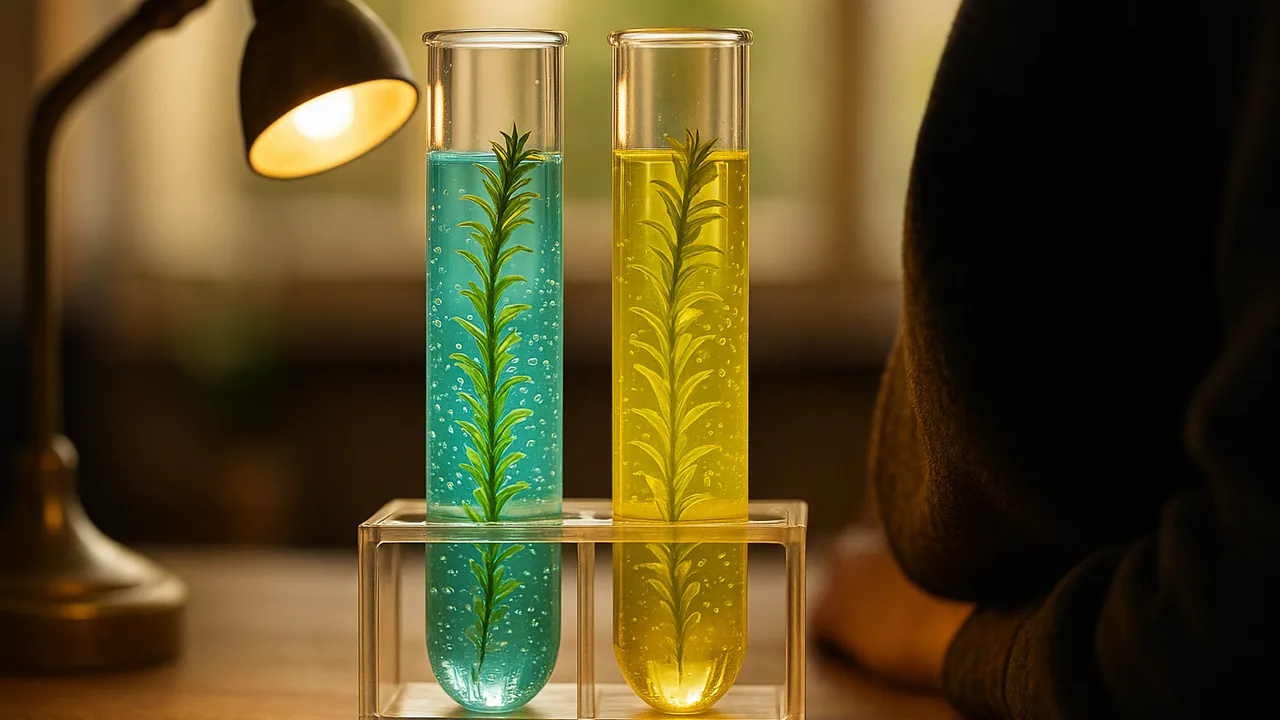
use bromothymol blue to gather evidence that plants take in carbon dioxide in the light and give it off in the dark.
- I can describe how plants, algae, and photosynthetic microorganisms need sunlight, carbon dioxide, and water to survive.
- I can explain how energy from sunlight is used to make food molecules (like sugar) and oxygen from carbon dioxide and water.
- I can describe how animals get energy and materials for growth and survival by eating food and breathing oxygen, and how some animals eat plants or other animals that have eaten plants.
- I can explain how plants, algae, and photosynthetic microorganisms take in carbon dioxide and water and use sunlight to make food and release oxygen.
- I can describe how plants use the food they make for energy, growth, and other important functions.
- I can explain how animals depend on plants for food and oxygen, and how all food and most oxygen animals use come from energy from the sun moving matter through photosynthesis.
Phase 2: Investigate
Warm-Up ~5 min
Do Now. Your teacher shows a tube of blue liquid. Wearing goggles, your teacher gently blows out through a straw into the tube for about a minute. Watch closely.
The liquid turned from blue to yellow. What did the breath add?
Instruction ~10 min
Meet bromothymol blue (BTB). BTB is an indicator, a dye that changes color to show a change in a liquid. Blue means little carbon dioxide. Green means some. Yellow means a lot. The color can change in both directions.
The setup. Every team gets four tubes of BTB that have been turned yellow with gently blown breath. Add a sprig of elodea, a water plant, to tubes A and B. Tubes C and D get no plant. Wrap tubes B and D in foil to keep them dark. Cap all four and set them under a bright light until next class.
| Tube | Elodea? | Light or dark? | Color at start | Color after 24 hours | Carbon dioxide: more, less or same? |
|---|---|---|---|---|---|
| A | Yes | Light | |||
| B | Yes | Dark (foil) | |||
| C | No | Light | |||
| D | No | Dark (foil) |
Worked example 1: what are tubes C and D for? Diego’s tubes C and D stayed yellow. That shows light and time alone do not remove carbon dioxide. So any change in tube A must be caused by the plant. C and D are the controls.
Worked example 2: reading tube B. In many classes, tube A turns back to blue, and tube B stays yellow or turns an even deeper yellow. Priya reasoned: “In the light, the elodea removed carbon dioxide from the water. In the dark, it did not remove it. It may even have added more.” Both parts of that sentence matter.
Naming the ideas. In light, plants carry out photosynthesis. They use light energy to turn carbon dioxide and water into sugar, and they release oxygen. Plants, like animals, also carry out cellular respiration all day and all night. It uses sugar and oxygen and releases carbon dioxide. In bright light, photosynthesis uses carbon dioxide faster than respiration gives it off, so the tube turns blue.
A second source. Gardeners who grow plants in sealed glass jars report that the plants can live for a long time, because the plants and the tiny organisms in the soil recycle the same gases. That observation fits our tube data.
Guided Exercises ~15 min
Use your team’s tube colors. If your tubes are still changing, use the sample results your teacher posts.
Independent Practice ~10 min
Explain the clue in your own words.
Draw tubes A and B. Add arrows for carbon dioxide going into or out of the plant in each tube. Write one sentence under each drawing that uses your color data.
How confident are you that you can I can use indicator data to show that plants take in carbon dioxide in the light.
Closure ~5 min
Plants take in carbon dioxide from water or air when light shines. Next time we ask a bigger question: is that carbon dioxide where a plant’s mass comes from?
Exit ticket: what does a grow lab plant need from its surroundings to make its own food, and what does it give back? Use evidence from the tubes.
Teacher notes
Materials (per team): 4 clear test tubes or small jars with caps, about 100 mL of dilute BTB solution, elodea sprigs (from an aquarium or pond supply shop), aluminum foil, one drinking straw per student who blows, goggles, a bright lamp or the grow light. Prepare BTB at classroom-kit dilution (a pale blue).
Setup: to save time, the teacher or one goggled student per team blows gently through a straw into a beaker of BTB until it is yellow-green, then fills all four tubes from it. Use a straw with a small hole poked near the top if you worry about students sucking in. Results take several hours to a day; post sample results for teams whose tubes are slow.
Listen for: “plants breathe in carbon dioxide and we breathe in oxygen, so plants don’t respire.” Tube B is the evidence that they do. Keep photosynthesis as a word statement; no chemical steps.
Support / stretch: give a color key strip. Stretch: predict the color of a tube placed in dim light and test it.