3.12 CER: Is Every Living Thing Made of Cells?
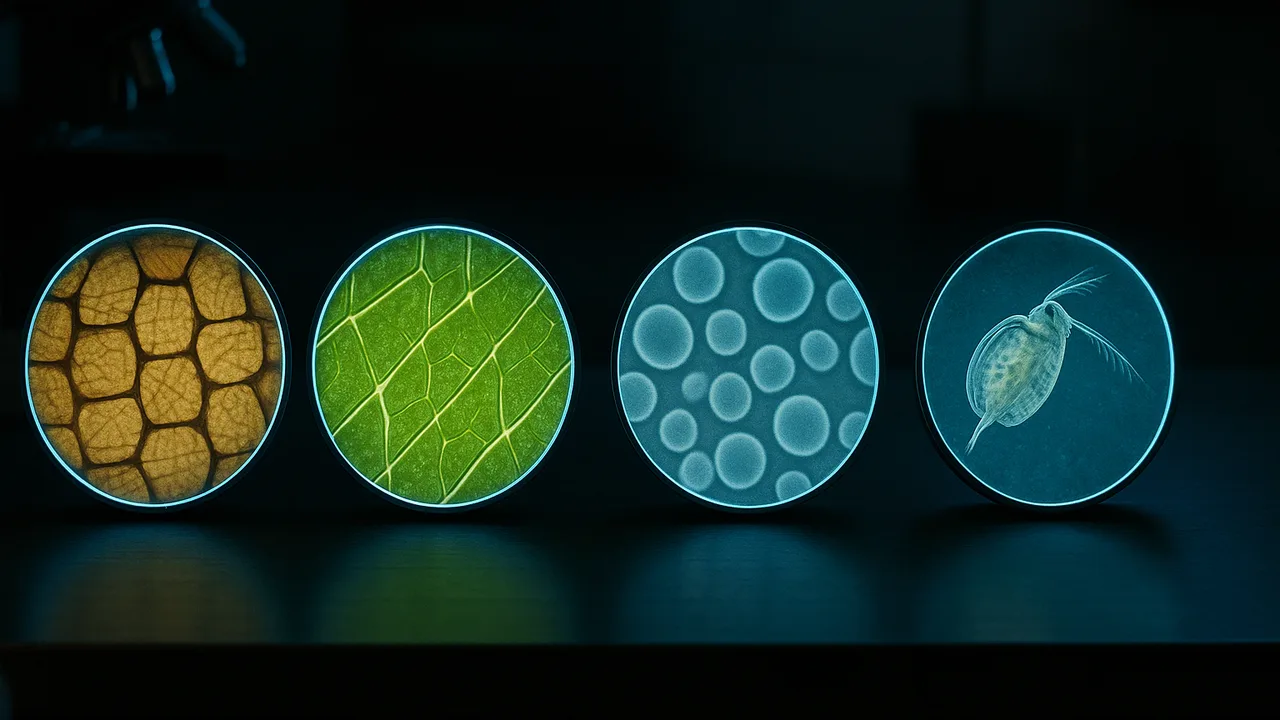
write a claim, evidence and reasoning argument, using our microscope data, that all living things are made of one or more cells.
- I can explain the purpose of my investigation: to show that all living things are made of cells, and that the cell is the smallest unit that can be alive.
- I can explain how the evidence I collect will help answer the purpose of my investigation.
- I can analyze my data to decide if the evidence shows that cellular composition is a feature that distinguishes living things.
Phase 3: Make Sense
Warm-Up ~5 min
Do Now. Read this claim from a student: “Plants are made of cells, but tiny pond creatures are too small to have cells.” Then predict.
Which piece of our data best answers that student?
Instruction ~10 min
Reading: the cell idea. After lens makers first saw cells, scientists kept looking at more and more living things: leaves, roots, muscles, pond water. Every living thing they studied was made of one or more cells. In the 1830s, scientists put these observations together into what we now call the cell theory: all living things are made of cells; the cell is the smallest unit that can be alive; and new cells come from existing cells. A theory in science is a well-tested explanation supported by a large body of evidence, not a guess.
How to write a CER. A claim answers the question. Evidence is specific data you collected. Reasoning explains why the evidence supports the claim, using science ideas.
Worked example 1: a weak CER. Diego wrote: “Claim: living things have cells. Evidence: I saw cells. Reasoning: because cells are everywhere.” His evidence names no sample or magnification, and his reasoning does not explain anything.
Worked example 2: a strong CER. Priya wrote: “Claim: all living things are made of one or more cells. Evidence: at 100×, onion skin showed rows of cells with a nucleus. At 400×, elodea showed cells with chloroplasts. Yeast and a pond creature were each a single cell. Sand, which was never alive, showed no cells. Reasoning: every living or once-living sample, big or tiny, plant or not, showed cells, while the nonliving sample did not. A single living cell carries out all life functions, so the cell is the smallest unit of life. Our data supports the claim, but we tested only six samples, so more samples would make it stronger.”
Sentence starters. “We claim that…” “At ___×, we observed…” “In contrast, ___ showed…” “This supports our claim because…” “One limit of our evidence is…”
Guided Exercises ~15 min
Strengthen the argument piece by piece.
Independent Practice ~10 min
Write your own CER.
Write a full CER: Are all living things made of cells? Use at least three samples from our data, including one unicellular organism and one nonliving sample. Describe the purpose of our investigation in your reasoning, and end with one limit of your evidence.
How confident are you that you can I can argue from data that living things are made of cells.
Closure ~5 min
Our evidence came from images. Next time, we argue why those images should be shared as digital files.
Exit ticket: in two sentences, explain to a clinic visitor why a single pond creature counts as a whole living thing.
Teacher notes
Materials: class data tables and sketches from 3.06–3.07, CER template with sentence starters, highlighters (one color each for C, E and R).
Setup: read the short reading aloud together, then score the two worked examples with a quick 3-point scale before students write.
Listen for: evidence without samples or magnification, and reasoning that only repeats the claim. The cell theory’s 1830s origin is well documented; do not add names or dates beyond what is here.
Support / stretch: give a partly filled CER with the claim written. Stretch: address a counterclaim, such as “viruses are alive but not cells,” and explain why most scientists do not count viruses as living.