3.17 Pictures Across the Miles: How Health Workers Share Microscope Images
use a case study to explain why digital images can be stored and sent more reliably than analog pictures, and borrow ideas for our station.
- I can gather evidence from different sources, like texts, graphs, videos, or digital materials, to support the claim that using waves to carry digital signals is more reliable than using waves to carry analog signals.
- I can explain specific features that make digital transmission of signals more reliable than analog transmission, such as how digital information can be recorded reliably, stored for future recovery, and transmitted over long distances without significant degradation.
- I can describe at least one technology that uses digital encoding and transmission, and explain how digitization has helped advance science or scientific investigations.
- I can describe what I need to know about how similar problems have been solved before.
- I can identify what evidence I need about how each solution might affect people and the environment.
Phase 4: Build
Warm-Up ~5 min
Do Now. Imagine a photo printed on paper, then copied on a copy machine, then the copy copied again, ten times. What happens to the last copy? Now imagine sending a phone photo to ten friends in a row. What does the tenth friend get?
Which keeps more detail after ten copies?
Instruction ~10 min
Analog vs digital. An analog signal changes smoothly, like the shades on a printed photo or the groove in an old record. A digital signal stores information as numbers, usually written in binary: only 0s and 1s. A digital picture is a grid of pixels, and each pixel’s color is stored as numbers.
Why digital is more reliable. When any signal travels, small random changes called noise sneak in. In an analog signal, the noise becomes part of the picture. In a digital signal, each value only needs to be read as a 0 or a 1. A slightly fuzzy 1 is still read as 1, so the original numbers are recovered. Digital files can also be checked for errors, stored for years and copied exactly.
Worked example 1: one pixel in binary. Suppose a gray pixel has brightness 200 on a 0–255 scale. In binary, 200 is 11001000: eight 0s and 1s, called bits. Noise might make a 1 look like 0.9. The phone reads anything above one half as 1, so it still gets 11001000 and the pixel is exactly 200.
Worked example 2: an analog print sent by fax-style scanning. A printed slide photo is scanned and sent as a smoothly varying signal. Noise along the way shifts a shade from 200 to 193 here and 208 there. Nothing can tell which shades were changed, so the receiver gets a slightly speckled picture, and each resend adds more.
Science depends on this. Digital cameras on microscopes let scientists measure images, store them in shared libraries and compare them years later. Our station uses the same idea on a small scale.
Guided Exercises ~15 min
Read the case study below first, then work through these blocks.
Independent Practice ~10 min
Make the argument in your own words.
Write a claim-evidence-reasoning paragraph: digital images are more reliable than analog pictures for sharing microscope views. Use one fact from the lesson and one from the case study.
What evidence would you need to know whether a shared-image system helps people? Name one possible benefit and one possible problem, such as privacy.
🔎 Mini case study: Mini case study: sharing microscope pictures with faraway experts ~7 min
In many places, a small clinic has a microscope but no specialist who can read every slide. The nearest expert may be hours away. In the past, the slide itself had to be mailed, or the patient had to travel.
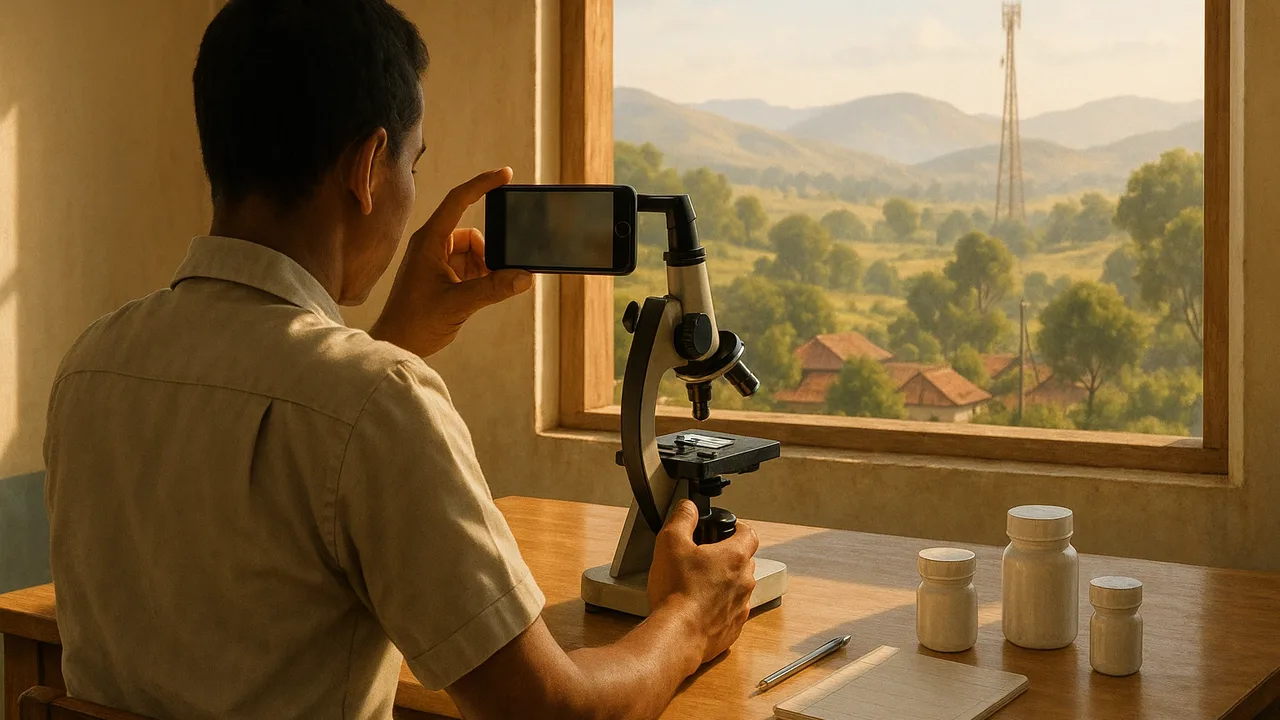
Digital imaging changed that. Health workers fit a camera, or even a phone with an adapter, onto the microscope. They photograph the slide and send the digital file over the internet. A specialist in another city, or another country, opens the exact same image within minutes and replies with advice. Because the files are digital, they can also be stored and compared later, and used to train new workers.
These systems only work when the pictures are sharp and well lit, the files are labeled carefully, and patient privacy is protected. A blurry or mislabeled image wastes everyone’s time.
Think about it: Which TWO lessons from this case study should shape our clinic station, and what test would show each one is working?
Closure ~5 min
You learned from people who solve a bigger version of our problem. Next class: prototype day.
Exit ticket: in two sentences, explain to a clinic parent why a phone photo of a cell stays sharp when it is forwarded to someone else.
How confident are you that you can I can explain why digital signals are more reliable than analog signals.
Teacher notes
Materials: a printed photo and a photocopy of a photocopy (for contrast), a phone or tablet to zoom into an image, the case study.
Setup: the case study describes telemedicine image sharing in general terms; keep it general and do not add specific programs or numbers. The fax-style example is simplified on purpose.
Listen for: “digital pictures are always better” (they are more reliable to store and send, but a bad photo stays bad); “binary means black and white.”
Support / stretch: provide a CER frame: “I claim… My evidence is… This matters because…” Stretch: convert 255 and 128 to binary.