3.08 Analog vs Digital: Pixels, Binary and the Copy of a Copy
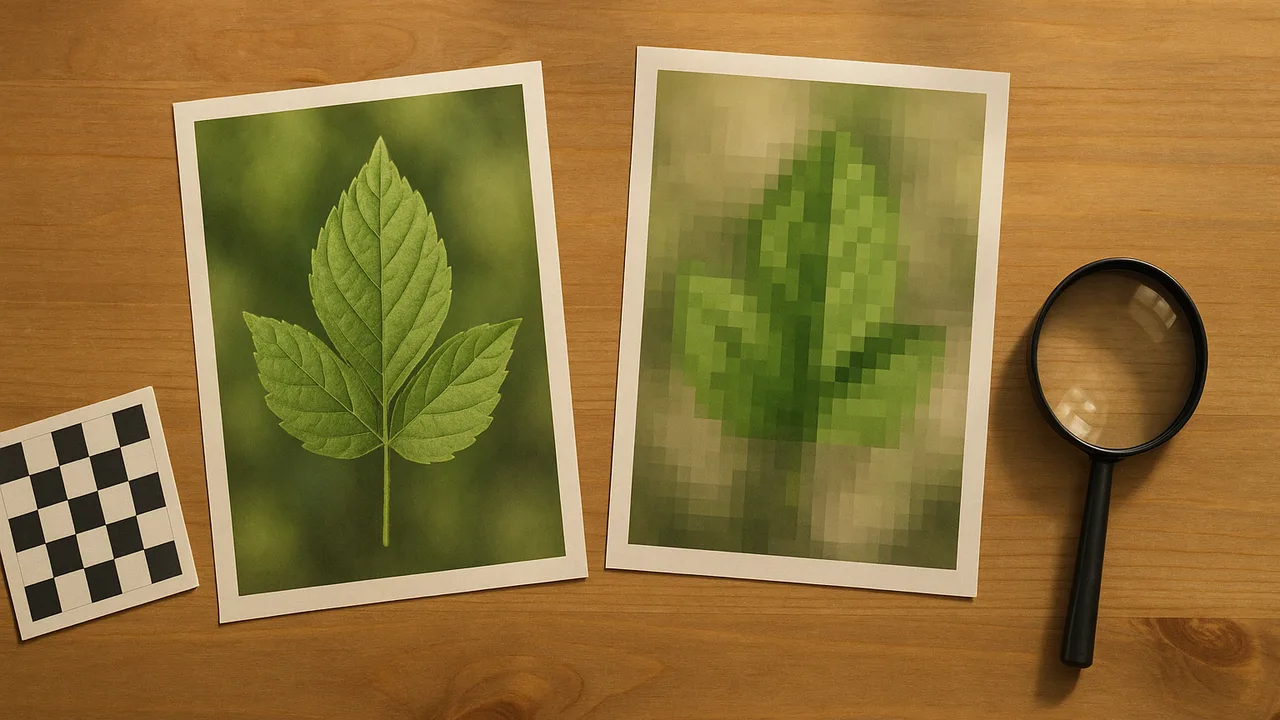
gather evidence from a copying test and a pixel model that digital signals store and send images more reliably than analog signals.
- I can gather evidence from different sources, like texts, graphs, videos, or digital materials, to support the claim that using waves to carry digital signals is more reliable than using waves to carry analog signals.
- I can explain specific features that make digital transmission of signals more reliable than analog transmission, such as how digital information can be recorded reliably, stored for future recovery, and transmitted over long distances without significant degradation.
- I can describe at least one technology that uses digital encoding and transmission, and explain how digitization has helped advance science or scientific investigations.
Phase 2: Investigate
Warm-Up ~5 min
Do Now. Your teacher shows a picture that was photocopied, then the copy was copied, five times in a row. Compare copy 1 and copy 5. Then predict.
A phone photo of a cell is sent from phone to phone five times. What will the fifth copy look like?
Instruction ~10 min
Part A: the wave relay (analog). Teams of four sit in a line. The first person sees a smooth wave line drawn on a card. They copy it freehand onto tracing paper laid on top. The next person traces the copy, and so on. Compare the last drawing with the original.
Part B: the number relay (digital). Now the first person gets a 6 × 6 grid picture of a cell, shaded black and white. They read it row by row as 1s (black) and 0s (white) and whisper the numbers. Each person rebuilds the grid from the numbers, then reads it to the next person.
| Relay | Copy 1 matches the original? (% of parts) | Copy 4 matches? (%) | Errors that crept in | Could you spot and fix an error? |
|---|---|---|---|---|
| Analog wave tracing | ||||
| Digital number grid |
Naming what you saw. An analog signal changes smoothly, like the wavy line. Every copy or long trip adds small, random changes called noise, and the noise builds up. A digital signal stores information as a code of separate values, often just 0s and 1s. This code is called binary. A digital image is a grid of tiny squares called pixels. Each pixel is stored as a number.
Worked example 1: encoding a picture. Mei’s top row was black, white, white, white, white, black. She encoded it as 1 0 0 0 0 1. A phone uses the same idea with millions of pixels. With 8 binary digits per pixel, a pixel can be any of 256 shades of gray (2 multiplied by itself 8 times = 256).
Worked example 2: why digital wins. Sample class data: the traced wave matched 90% on copy 1 but only about 60% by copy 4. The number grid matched 100% on every copy except one, where Jamal heard a 0 as a 1. Because the receiver only has to choose between two values, a little noise does not change the message. Digital copies can be exact, can be stored for years, and can be checked for errors and fixed. That is why scientists save microscope and telescope images as digital files and send them across the world.
Guided Exercises ~15 min
Use your relay results to answer each card.
Independent Practice ~10 min
Encode your own image.
Draw a simple 6 × 6 pixel cell (outline plus a nucleus). Write its binary code row by row. Then write two sentences of evidence, from today's relays, for why digital signals are more reliable than analog ones.
How confident are you that you can I can explain why digital signals store and send information more reliably than analog signals.
Closure ~5 min
We now know the science behind each part of the station: waves, light, lenses, cells and digital images. Next time, we turn that science into the criteria and constraints for our design.
Exit ticket: the clinic wants families to get the same sharp image the class saw. Should the station send images as digital files or print photocopies? Give one piece of evidence from today.
Teacher notes
Materials: a picture photocopied five times in a row (make ahead); smooth wave line cards; tracing paper; 6 × 6 grid cards and blank grids; pencils.
Setup: run Part A for 10 minutes and Part B for 10. Make the grid simple so the relay finishes on time.
Listen for: “digital is always perfect.” Digital files can be damaged, and apps that compress images do lose detail; the point is that exact copies and error checks are possible. Stay away from how phones or cables work inside (outside the MS-PS4-3 boundary). The percentages in worked example 2 are sample data; use your class’s own.
Support / stretch: give a 4 × 4 grid. Stretch: add a “check digit” at the end of each row (1 if the row has an odd number of 1s) and use it to catch a planted error.