3.26 Unit 3 Checkpoint: Light, Lenses and Cells
show what I learned about waves, light, lenses, digital signals, cells and engineering design across the unit.
- I can use my model to explain what happens when light or mechanical waves are reflected, absorbed, or transmitted by different materials.
- I can use my model to explain how different parts of a cell, both alone and together, help the cell get energy and keep its internal processes going.
- I can describe how the cell membrane and cell wall help the cell keep its shape and control what enters and leaves the cell.
- I can show how all the parts of a cell work together as a system to make the cell function.
- I can use a systematic method, like a decision matrix, to find the strengths and weaknesses of each solution.
- I can evaluate each solution using the criteria and constraints we defined.
- I can compare the solutions based on how well they meet the criteria and constraints.
Phase 5: Prove It
Warm-Up ~5 min
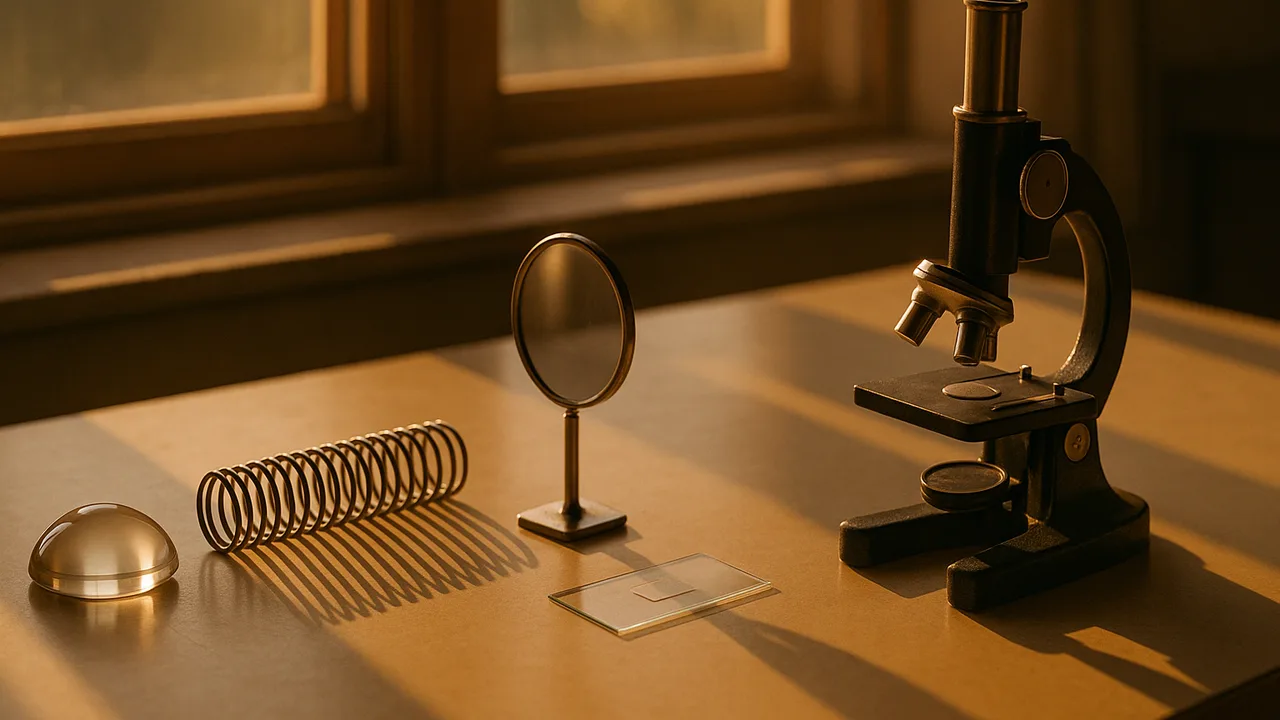
Do Now. Back to our phenomenon: a drop of pond water looks clear, but under a lens it is full of moving living things, and a phone can send that picture across the world in a second. In two sentences, explain both halves.
A lens works because light bends as it passes from air into the lens material and back out.
Instruction ~10 min
How the checkpoint works. Part A (guided) has short questions on waves, light, signals and cells. Part B (independent) has data analysis and constructed responses about the whole project. Work alone. Show math in your notebook. You have about 35 minutes.
Reminder 1: wave math. Wavelength = distance ÷ number of waves. Frequency = waves ÷ seconds. Doubling amplitude makes about 4 times the energy.
Reminder 2: magnification and pixels. Magnification = image size ÷ real size. Total pixels = width × height. Doubling both sides makes 4 times the pixels.
Data for Part B (sample data).
| Specimen | Living? | Cells seen? | Cell wall? | Chloroplasts? |
|---|---|---|---|---|
| Onion skin | Yes | Many | Yes | No |
| Elodea | Yes | Many | Yes | Yes |
| Pond organism A | Yes | One | No | No |
| Yeast | Yes | One each | Yes | No |
| Cotton thread | No | No living cells | — | — |
Guided Exercises ~15 min
Part A. Choose the best answer.
Independent Practice ~10 min
Part B. Use the data table and your project experience. Write in full sentences.
Data analysis: use the table to argue that being made of cells is a feature of living things. Name the purpose of the investigation, the data that supports your claim, and why the cotton thread matters.
Explain why a scientist might need a hand lens, a clip-on lens and a microscope to study the specimens in the table. What could each tool show?
Draw and label a model of an elodea cell. Include the nucleus, chloroplasts, mitochondria, cell membrane and cell wall. Explain how two parts work together to keep the cell alive and supplied with energy.
Draw a model of light traveling from a source through a slide and a lens to a camera. Label where light is transmitted, absorbed, reflected and bent. Then compare how a thick curtain affects light versus sound.
A clinic's photo is 1000 × 800 pixels. How many pixels is that? If the clinic doubles both sides, how many times larger is the pixel count, and what is one benefit and one cost?
Engineering: describe the clinic's problem, who it affects and the system involved. List two criteria and two constraints.
Engineering: compare two of the three station designs using criteria. Use evidence, including how health workers share microscope images, to claim which design is better for the clinic and why.
Closure ~5 min
Checkpoint complete. The next two days are catch-up and stretch, matched to what you need.
Exit ticket: which idea from this unit do you feel strongest about, and which one do you want to practice?
How confident are you that you can I can explain how light, lenses and digital signals let us see and share cells.
Teacher notes
Materials: printed checkpoint for students without devices, rulers, calculators, colored pencils for models.
Coverage map: Part A items 1–3 MS-PS4-1; 4–5 MS-PS4-2; 6 MS-PS4-3; 7–9 MS-LS1-2; 10 MS-LS1-1; 11–12 MS-ETS1-1/2. Part B items 1–2 MS-LS1-1; 3 MS-LS1-2; 4 MS-PS4-2; 5 MS-PS4-3 and pixels; 6 MS-ETS1-1; 7 MS-ETS1-2.
Listen for: “double amplitude, double energy”; “animal cells have walls”; criteria and constraints swapped.
Support / stretch: read aloud on request; allow a vocabulary card for students with IEPs as written. Sort results into the 3.27 and 3.28 stations. Stretch: add “What would change if the clinic’s budget doubled?”