4.09 Food as Fuel and Building Material
gather evidence that living cells break down food to release energy, giving off carbon dioxide, and write the word equation for cellular respiration.
- I can describe in my model how food molecules react with oxygen during cellular respiration to release stored energy.
- I can show in my model that the atoms in food are rearranged through chemical reactions to form new molecules.
- I can develop a model that shows food molecules, oxygen, and energy involved as matter moves through an organism.
- I can identify and show in my model that food molecules are complex and contain carbon, and that new molecules are made during chemical reactions.
- I can use my model to show that energy is released or absorbed when food and oxygen react.
Phase 2: Investigate
Warm-Up ~5 min
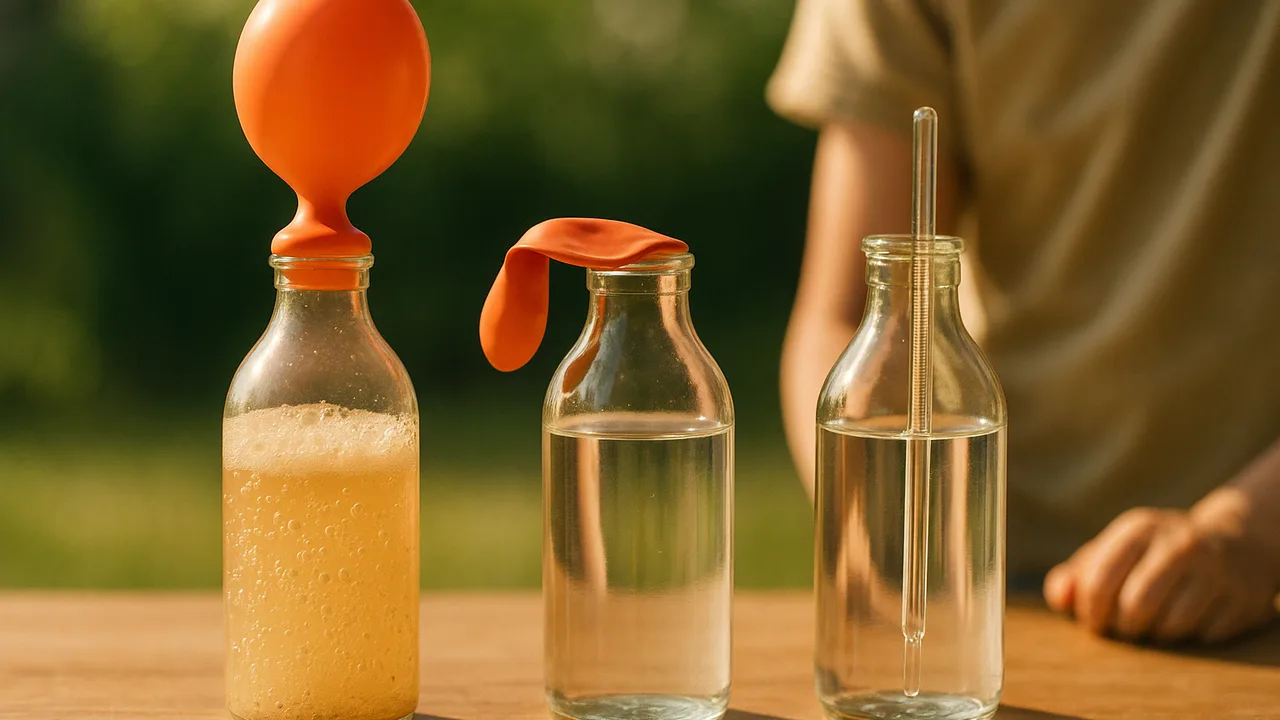
Do Now. Look back at your 4.01 answer about the runner and the banana. Now look at two bottles your teacher set up ten minutes ago. Each has a balloon on top. One balloon is starting to puff up.
Bottle 1 has yeast, sugar and warm water. Bottle 2 has yeast and warm water but no sugar. Which balloon will inflate more?
Instruction ~10 min
Explore first. Each team sets up three bottles with the same amount of warm water: Bottle 1 gets yeast and sugar, Bottle 2 gets yeast only, and Bottle 3 gets sugar only. Stretch a balloon over each neck. Measure each balloon’s distance around with a string every 5 minutes.
| Bottle | Contents | 0 min (cm) | 5 min | 10 min | 15 min | 20 min | Change (cm) |
|---|---|---|---|---|---|---|---|
| 1 | Yeast + sugar + water | ||||||
| 2 | Yeast + water | ||||||
| 3 | Sugar + water |
Worked example 1: what each bottle rules out. These are sample data. Bottle 3 (no yeast) did not change, so sugar alone makes no gas. Bottle 2 (no sugar) grew only a little. Bottle 1 grew from 0 to 24 cm around. Priya concluded: “Living cells AND food are both needed to make lots of gas.”
Naming the idea. Inside cells, food molecules such as sugar react with oxygen. The atoms are rearranged into carbon dioxide and water, and stored energy is released for the cell to use. This is cellular respiration, and it happens in your cells, yeast cells and plant cells. As a word equation:
sugar + oxygen → carbon dioxide + water + energy
Compare it with photosynthesis: carbon dioxide + water + light energy → sugar + oxygen. Respiration runs the same matter in the other direction and releases the energy that photosynthesis stored. The cell part where much of this happens is the mitochondrion, which you met in Unit 3.
Worked example 2: fuel or building material? A food label lists Calories, which measure the energy food can provide. It also lists protein, which the body mostly uses to build and repair cells. Diego read a bean label: the sugars and starches are mostly fuel, and the protein is mostly building material. Both jobs depend on atoms from food being rearranged into new molecules.
Back to the runner. The banana’s sugar travels to the runner’s muscle cells. Respiration releases its energy so the muscles keep working, and the carbon dioxide is breathed out faster. That is why breathing and pulse rose in 4.07.
Guided Exercises ~15 min
Use your balloon data and the word equation.
Independent Practice ~10 min
Model one cell at work.
Draw a muscle cell as a box. Show sugar and oxygen arriving, and carbon dioxide, water and energy leaving. Label which arrows are matter and which is energy. Then add one arrow for protein used as building material.
How confident are you that you can I can write and explain the word equation for cellular respiration.
Closure ~5 min
That ends our investigations. We have tube colors, plant masses, flower parts, pulse data and balloons. In the Make Sense phase we build models and arguments that tie them all together.
Exit ticket: explain in two sentences how the runner's banana is both fuel and building material. Use the word equation.
Teacher notes
Materials (per team): three small plastic bottles (500 mL), three balloons (stretch them first), a packet of dry baker’s yeast, sugar, a measuring spoon, warm water (about 40°C, comfortable to the touch), string and rulers, goggles. Optional: a few food labels.
Setup: start one demo pair ten minutes before class. Use 1 packet of yeast and 2 teaspoons of sugar in about 100 mL of warm water per bottle.
Accuracy note: in a sealed bottle, yeast soon run low on oxygen and switch to a process without oxygen (fermentation), which also gives off carbon dioxide. That is fine for showing that cells break down food and release gas; keep the word equation for respiration with oxygen, and tell curious students that cells have a backup process.
Listen for: “energy turns into matter” or “food is burned up and disappears.” Atoms are rearranged and leave as carbon dioxide and water. No biochemical steps (assessment boundary).
Support / stretch: give a word-equation card with blanks. Stretch: test warm versus cold water and explain the difference.