4.12 Cells to Systems: The Body as a Team
build a model of the body’s levels of organization and argue, using exercise and meal-tracing evidence, that body systems interact to keep us alive.
- I can use reasoning to connect my evidence to my claim by explaining how cells form tissues, tissues form organs, organs form organ systems, and these systems interact to keep the body alive.
- I can use oral or written arguments to support or challenge an explanation or model about how the body is a system of interacting subsystems.
Phase 3: Make Sense
Warm-Up ~5 min
Do Now. A sports team has players, positions, the team and the league. Match each to a body level: cell, tissue, organ, organ system.
If the respiratory system stopped working, which other system would fail first in its job?
Instruction ~10 min
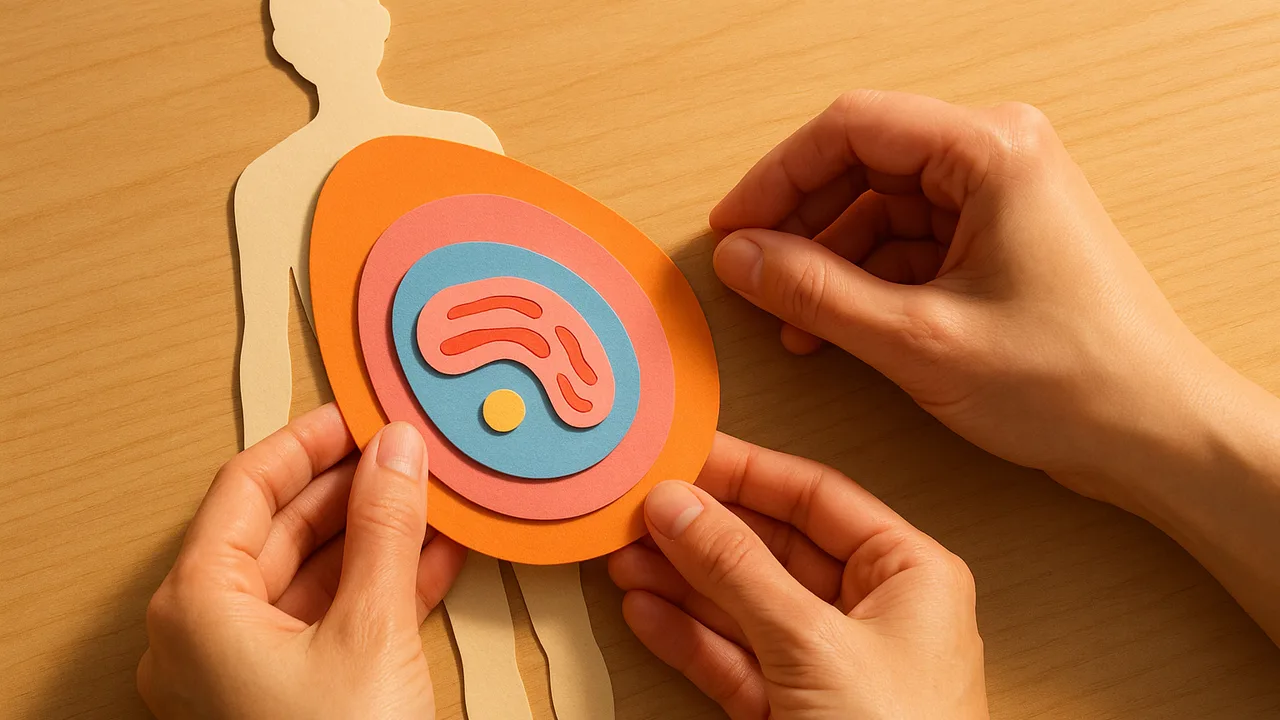
The model. Each team builds a nested model for the exhibit: five paper rings, from smallest to largest, labeled cell, tissue, organ, organ system and organism. Choose one example for each ring, such as a muscle cell, muscle tissue, a leg muscle, the muscular system and you. Then draw arrows between your organism ring and other systems to show interactions.
| Interaction | System A | System B | What passes between them | Our evidence (lesson and data) |
|---|---|---|---|---|
| Oxygen to muscles | ||||
| Sugar to muscles | ||||
| Carbon dioxide out | ||||
| Signals to speed up |
Worked example 1: reasoning across levels. Priya wrote: “Muscle cells form muscle tissue, which forms leg muscles, part of the muscular system. During exercise those cells need more oxygen and sugar. The respiratory and circulatory systems speed up to deliver them, and the nervous system signals the change. My pulse rose 1.6 times and my breathing 1.75 times (sample data).” Her reasoning moves from cells up to systems.
Worked example 2: challenging a model. Diego’s team drew the digestive system with no arrow to any other system. Ava challenged it: “Your model shows food digested but not delivered. Our meal-trace evidence shows the circulatory system carries sugar to the cells.” Diego’s team added the arrow. A good challenge uses evidence and suggests a fix.
Judging evidence. Our pulse counts are direct measurements, repeated three times: strong. A fitness watch gives a second source: helpful if it agrees. An advertisement claiming a drink “supercharges your lungs” gives no data: weak. Always ask where evidence comes from and whether another explanation fits.
Guided Exercises ~15 min
Use your nested model and your interaction table.
Independent Practice ~10 min
Write the exhibit’s body-systems argument.
Write a CER: How do body systems work together when a student runs? Claim: the body is a system of interacting subsystems. Evidence: use data from 4.07 and the meal trace from 4.08. Reasoning: connect cells to tissues, organs and systems.
How confident are you that you can I can argue with evidence that the body is a system of interacting subsystems.
Closure ~5 min
The body works as a team built level by level from cells. Next time we return to our seedlings and flowers and argue about chance: why do some plants grow and reproduce better than others?
Exit ticket: pick two systems and describe one way they interact. Name the evidence that supports your answer.
Teacher notes
Materials: paper rings or nested circles cut from five colors, markers, string or yarn for interaction arrows, student data from 4.07 and 4.08.
Setup: 15 minutes to build, 10 minutes for a gallery walk with written critiques, then the CER.
Listen for: skipped levels (“cells form organs”) and critiques with no evidence. Keep claims at the system level; no mechanisms inside a single system.
Support / stretch: give a filled-in ring set for one system. Stretch: model a second situation, such as eating a big lunch, and compare which systems change most.