3.05 A Drop of Water Becomes a Lens
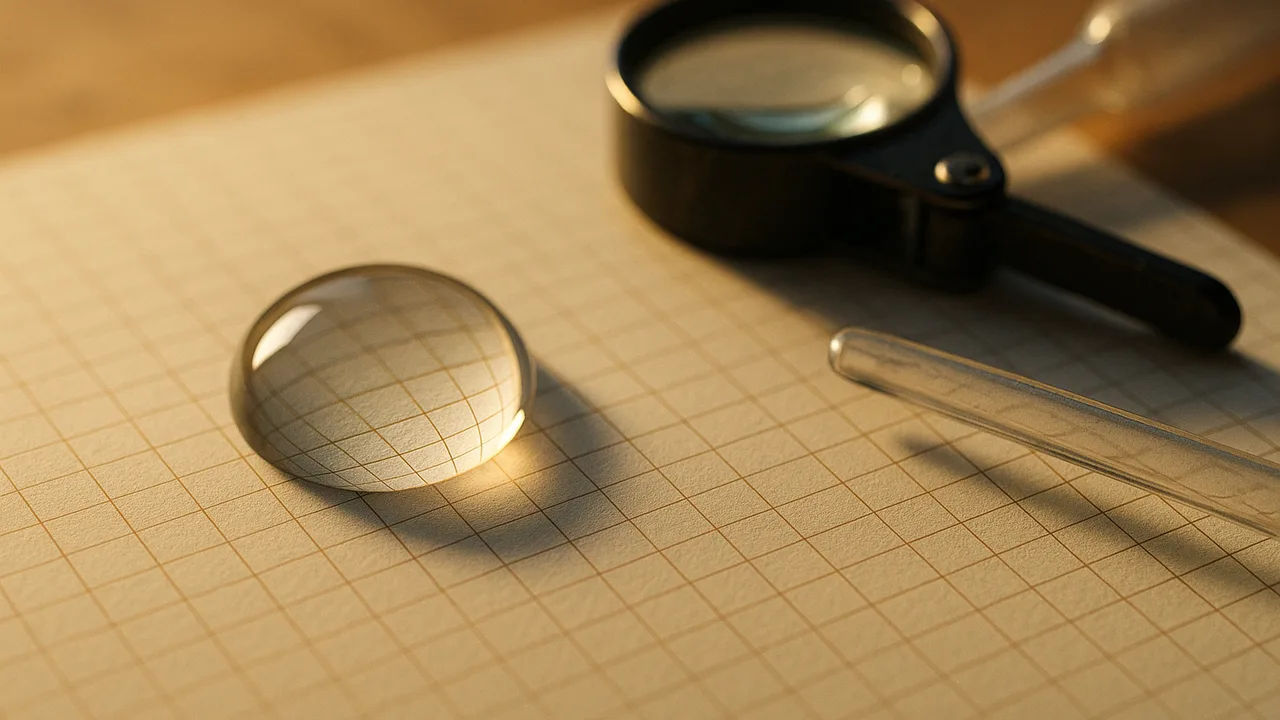
investigate how curved, clear materials bend light to magnify, and explain why cells need magnification to be seen.
- I can use my model to describe how waves can be reflected, absorbed, or transmitted when they hit different materials.
- I can explain that light travels in straight lines but bends when it passes from one material to another.
- I can describe that light can travel through empty space, but mechanical waves need a material to move through.
- I can use my model to explain why certain materials are chosen for specific uses, like mirrors, lenses, sound barriers, or light filters.
- I can describe how the tools and methods I use will help me find evidence about cells, including that cells are too small to see without magnification devices.
Phase 2: Investigate
Warm-Up ~5 min
Do Now. Look at a pencil standing in a clear glass of water, from the side. Sketch what you see. Then predict.
You put one drop of water on a sheet of clear plastic over a page of tiny print. What happens to the letters under the drop?
Instruction ~10 min
The investigation. Lay a clear plastic sheet over a ruler and a page of tiny print. Use a dropper to make a small drop, a medium drop and a large drop. Look straight down through each from the same height. Estimate how many times larger the ruler’s millimeter marks look. Then compare a hand lens and a flat piece of clear plastic.
| Lens | Shape (flat, gently curved, very curved) | 1 mm looks like ___ mm | Magnification (×) | Sharp or blurry? |
|---|---|---|---|---|
| Flat plastic | ||||
| Large water drop | ||||
| Medium water drop | ||||
| Small water drop | ||||
| Hand lens |
Naming what you saw. Light travels in straight lines. When it passes at a slant from one material into another, such as from water into air, it bends. This bending is called refraction. A convex lens is thicker in the middle. It bends light rays toward each other, and that makes objects look larger. A more strongly curved lens bends light more and usually magnifies more.
Worked example 1: computing magnification. Through a hand lens, Mei saw that 1 mm on the ruler looked as wide as 5 mm. Magnification = 5 ÷ 1 = 5×. Through a small water drop, 1 mm looked like 8 mm, so the drop gave about 8×. The more curved drop magnified more, but its edges were blurry.
Worked example 2: why we need lenses for cells. Our unaided eyes struggle to see things much smaller than about a tenth of a millimeter. Most cells are smaller than that. A cell that is 0.05 mm wide, seen at 8×, looks 0.4 mm wide: barely a speck. A school microscope stacks two lenses. A 10× eyepiece with a 40× objective gives 10 × 40 = 400×. Now that cell looks 20 mm wide, easy to see. Different tools fit different scales.
Choosing materials for a job. Lenses must be transparent and smoothly curved. That is why they are made of clear glass or plastic, not frosted plastic or metal.
Guided Exercises ~15 min
Use your table and the worked examples for each card.
Independent Practice ~10 min
Think about scale.
A pond creature is 0.2 mm long. How large would it look through the hand lens (5×) and through a microscope at 100×? Which tool would you choose to show its parts on the clinic's screen, and why?
How confident are you that you can I can explain how a lens bends light to magnify and why cells need magnification.
Closure ~5 min
One curved lens magnifies a little. Two lenses together magnify a lot. Next time, you use a real microscope to look for cells.
Exit ticket: explain how a water drop magnifies print. Use the words light, bend and curved.
Teacher notes
Materials (per team): clear plastic sheets (overhead transparency or a cut-up clear container), dropper, cup of water, metric ruler, page of small print, hand lens, clear glass of water and a pencil; paper towels.
Setup: students hold the ruler under the sheet and compare marks seen through the drop with marks seen beside it. Magnification estimates will vary; accept reasonable ranges.
Listen for: “the lens makes the object bigger.” The object does not change; the lens changes the path of light. The tenth-of-a-millimeter limit of unaided vision is a rough, commonly cited figure; present it as “about.”
Support / stretch: give a magnification frame: looks-like size ÷ real size. Stretch: sketch how light travels from a sample, through a clip-on lens and into a phone camera.