4.08 Tracing a Meal: From Plate to Cell
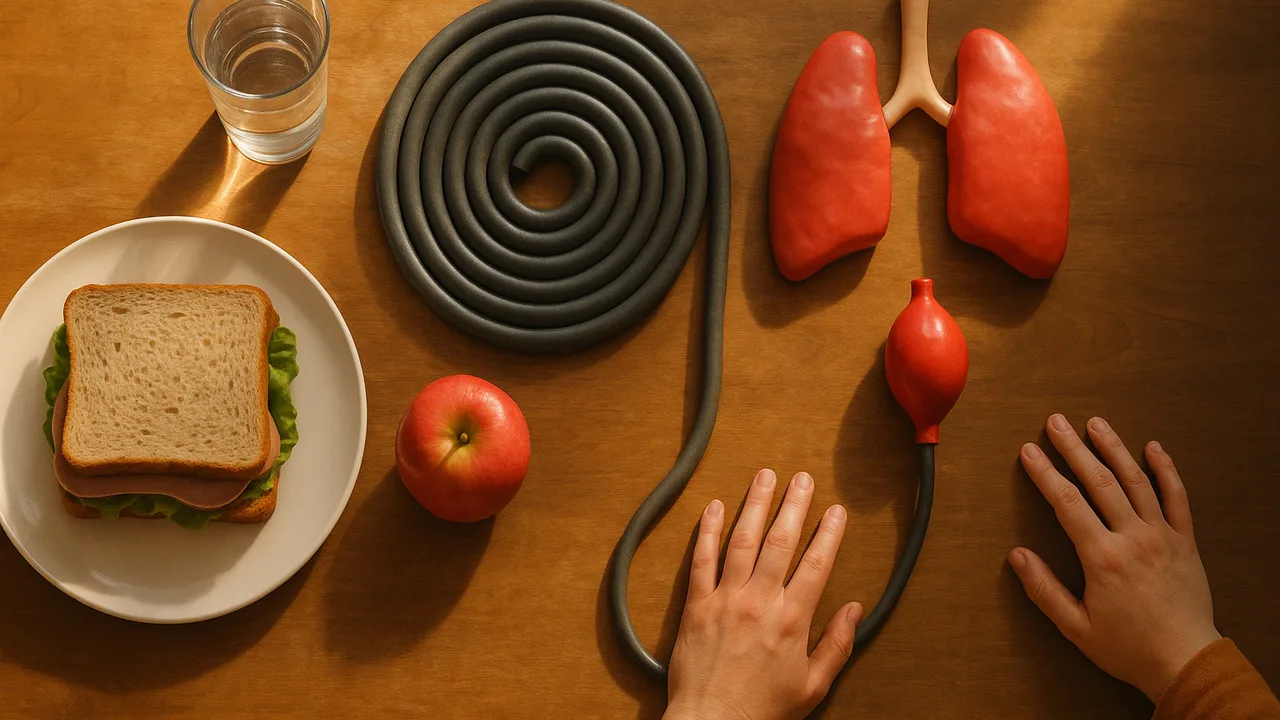
trace the matter in a meal through the digestive, circulatory and respiratory systems to the body’s cells and model what enters and leaves each system.
- I can describe evidence that specialized groups of cells work together to form tissues, and that different tissues make up organs with specific functions.
- I can explain how organs work together as subsystems to form organ systems that carry out complex functions in the body.
- I can use evidence to show how organ systems interact with each other to help the body survive and grow.
- I can develop a model that shows food molecules, oxygen, and energy involved as matter moves through an organism.
- I can identify and show in my model that food molecules are complex and contain carbon, and that new molecules are made during chemical reactions.
- I can use my model to show that energy is released or absorbed when food and oxygen react.
Phase 2: Investigate
Warm-Up ~5 min
Do Now. Today’s lunch is a wrap with grow-lab lettuce, beans and a whole-wheat tortilla. List every place in your body you think the wrap travels after you take a bite.
How does the sugar from the tortilla reach a muscle cell in your leg?
Instruction ~10 min
Explore first: the body map walk. Six stations are posted around the room, each a body system. Your team carries a bag of “meal cards”: sugar, protein pieces, fiber, water and oxygen. At each station, read the system card and decide which meal cards enter, which leave, and where they go next. Record your moves.
| Station | Body system | What enters | What leaves | Where it goes next |
|---|---|---|---|---|
| Mouth, stomach, intestines | ||||
| Lungs | ||||
| Heart and blood vessels | ||||
| Leg muscle cell | ||||
| Kidneys | ||||
| Brain and nerves |
Naming the path. The digestive system breaks the wrap into small molecules, such as sugars and the building blocks of protein. Fiber mostly passes through and leaves as waste. The small molecules enter the blood. The respiratory system adds oxygen to the blood in the lungs. The circulatory system carries sugar, building blocks and oxygen to every cell. Carbon dioxide made in the cells rides the blood back to the lungs and is breathed out. The excretory system filters other wastes from the blood. The nervous system signals hunger and fullness and coordinates everything.
Worked example 1: one sugar molecule’s trip. Mei followed one sugar card: tortilla → digestive system → blood → heart → blood vessels in the leg → muscle cell. In the cell, the sugar meets oxygen that came from the lungs by the same blood. Three systems were needed to bring them together.
Worked example 2: a protein piece’s trip. Jamal followed a bean protein card. It was broken into building blocks in the digestive system, carried by the blood, and used by a skin cell to build new cell parts. That is food as building material, not fuel. The same meal can do both jobs.
Guided Exercises ~15 min
Use your station table as evidence. Each card checks one link in the chain.
Independent Practice ~10 min
Draw the path for our exhibit.
On a body outline, draw the path of one sugar molecule from a grow-lab lettuce leaf to a leg muscle cell. Then draw the path of one oxygen molecule from the air to the same cell. Label each system.
How confident are you that you can I can trace food and oxygen through body systems to the cells.
Closure ~5 min
Food and oxygen both end up in the cells, delivered by systems working together. So what does a cell actually DO with them? Next time we test food as fuel.
Exit ticket: name three systems a bite of lettuce depends on to reach your cells, and give one job each system does on the way.
Teacher notes
Materials: six station posters with a simple system card each, a bag of paper meal cards per team (sugar, protein pieces, fiber, water, oxygen, carbon dioxide), a body outline per student.
Setup: place stations in a loop so teams walk the body’s path. Allow about 4 minutes per station, then debrief the table together.
Listen for: “food goes straight to the muscles,” “the lungs send air to the stomach” and “we breathe out oxygen.” Keep explanations at the system level; the assessment boundary excludes mechanisms inside a system (for example, how the kidneys filter). Be sensitive to food allergies and family food choices; the wrap is only a model.
Support / stretch: give a filled-in example row. Stretch: add a seventh station for the skin or bones and decide which meal cards it needs.