3.25 Clinic Open House: Presenting the Microscope Station
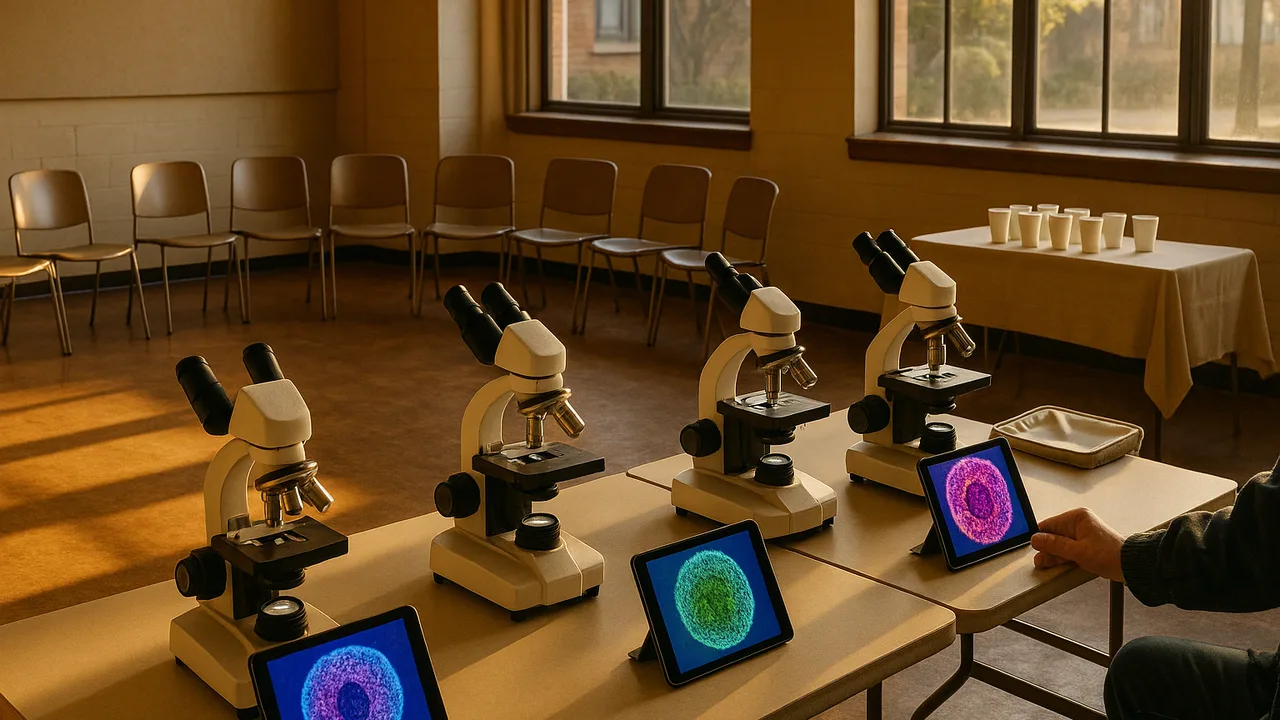
present our microscope station, cell gallery and test data to the clinic and defend our design with science and evidence.
- I can use evidence and reasoning to make a claim about which solution works best, based on their strengths and weaknesses.
- I can analyze my data to decide if the evidence shows that cellular composition is a feature that distinguishes living things.
- I can explain specific features that make digital transmission of signals more reliable than analog transmission, such as how digital information can be recorded reliably, stored for future recovery, and transmitted over long distances without significant degradation.
- I can describe at least one technology that uses digital encoding and transmission, and explain how digitization has helped advance science or scientific investigations.
Phase 5: Prove It
Warm-Up ~5 min
Do Now. A parent at the open house has never used a microscope. In one sentence, what is the first thing you want them to understand?
Which opening grabs a family audience best?
Instruction ~10 min
Open house format. Each team gets a table. Clinic staff and family visitors rotate. Every team gives a 4-minute talk, then lets one visitor try the station and send a picture.
The five-part talk. (1) The problem and the client. (2) The three designs and the decision matrix. (3) How the station works: light, lens and pixels. (4) The cell gallery: what it proves about living things. (5) Test results and an honest recommendation.
Worked example 1: explaining the science in plain words. Priya says: “Light from this flashlight passes through the thin onion skin. The dark nucleus absorbs some light, so it shows up. The microscope’s lenses bend the light so the image is 100 times larger, and the phone shows it on this screen. The phone saves it as numbers, so when we send it to you, nothing gets lost.”
Worked example 2: an honest recommendation. Diego says: “We recommend the microscope-and-adapter station. It met every criterion. Setup took 11 minutes the first time, so we added a picture card of the steps. A clip-on lens is cheaper, but ours did not reach 100×. Even this station cannot show mitochondria clearly; that needs a far stronger microscope.”
Guided Exercises ~15 min
Rehearse with another team before visitors arrive. Use these blocks to check your talk.
Independent Practice ~10 min
After the open house, reflect.
What did a visitor ask or suggest? Name one idea from another team that you would borrow, and explain why.
Write a one-paragraph recommendation to the clinic: which design should they build, and why? Use evidence from at least two teams.
Project task: A Digital Microscope Station for the Clinic
Design, build, test and present a low-cost digital microscope station for a community health clinic. It must magnify at least 100× so the nucleus and cell wall are clear, let at least 8 people see a nucleus from 2 m away, and save and send images to families as digital files. It must cost less than the $150 sample budget, set up in under 10 minutes, and show slides, never faces. Defend your design with a decision matrix, a light-and-lens model, a labeled cell gallery and test data.
Submission workflow
- Define the problem: the client, the system, the criteria and the constraints.
- Compare three competing designs (clip-on lens, water-drop lens, microscope with phone adapter) in a weighted decision matrix and choose one.
- Build version 1, measure magnification and clarity, and choose an image size that balances detail and file size.
- Build the labeled cell gallery, take peer critique and build version 2.
- Run the image-quality test against every criterion and present to the clinic with an honest recommendation.
How it is scored
| Criterion | What proficient looks like |
|---|---|
| Defining and evaluating designs | Criteria and constraints are measurable; three designs are scored in a weighted decision matrix; the claim names strengths, weaknesses and ideas borrowed from how others share microscope images. |
| Light, lenses and signals | A model shows light being transmitted, absorbed, reflected and bent by the lens; magnification is calculated correctly; the team explains why digital images store and send detail reliably and justifies its pixel setting. |
| Cells as evidence | The gallery shows several living specimens and one nonliving comparison; nucleus, cell wall, cell membrane and chloroplasts are labeled where visible; captions explain what each part does and that living things are made of one or many cells. |
| Testing and communication | Test results are compared with every criterion with evidence; one limitation is named; every member speaks; the recommendation to the clinic is clear and honest. |
Closure ~5 min
You solved a real problem for real people, design engineers. Next: the unit checkpoint, then two catch-up and stretch days.
Exit ticket: which question from our Wonder Board can you now answer? Write the question and your answer.
How confident are you that you can I can defend a design to a client with data and science.
Teacher notes
Materials: final stations, printed or on-screen galleries, matrices and test tables, rubric copies for visitors, a timer, fresh pond water and onion slides.
Setup: invite clinic or school health staff and families; a video call works if a partner cannot attend. Visitors can score the “Testing and communication” row. Score the other rows during talks.
Listen for: talks that skip the data; “the lens makes the cell bigger”; one student doing all the talking.
Support / stretch: give a five-box presentation frame and allow note cards. Stretch: ask teams to estimate what the clinic would need to see bacteria, and why a stronger lens is required.