4.05 Where Does a Plant’s Mass Come From?
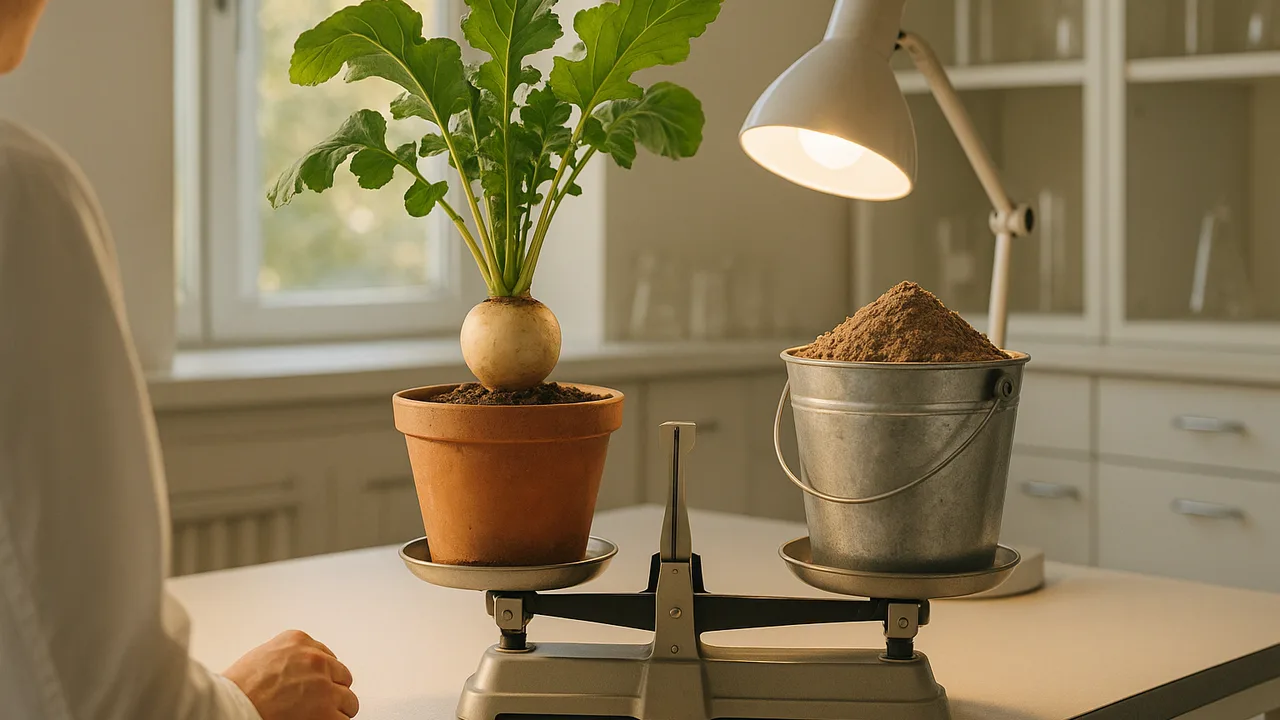
compare the mass a plant gains with the mass of the soil and water added, and argue that most of a plant’s matter comes from water and carbon dioxide.
- I can use evidence and reasoning to build a scientific explanation for how photosynthesis affects the cycling of matter and energy.
- I can use my model to explain that the number of each type of atom stays the same before and after chemical reactions, showing that matter is conserved as it moves through an organism.
- I can describe how all the matter an organism uses for growth comes from the products of chemical reactions involving the food it takes in.
- I can explain that food molecules are broken down and rearranged to become the molecules that make up the organism, and that energy is released to support other processes.
Phase 2: Investigate
Warm-Up ~5 min
Do Now. Look back at your prediction from 4.01: where does most of a plant’s mass come from? Today we weigh things and find out.
A radish cup started with 200 g of dry soil. After four weeks of growth, how much dry soil will be left once the plant is removed?
Instruction ~10 min
Explore first. Four weeks ago each team planted radish seeds in a cup of weighed, oven-dried soil. The Recorder logged every milliliter of water added. Today the Tester gently removes the plants, rinses the roots and weighs the plants. The soil is dried and weighed again.
| Measurement | Our team (g or mL) | Sample data |
|---|---|---|
| Dry soil at start | 200.0 g | |
| Seeds at start | 0.2 g | |
| Total water added over 4 weeks | 450 mL (450 g) | |
| Fresh plants at end | 24.0 g | |
| Dried plants at end | 2.0 g | |
| Dry soil at end | 199.8 g |
Worked example 1: following the numbers. These are sample data. The soil lost only 0.2 g. The fresh plants gained about 24 g. Mei divided: 24 ÷ 0.2 = 120. The plants gained about 120 times more mass than the soil lost. Soil supplies a few minerals, but it is not the main source.
Worked example 2: fresh mass versus dry mass. Jamal dried the plants in a warm oven. Their mass fell from 24 g to 2 g. That means most of a fresh plant’s mass is water. The 2 g left is the plant’s solid matter: sugar, fiber and other molecules. It is far more than the 0.2 g the soil lost. Where did it come from?
A famous earlier test. In the 1600s, a scientist named Jan Baptist van Helmont grew a willow tree in a pot of weighed soil for five years, adding only water. The tree gained a large amount of mass, but the soil lost very little. He concluded the mass came from water. He was partly right. He did not know about carbon dioxide yet.
Naming the idea. Your BTB tubes showed that plants take in carbon dioxide in the light. In photosynthesis, the atoms in carbon dioxide and water are rearranged into sugar. The plant then uses sugar to build the other molecules of its body. So most of a plant’s solid matter is built from carbon dioxide from the air plus water. No atoms appear from nowhere, and none disappear: they are rearranged.
Guided Exercises ~15 min
Use your table. Show the math on each card where it asks.
Independent Practice ~10 min
Use your own team’s data.
Compare your team's numbers with the sample data. Write two sentences that use your numbers to argue where the plant's mass came from.
How confident are you that you can I can use mass data to explain that a plant's matter comes mostly from carbon dioxide and water.
Closure ~5 min
A plant is built mostly from air and water, powered by light. That will be one of the most surprising panels in our exhibit. Next time we look at how plants make more plants: flowers, pollinators and seeds.
Exit ticket: a classmate says, “Plants eat soil to grow.” Use one number from today to respond.
Teacher notes
Materials (per team): a clear cup of oven-dried potting mix (weighed), radish seeds, a graduated cylinder, a water log sheet, a balance reading to 0.1 g, paper towels. Teacher: an oven or a sunny warm windowsill for drying, foil trays.
Setup: plant 3–4 weeks ahead under the grow light. Dry the soil and plants after class, or a day ahead using a spare cup. Class results vary and small balances are noisy; the sample data in the lesson are made up for teaching, so label them as sample data.
Listen for: “the plant made new matter” (atoms are rearranged, not created) and “light turns into the plant.” Light energy is stored in sugar but adds no mass. Mention the van Helmont study only in general terms; avoid quoting precise figures from it.
Support / stretch: give a subtraction frame for each row. Stretch: estimate what fraction of the fresh mass was water.