3.10 Modeling Waves Meeting Materials
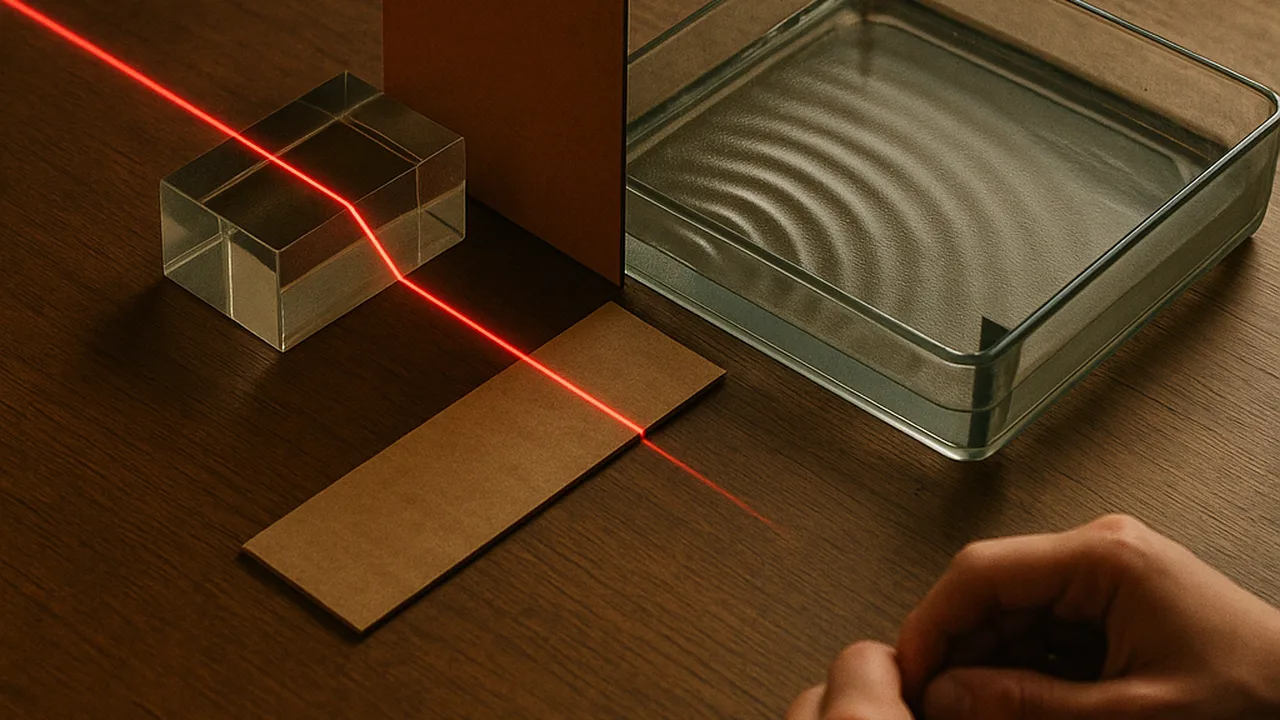
build a model that shows how light and sound waves are reflected, absorbed, transmitted or bent by materials, and use it to explain material choices for the station.
- I can use my model to explain what happens when light or mechanical waves are reflected, absorbed, or transmitted by different materials.
- I can use my model to compare how light waves and mechanical waves interact differently with materials.
- I can use my model to explain why certain materials are chosen for specific uses, like mirrors, lenses, sound barriers, or light filters.
Phase 3: Make Sense
Warm-Up ~5 min
Do Now. Look back at your arrow drawings from 3.04 and your lens table from 3.05. Then predict.
A wave hits a material and comes out the other side with a smaller amplitude. What happened to some of its energy?
Instruction ~10 min
A model of waves meeting materials. Your model is a labeled diagram with arrows. Draw the source on the left. Draw the wave as a wavy arrow, with its amplitude shown by height and its frequency by how close the crests are. When the wave meets a material, split the arrow to show what is reflected, absorbed and transmitted. Use the arrow’s height for amplitude.
Light compared with sound. Light can travel through empty space. Sound is a mechanical wave and needs a material such as air, water or a solid. Light passes easily through glass and clear water. Sound passes well through solids and water, but soft, porous materials like foam absorb a lot of it. In both cases the frequency stays the same when a wave passes into a new material; the amplitude usually drops.
Worked example 1: the microscope’s light path. Ava’s model: a lamp sends light up. The glass slide transmits most of it. The thin onion layer absorbs a little, more where the stain is dark, so the nucleus looks darker. The lens transmits the light and bends it, so the image is magnified. A dark shield around the camera absorbs stray room light that would wash out the screen.
Worked example 2: choosing materials for a job. Diego made a table. Mirror: reflects light, so it can aim lamp light up through a slide. Clear glass lens: transmits and bends light, so it magnifies. Black card: absorbs stray light. Foam pad under the station: absorbs vibrations, so the image does not shake when someone bumps the table. Colored filter: transmits one color, which can make some cell parts stand out.
| Station part | Material | Wave (light or mechanical) | Reflects, absorbs, transmits or bends? | Why it helps the station |
|---|---|---|---|---|
| Slide | ||||
| Lens | ||||
| Light shield | ||||
| Under-table pad |
Guided Exercises ~15 min
Test your model against each card.
Independent Practice ~10 min
Complete your model.
Draw a full model of light traveling from the lamp to the camera through slide, sample and lens. Then draw a second model of a vibration traveling from a bumped table to the camera, with and without a foam pad. Label reflect, absorb, transmit and bend.
How confident are you that you can I can use a model to explain how waves interact with materials and why materials are chosen for a job.
Closure ~5 min
Our light model explains how we see the sample. Next time, we model what we are seeing: the cell itself.
Exit ticket: choose two station parts. For each, name the material, the wave it affects and whether it reflects, absorbs, transmits or bends the wave.
Teacher notes
Materials: student data from 3.04 and 3.05, chart paper, colored pencils, a mirror, a black card, a foam pad and a lens to hold up as anchors.
Setup: model a quick example with the whole class, then teams build their own. Gallery walk for the last 8 minutes.
Listen for: “the energy disappeared.” Redirect to reflected and absorbed energy. Keep the frequency-stays-the-same idea simple; do not introduce wave speed formulas or electromagnetic theory (MS-PS4-2 boundary).
Support / stretch: give an arrow model template. Stretch: model why a pond looks shiny from a low angle but you can see into it from straight above.