3.07 One Cell or Many? Plant and Animal Cells
compare one-celled and many-celled organisms and plant and animal cells, and use the data to decide whether cells set living things apart from nonliving things.
- I can describe the data I will collect to show if living and nonliving things have cells.
- I can describe how I will look for parts of living things that are not made of cells.
- I can compare the presence and types of cells in different organisms, including those made of one cell or many cells.
- I can analyze my data to decide if the evidence shows that cellular composition is a feature that distinguishes living things.
- I can use my model to compare plant and animal cells by showing that plant cells have both a cell wall and a cell membrane, while animal cells only have a cell membrane.
- I can use my model to explain that plant cells have chloroplasts for photosynthesis, but animal cells do not.
Phase 2: Investigate
Warm-Up ~5 min
Do Now. Sort these into living, once living and never living: a yeast packet, a cork, a grain of sand, a feather, a cotton thread, a pond creature. Then predict.
Which samples will show cells under the microscope?
Instruction ~10 min
Station rotation. Look at each sample at low, then high power. Record what you see. Your teacher has prepared slides of a one-celled organism, a plant leaf section and an animal tissue section.
| Sample | Living, once living or never living? | Cells? (yes / no) | One cell or many? | Cell wall seen? | Chloroplasts seen? | Nucleus seen? |
|---|---|---|---|---|---|---|
| Yeast in sugar water | ||||||
| Prepared one-celled organism slide | ||||||
| Prepared plant leaf slide | ||||||
| Prepared animal tissue slide | ||||||
| Thin cork slice | ||||||
| Grains of sand |
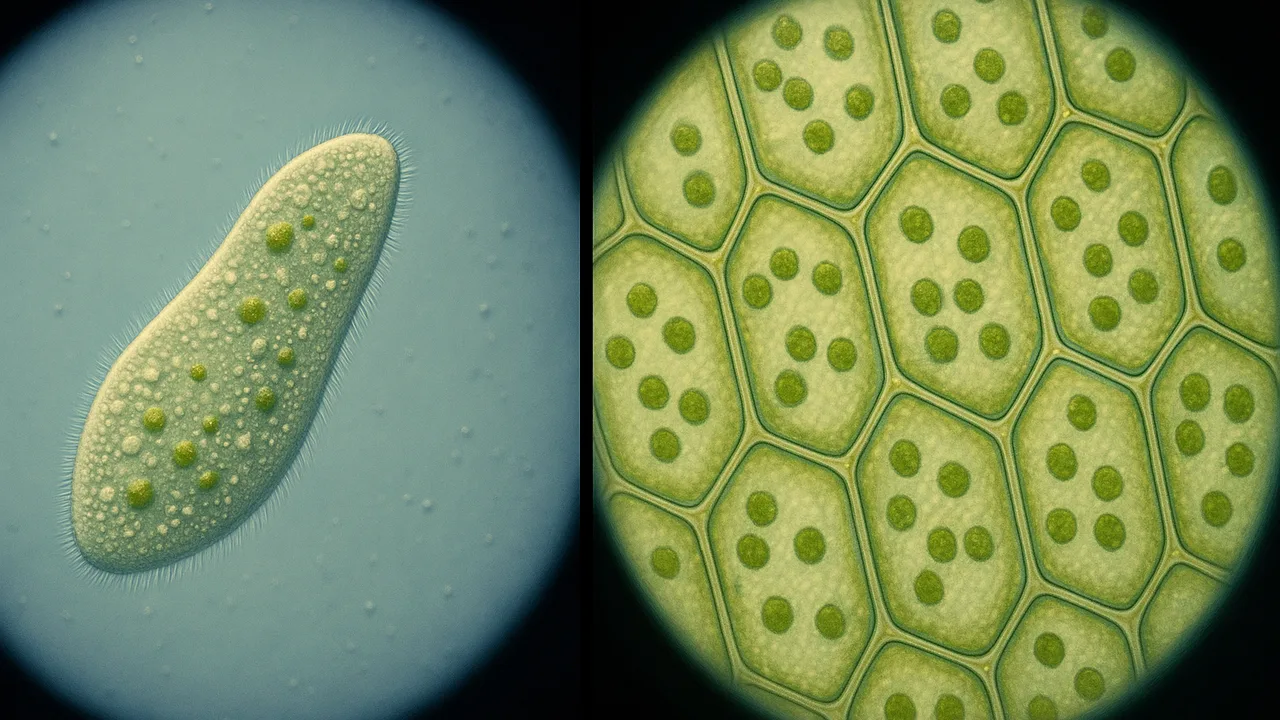
Naming what you saw. A unicellular organism is one cell that does everything needed to live: it takes in food, gets rid of waste, grows and reproduces. Yeast and many pond creatures are unicellular. A multicellular organism, like an onion, elodea or a frog, is made of many cells working together. Plant cells have a stiff cell wall outside a thin cell membrane, and many have green chloroplasts. Animal cells have a cell membrane but no cell wall and no chloroplasts. Both have a nucleus.
Worked example 1: one or many? In pond water, Diego saw a slipper-shaped creature swimming on its own. Its whole body was inside one membrane. He recorded “one cell, living, unicellular.” On the elodea slide, cells were joined in a sheet, so elodea is multicellular.
Worked example 2: a data pattern. Priya’s team tallied their table. Every sample that is alive or came from something alive showed cells. Sand showed none. Their evidence supports the claim that cells are a feature of living things. The evidence is strong because it compares living and nonliving samples, not just living ones.
Guided Exercises ~15 min
Use the class data table for every card.
Independent Practice ~10 min
Make a comparison chart.
Draw a plant cell and an animal cell side by side from your slides. Label the parts you saw. Then decide: does your class data show that having cells is a feature that sets living things apart? Explain.
How confident are you that you can I can compare one-celled and many-celled organisms and plant and animal cells.
Closure ~5 min
Our station’s screen will show images like these. Next time, we ask how a picture becomes numbers and travels to a family’s phone.
Exit ticket: a student says, “Only big living things are made of cells.” Use two samples from today's data to answer them.
Teacher notes
Materials: compound microscopes; yeast in warm sugar water (started 15 minutes ahead); prepared slides of a one-celled organism (such as paramecium or amoeba), a plant leaf section and an animal tissue section (such as a commercial frog or other animal tissue slide); thin cork slices; sand; slides and cover slips.
Setup: six stations, about 5 minutes each. Use prepared slides for all animal cells. Per the course boundary, do not swab cheeks or use blood.
Listen for: “plants are not alive” and “animal cells have walls.” Expect confusion about cork: it shows cell walls left behind by dead cells, which is why Hooke saw empty boxes.
Support / stretch: give a two-column comparison frame. Stretch: a Venn diagram with unicellular, multicellular, plant and animal.