4.20 Growing Food Indoors: Vertical Farms and School Gardens
use what indoor farms and school gardens have learned to improve our grow lab through testing and changes.
- I can describe how the data from my model, along with the criteria and constraints, can help me improve my design through testing and making changes.
- I can use data to identify the best features from each design that could be combined to create a better solution.
- I can explain how plants, algae, and photosynthetic microorganisms take in carbon dioxide and water and use sunlight to make food and release oxygen.
- I can describe how plants use the food they make for energy, growth, and other important functions.
- I can explain how animals depend on plants for food and oxygen, and how all food and most oxygen animals use come from energy from the sun moving matter through photosynthesis.
Phase 4: Build
Warm-Up ~5 min
Do Now. Imagine a farm with no fields, inside a warehouse in the middle of a city, with plants stacked in shelves to the ceiling. What would that farm need to replace the sun and the rain?
An indoor farm has no sunlight. What must it supply for photosynthesis?
Instruction ~10 min
Grow-lab engineers, others have solved a bigger version of our problem. Today we study indoor growers and borrow their ideas. This is a normal step in engineering: learn from existing solutions, then test the ideas in your own design.
Worked example 1: one idea, one test. Indoor growers often use reflective walls so less lamp light is wasted. Diego’s team lined the sides of their tray with foil. Their test: measure growth rate for one week with foil, compared with a twin tray without foil. Their sample data: 0.55 cm a day with foil, 0.48 without. They kept the foil.
Worked example 2: a change that did not help. Ana’s team added a second nutrient dose each week, copying a hydroponic farm’s schedule. Their sample data showed no faster growth, and the leaf tips turned brown. They went back to one dose. A failed test is still useful data: it tells you what NOT to change.
| Idea we borrow | Feature in our lab | Test we will run | Result | Keep or drop? |
|---|---|---|---|---|
Guided Exercises ~15 min
Read the case study, then work through these with your team.
Independent Practice ~10 min
Plan your next iteration.
Choose ONE idea from the case study to try in your grow lab. Fill in a row of the iteration table: the feature, the test, what you will measure, and what result would make you keep it.
Explain how a school garden helps students see that the food they eat started with photosynthesis.
🔎 Mini case study: Mini case study: growing food indoors ~6 min
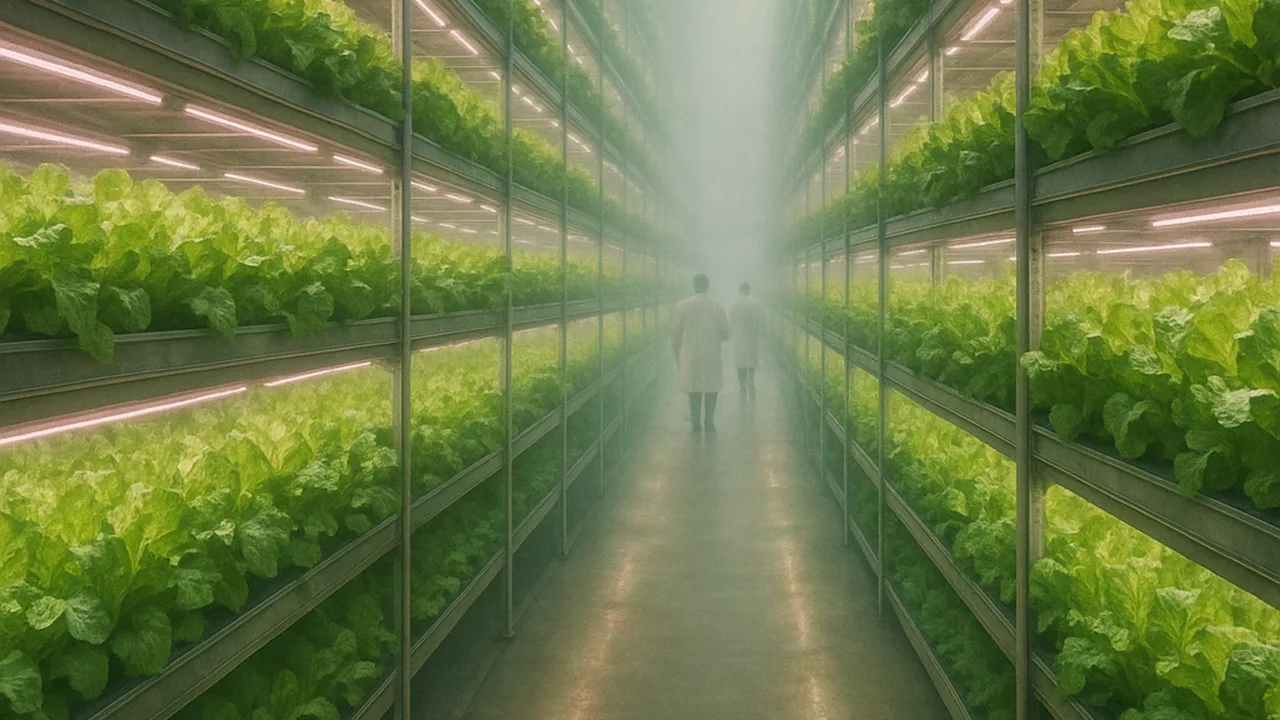
Vertical farms grow leafy greens and herbs indoors, in tall racks of shelves inside warehouses or shipping containers. LED lamps replace the sun. Many grow plants hydroponically, with roots in nutrient water. Because the water is collected and recirculated, these farms can use far less water than watering a field. There is no weather, so they can grow all year, close to the people who eat the food.
Indoor farming has trade-offs. Lamps, pumps and air control all use electricity, which costs money. Leafy greens grow well this way, but large crops like wheat or corn usually do not make sense indoors.
Many schools run their own smaller versions: classroom grow towers, greenhouse tables and outdoor beds. Students plant, measure and harvest, and some gardens send greens to the school cafeteria. Growers big and small do the same thing we do: test one change, look at the data, and improve.
Think about it: Which TWO ideas from indoor farms or school gardens could help our grow lab meet the 4-week and 2-liter criteria? What test would show each one works?
Closure ~5 min
You learned from growers who work at a bigger scale. Next class we head outdoors to plan a garden bed for pollinators.
Exit ticket: name one idea you will test, and the one measurement that will tell you if it helped.
How confident are you that you can I can use test data to decide how to improve a design.
Teacher notes
Materials: aluminum foil, a second “twin” tray if possible, the iteration table.
Setup: the case study is kept general on purpose; no specific company or water-savings figure is claimed. The foil and nutrient results are sample data. Only change one variable per test.
Listen for: “indoor plants don’t do photosynthesis”; teams changing several features at once.
Support / stretch: give a sentence frame for the iteration plan. Stretch: list everything an indoor farm must supply that a field gets for free, and the energy cost of each.