4.10 Building the Model: Photosynthesis Meets Respiration
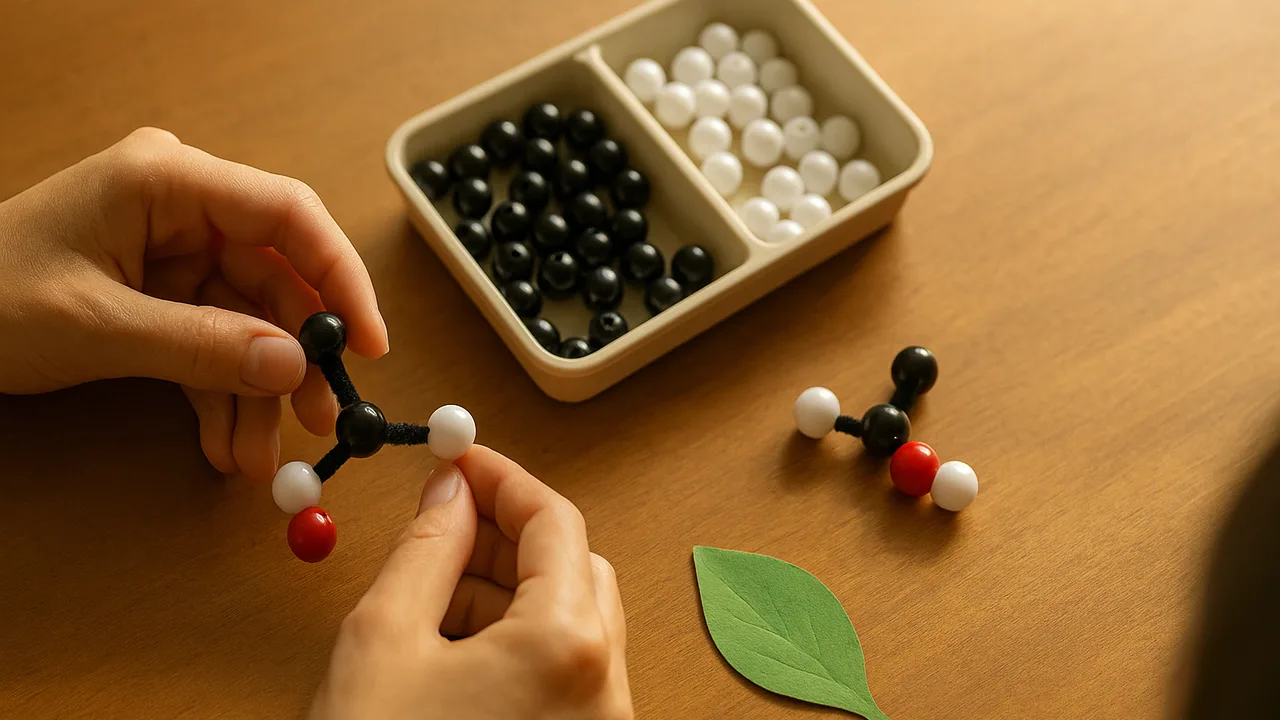
build a physical model showing that the atoms in carbon dioxide and water are rearranged into sugar and oxygen and back again, while energy is stored and released.
- I can use evidence and reasoning to build a scientific explanation for how photosynthesis affects the cycling of matter and energy.
- I can describe in my model how food molecules react with oxygen during cellular respiration to release stored energy.
- I can show in my model that the atoms in food are rearranged through chemical reactions to form new molecules.
Phase 3: Make Sense
Warm-Up ~5 min
Do Now. In Science 7 I you showed that atoms are conserved in a reaction. Write one sentence about what that means. Then look at your team’s bag of colored beads: 6 black, 12 white and 18 red.
We will rebuild these beads from carbon dioxide and water into sugar and oxygen. How many beads will be left over or missing?
Instruction ~10 min
The model kit. Black beads are carbon atoms, white beads are hydrogen atoms and red beads are oxygen atoms. A yellow card labeled “light energy” stands for energy. Energy is not matter, so it is never a bead.
Step 1: build the inputs. Build 6 carbon dioxide molecules (1 black + 2 red each) and 6 water molecules (2 white + 1 red each). Count: 6 black, 12 white, 18 red. Place the light energy card beside them.
Step 2: photosynthesis. Take all the pieces apart. Rebuild them into ONE sugar molecule (all 6 black, all 12 white and 6 red in one chain) and 6 oxygen molecules (2 red each). Tuck the light energy card under the sugar: the energy is now stored in it.
| Stage | Black (carbon) | White (hydrogen) | Red (oxygen) | Where is the energy card? |
|---|---|---|---|---|
| Before photosynthesis | ||||
| After photosynthesis | ||||
| After respiration |
Worked example 1: counting the atoms. Ava counted the beads before and after Step 2: 6 black, 12 white and 18 red both times. The beads were rearranged into new molecules, but none appeared or vanished. That is why the radish in 4.05 could gain mass only by taking in matter from carbon dioxide and water.
Step 3: respiration. Now a cell uses the sugar. Take apart the sugar and the 6 oxygen molecules. Rebuild 6 carbon dioxide and 6 water molecules. Pull out the energy card and pass it to a “muscle” label: the energy is released for the cell to use.
Worked example 2: the two processes as a cycle. Jamal drew a circle. On the top arc, a plant uses light energy to turn carbon dioxide and water into sugar and oxygen. On the bottom arc, cells in plants and animals turn sugar and oxygen back into carbon dioxide and water, releasing energy. Matter cycles around the circle. Energy enters as light and leaves as energy cells use, and finally as heat.
Limits of the model. Real molecules are not beads on strings, and real cells take many small steps. Our model shows only the big idea: atoms are rearranged and conserved, and energy is stored and released.
Guided Exercises ~15 min
Use your bead model and table to answer.
Independent Practice ~10 min
Draw your model for the exhibit.
Draw the photosynthesis-respiration cycle. Use circles for atoms, a different symbol for energy, and arrows labeled with each process. Add one sentence explaining how your drawing shows that matter is conserved.
How confident are you that you can I can model how matter cycles and energy flows through photosynthesis and respiration.
Closure ~5 min
Matter cycles; energy flows through. Next time we use that model to write a full scientific argument about where the radish got its mass.
Exit ticket: name one thing that cycles in your model and one thing that flows through and does not return. Explain the difference.
Teacher notes
Materials (per team): 6 black, 12 white and 18 red beads (or pop beads, paper clips or colored cereal pieces), pipe cleaners or string, a yellow “light energy” card, a “muscle” label.
Setup: pre-count kits into bags. The 6–12–18 counts match one sugar molecule made from six carbon dioxide and six water molecules; students do not need to write formulas or balance symbolic equations (assessment boundary).
Listen for: “the plant turns light into sugar” (light energy is stored; the matter comes from carbon dioxide and water) and “energy is recycled.” Matter cycles, but energy flows through and leaves as heat.
Support / stretch: provide a step card with pictures. Stretch: use the model to explain why a plant left in the dark for weeks loses dry mass.