2.21 Bead Model Day: The Plan Generation by Generation
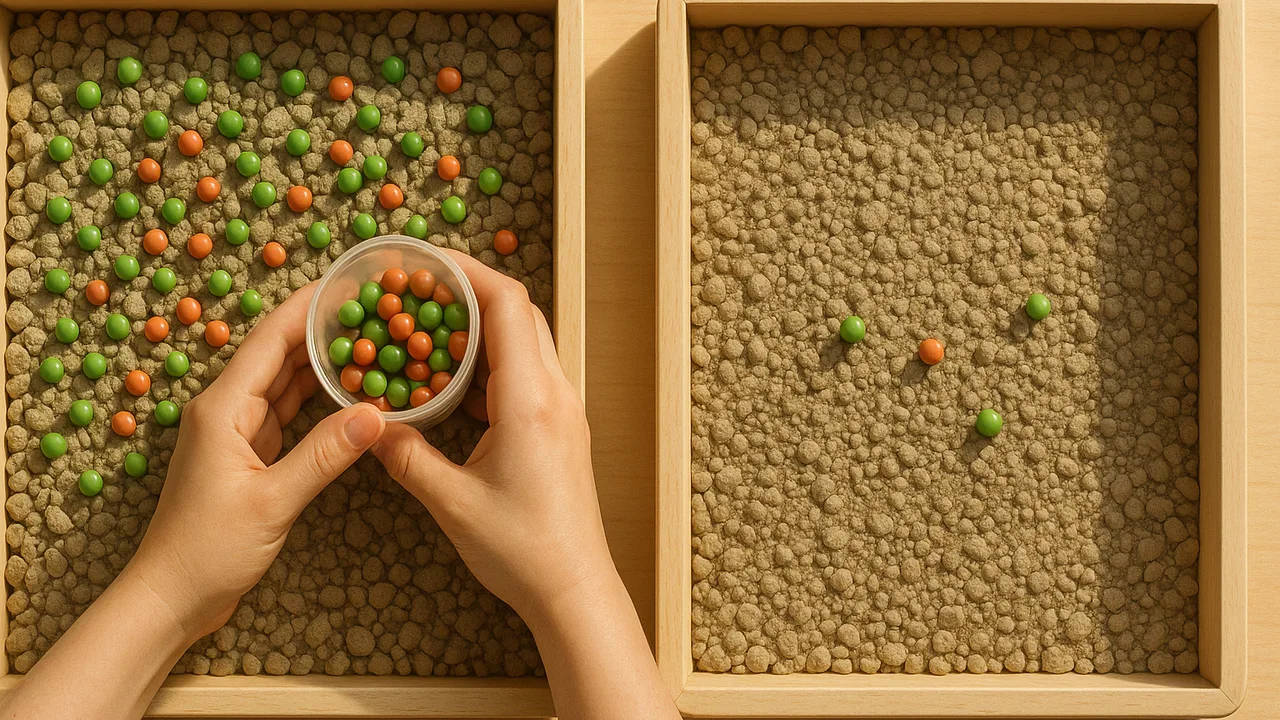
build a bead model of our breeding plan, run it through sample dry years, and use the data to explain how the share of tolerant plants changes over generations.
- I can develop a model that shows the problem I am trying to solve, including its criteria and constraints.
- I can identify and show the parts of my proposed solution, including the inputs and outputs in my model.
- I can use my model to generate data that shows how my proposed solution works and how it changes when I modify its parts.
- I can identify and describe evidence showing that individuals in a species have genetic variations that can be passed to their offspring.
- I can describe how to use probability to determine the chances of an organism surviving and reproducing in a specific environment.
- I can explain the cause-and-effect relationship between specific traits, their genetic variations, and the probability of survival and reproduction in a given environment.
Phase 4: Build
Warm-Up ~5 min
Do Now. A plant has an 80% chance of surviving a dry year. Out of 20 such plants, about how many would you expect to survive? Show your math.
Two teams run the exact same bead model. Will they get the exact same number of survivors?
Instruction ~10 min
Breeders, today the plan comes to life. A model lets us test five generations in one class period instead of five summers. Our model has inputs (the starting plants, the dry-year chances and the seed-saving rule) and outputs (survival each generation). The criteria tell us what success looks like.
How the bead model works. A cup of 20 beads is a field of 20 plants: green beads are tolerant, tan beads are not. In a dry year, draw a number card from 1 to 10 for each bead. A green bead survives on 1 to 8 (80%); a tan bead survives on 1 to 3 (30%). Survivors make the seed for the next generation, so you refill the cup to 20 in the same green-to-tan proportion as the survivors. For a hybrid plan, generation 1 is all green (every plant is Dd), and generation 2 uses the Punnett result: 15 green and 5 tan.
Worked example 1: expected values for Plan A. Plan A starts with 6 green and 14 tan (30% tolerant, sample data). Expected survivors: 6 × 0.8 = 4.8, about 5 green; 14 × 0.3 = 4.2, about 4 tan. That is 9 of 20, or 45%. Green among survivors: 5 ÷ 9 ≈ 56%, so generation 2 starts with about 11 green and 9 tan. The tolerant share rose because tolerant plants were more likely to survive and leave seed.
Worked example 2: chance in small fields. Mei’s team ran Plan A’s generation 1 three times and got 8, 10 and 9 survivors. The average is 27 ÷ 3 = 9, matching the expected 45%. One trial alone could fool you; averages of several trials are more reliable.
Same idea as nature. When drought kills more non-tolerant plants in the wild, the survivors leave the seeds. That is natural selection: a trait that raises the chance of surviving and reproducing becomes more common over generations. Our farm just speeds it up by choosing the seeds.
| Generation | Green (tolerant) at start | Tan (not tolerant) at start | Green survived | Tan survived | % of all plants survived | % green among survivors |
|---|---|---|---|---|---|---|
| 1 | ||||||
| 2 | ||||||
| 3 | ||||||
| 4 | ||||||
| 5 |
Guided Exercises ~15 min
Run Plan A and your team’s hybrid, at least two trials each. Use the data table, then answer.
Independent Practice ~10 min
Make sense of your own data.
Graph % survived against generation for Plan A and your hybrid on the same axes. In which generation does each first reach 70%?
Explain, using your data and the word probability, why the share of tolerant plants changed from generation 1 to generation 5.
Closure ~5 min
Great modeling, breeders. Next class you will move the model into a spreadsheet, try wet years too, and find the model’s limits.
Exit ticket: did your hybrid meet the 70% criterion within 5 generations in your trials? Give the numbers.
How confident are you that you can I can use a model to generate data about how my design works.
Teacher notes
Materials (per team): 40 green and 40 tan pony beads, two cups, a deck of number cards 1–10 (or a 10-sided die, or a spinner), data tables, graph paper, calculators.
Setup: model one generation together under the document camera. Round survivors to whole beads when refilling. All probabilities are sample data. Collect class totals so averages over many trials can be compared with the expected values.
Listen for: “the plants learned to survive drought” (individuals do not change; the population’s proportions change); “our trial was wrong” when it differs from the expected value (chance variation).
Link to Part 1: 2.14’s rule of thumb (save seed from at least 20 parent plants) works inside each parent line; our diversity criterion (at least 3 parent lines) counts separate lines. Both protect variation, so the farm should follow both.
Support / stretch: give a pre-filled first row. Stretch: run a field of 100 using the class’s combined beads and compare its spread with fields of 20.