1.01 The Hillside That Gave Way
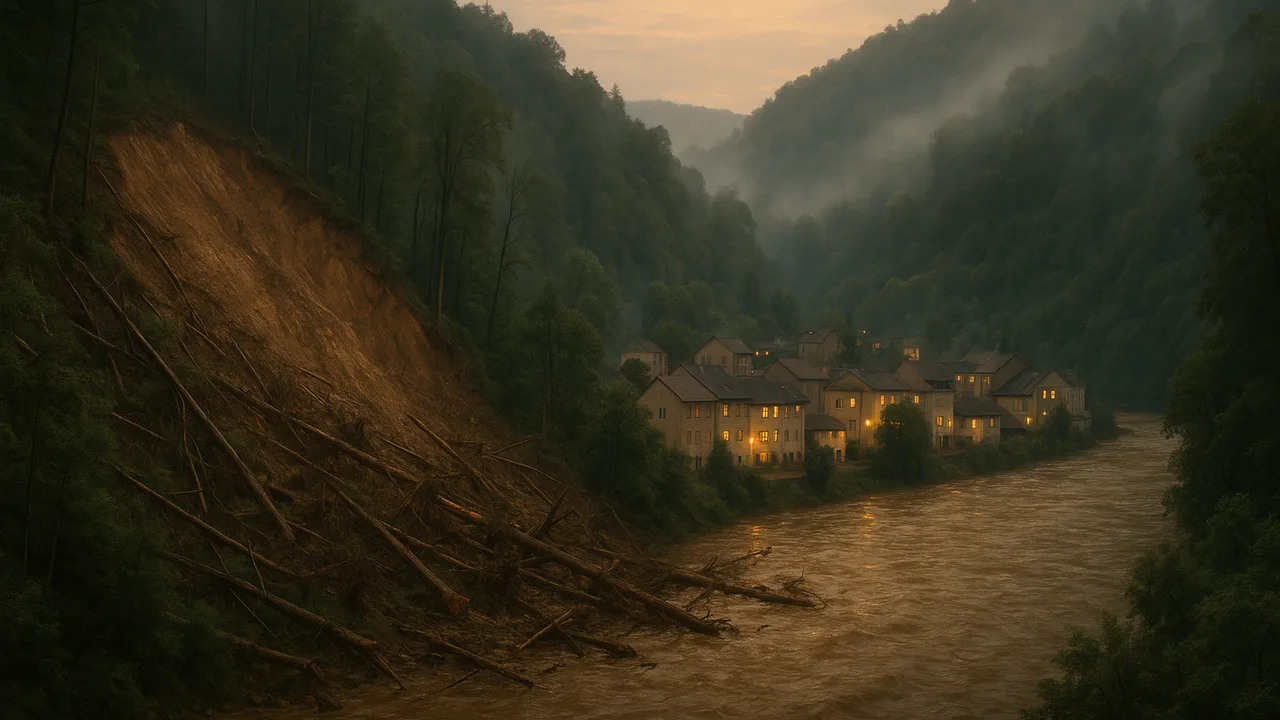
The Hazard-Ready River Town
How can reading Earth’s past help a town find its resources, forecast its hazards, and protect people from fast-moving debris?
The mystery: After days of heavy rain, a hillside above a river town gives way. Mud and boulders race downhill fast enough to knock over walls. In the road cut nearby, layers of rock hold seashells, coal and volcanic ash.
Questions we will figure out together in this unit:
- Why did the hillside fail after this storm and not earlier ones?
- How did seashells end up in rock high above a river?
- How old are the layers in the road cut, and which formed first?
- Why is there coal under some valleys and not others?
- Can scientists tell when the next landslide or flood will happen?
- How fast does a debris flow move, and how hard does it hit?
- What kind of barrier can stop boulders but still let water through?
- Where does our town’s well water come from?
describe the river town’s debris problem as one engineers could solve with a new object, process or system.
- I can describe a problem that could be solved by creating an object, tool, process, or system.
Phase 1: Spark
Warm-Up ~5 min
Do Now. Look at the photo set on the board. Picture 1 shows a green hillside above a river town. Picture 2 shows the same hillside after four days of heavy rain: a brown scar, and mud and boulders across the road. Write three things you notice and one thing you wonder.
What most likely made this hillside give way now, and not last summer?
Instruction ~10 min
Meet the client. A river-valley town’s planning board has written to our class. The town sits on a flat strip of land between a river and steep, wooded hills. After the hillside failed, the board asked three questions: What does the rock in our hills tell us about the past? Which useful resources lie under our valley, and why there? And how can we protect homes from the next debris flow?
Our mission. Hazard scientists, your job this unit is to read Earth’s history in the valley’s rock layers, explain where its resources and hazards come from, and design a barrier that stops fast-moving debris. In part 2 you will build and test that barrier and present to the board.
What engineers solve. An engineering problem is a need that a new object, tool, process or system could meet. “Landslides are scary” is a feeling. “Debris from the east slope reaches four homes on Mill Road, and the town needs a way to stop it in the gully above them” is a problem.
Worked example 1: from worry to problem. Priya wrote, “The river floods.” She revised it: “When the river rises above its banks, water covers the park and the low road, so drivers need an early warning system.” Her revision names who is affected, what happens and what kind of solution could help.
Worked example 2: object, process or system? A wall of logs and wire in a gully is an object. A rule that closes the road when rain passes a set amount is a process. Rain gauges linked to sirens make a system. Many real hazard plans combine all three.
The phenomenon has a second clue. In the road cut beside the slide, the rock shows stripes. Some hold seashells, one is black coal, and one thin layer is pale volcanic ash. Hold onto that puzzle; it leads us into Earth’s history.
Guided Exercises ~15 min
Work with your table group. Discuss each card before you answer.
Independent Practice ~10 min
Start your Hazard Notebook.
Write the board's debris problem in one or two sentences. Name who is affected, what happens, and whether an object, process or system could help.
Add two questions of your own to the class Wonder Board. One should be about the rock layers and one about the hazards.
Closure ~5 min
We have a client, a phenomenon and a problem. Next time, we map the valley as a system and form our teams.
Exit ticket: why is “stop debris before it reaches homes” an engineering problem and not just a science question?
Teacher notes
Materials: two photos or drawings of a hillside before and after a slide (generic images), chart paper for the Wonder Board, Hazard Notebooks.
Setup: keep the Wonder Board posted all unit; 1.14 returns to it.
Sensitivity: some students may have lived through floods, slides or evacuations. Open with a calm note that today’s goal is understanding and protection, let students pass on sharing, and follow up privately if anyone seems upset.
Listen for: “nothing can be done” (counter with examples of warnings and barriers) and problems with no stated user.
Support / stretch: give the frame “___ is affected when ___, so they need ___.” Stretch: write the problem from two viewpoints, a homeowner and the road crew.