1.20 Mid-Build Checkpoint: Layers, Resources, Hazards and Kinetic Energy
show what I know so far about rock layers, resources, hazard data and kinetic energy, and use the results to plan my next steps.
- I can describe how scientists use patterns in rock layers to figure out the order of events in Earth’s history.
- I can explain how changes in fossils and evidence of major events, like volcanic eruptions or extinctions, help determine when those events happened compared to others.
- I can explain how past and current geoscience processes have caused the uneven distribution of Earth’s mineral, energy, and groundwater resources.
- I can describe why these resources are usually limited and nonrenewable, including how long they take to form and how rare their formation is.
- I can describe that kinetic energy and mass have a linear relationship, so doubling the mass doubles the kinetic energy and halving the mass halves the kinetic energy.
- I can describe that kinetic energy and speed have a nonlinear (square) relationship, so doubling the speed makes the kinetic energy four times greater and cutting the speed in half makes the kinetic energy four times smaller.
Phase 4: Build
Warm-Up ~5 min
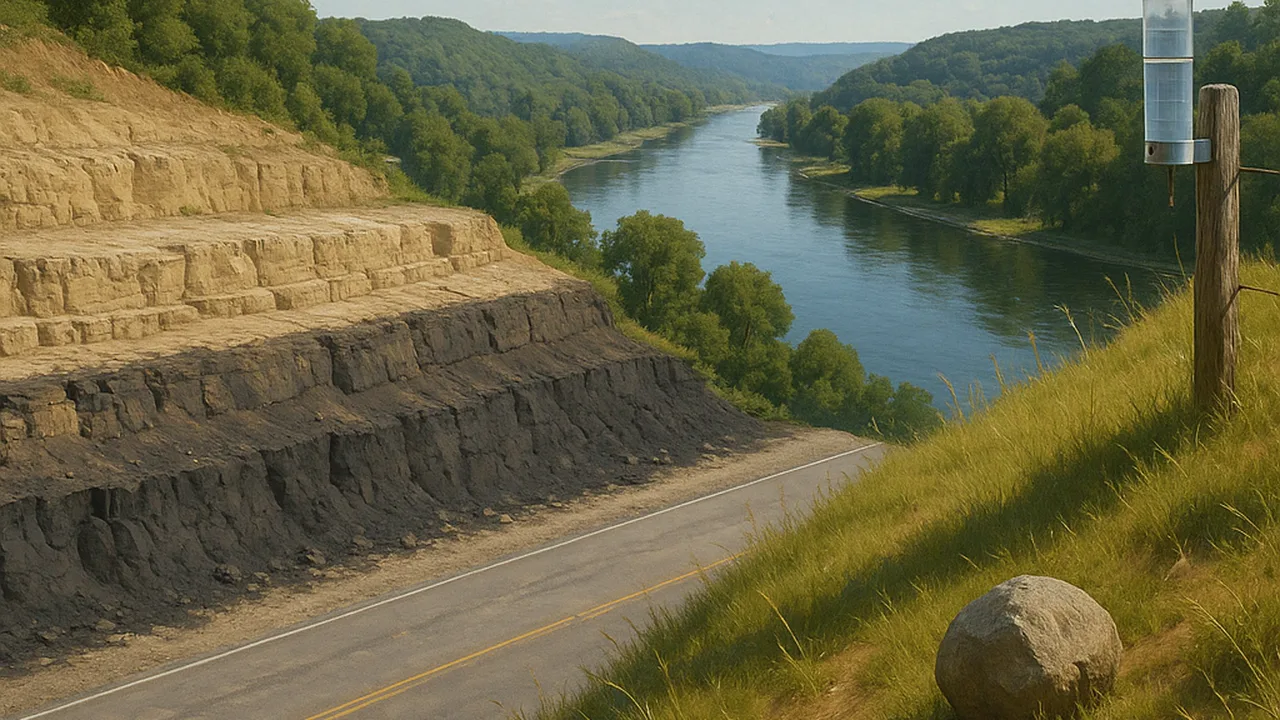
Do Now. Without notes, list three things the road cut tells us about this valley’s past. Then circle the one you are least sure about.
How confident are you that you can I can explain the order of events recorded in rock layers.
Instruction ~10 min
Engineers, this checkpoint is a progress check, not a final test. It shows your team which ideas to strengthen before Planning Board Night. Answer on your own, then compare with a partner.
Quick review: reading layers. Lower layers are older unless the rocks were disturbed. Faults and igneous intrusions are younger than the layers they cut. Fossils show what lived there and help match layers from place to place. A layer of volcanic ash, or a layer rich in impact debris, marks a single moment that can be matched across a wide area.
Worked example 1: ordering events (sample column). Layers A (bottom) to E (top). A dike of cooled magma cuts A, B and C but stops under D. Kofi writes the order: A, B and C were deposited; then the dike formed; then D and E were laid down. “The dike is younger than C because it cuts C, and older than D because D covers it.”
Worked example 2: an extinction line. In a sample column, many kinds of shell fossils appear in layers 1 to 4, but only two kinds continue above a thin clay layer. Lena writes: “Many groups died out at the time of the clay layer, so it marks a major event. Layers above it are younger.” Scientists use events like this, such as the asteroid impact about 66 million years ago, to compare times across Earth.
| Questions | My answers | Right? | Idea to review |
|---|---|---|---|
| 1–3 Layers | |||
| 4 Resources | |||
| 5 Hazards | |||
| 6–8 Kinetic energy |
Guided Exercises ~15 min
Answer on your own first.
Independent Practice ~10 min
Plan your next steps.
Check your answers with the key. For each one you missed, write the correct idea in your own words.
Write one goal for the rest of the Build phase, and name the lesson or resource you will use to reach it.
Closure ~5 min
Good checking, engineers. Next class, you plan how the town will warn people BEFORE debris starts moving.
Exit ticket: which idea from today do you most need to review, and how will you review it?
How confident are you that you can I can describe how kinetic energy changes with mass and with speed.
Teacher notes
Materials: printed checkpoint, the sample rock column cards, answer key, colored pens for self-correction.
Setup: 20 minutes of quiet work, 10 minutes of self-check with the key, then goal-setting. Record results by PE (ESS1-4, ESS3-1, ESS3-2, PS3-1) to form groups for 1.27 and 1.28.
Listen for: “faults are the oldest feature”; “half the speed means half the energy”; naming eras instead of using the order of layers (era names are not needed).
Support / stretch: read items aloud on request and allow the book-stack model. Stretch: write a new rock-column puzzle for a classmate.