1.09 Criteria and Constraints: Defining the Barrier Problem
define precise criteria and constraints for the debris barrier that meet the planning board’s needs and weigh effects on people and the environment.
- I can define the criteria for a solution that meet the needs of the people or groups affected by the problem.
- I can explain who the solution is meant to help and use criteria to compare different solutions, including using numbers when needed.
- I can define the constraints for a solution, including time, materials, costs, and scientific or other important issues.
- I can explain how the needs and wants of people involved, safety, and effects on others limit possible solutions.
- I can analyze how solutions or not solving the problem could negatively affect the environment.
Phase 2: Investigate
Warm-Up ~5 min
Do Now. Read the planning board’s letter: “We need something in the east gully that stops boulders, does not cause flooding upstream, fits our budget and fits the narrow channel.” Underline every need you could test or measure.
Which of these is a constraint rather than a criterion?
Instruction ~10 min
Explore first. In teams, sort the board’s needs into Criteria and Constraints. For each, write how we would check it in our ramp model and a target with units.
| Board’s need | Criterion or constraint? | How we check it in the model | Target (with units) |
|---|---|---|---|
| Stops boulders | |||
| Does not trap water and cause flooding | |||
| Fits the budget | |||
| Fits the narrow channel | |||
| Safe for crews to build and clean out | |||
| Gentle on the stream’s plants and animals |
Name the ideas. Criteria are the requirements a successful solution must meet. Constraints are its limits: time, materials, cost, size, safety and effects on people and the environment. Precise criteria have numbers, so different designs can be compared fairly.
Our class criteria and constraints. After the sort, the class agrees on these. Part 2 tests every barrier against them:
- Criterion 1: the barrier stops at least 9 of 10 marble “boulders” released from the top of a 1 m ramp.
- Criterion 2: it lets water drain through.
- Constraint 1: it costs no more than 10 sample “budget points”.
- Constraint 2: it fits a 30 cm wide channel.
Worked example 1: vague to precise. “Stops boulders” is vague. “Stops at least 9 of 10 marbles released from the top of a 1 m ramp” names an amount, a test and a starting point. Releasing from the top gives the marbles their greatest speed in our model, so it is the toughest fair test.
Worked example 2: why water must drain. Diego noted that a solid wall would hold back water as well as rocks. Water could pool upstream, soak the slope or spill over the top all at once. Letting water drain keeps the stream flowing and protects its habitat. That reason links an engineering choice to effects on the environment.
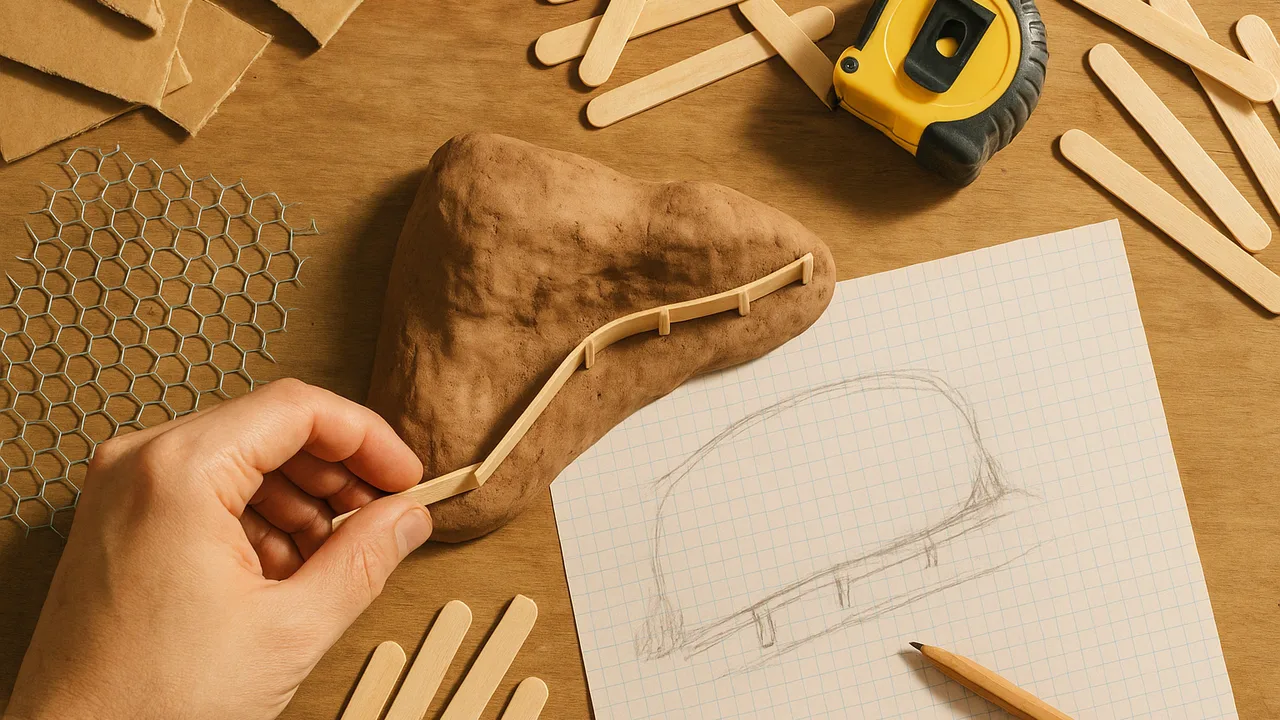
Worked example 3: a constraint with reasons. Mei explained the budget. Each material has a sample cost, such as 1 point per 5 craft sticks and 2 points per square of mesh. A 10-point limit stands for the town’s real budget and forces trade-offs between strength and cost.
Guided Exercises ~15 min
Use your sorting chart. Discuss each card first.
Independent Practice ~10 min
Write your team’s design brief.
Restate the barrier problem in one sentence. Then list the class's two criteria and two constraints, and give a reason for each.
Explain one way a barrier could harm the stream or downstream neighbors, and one risk to the town of building nothing at all.
Closure ~5 min
We have a clear, testable problem. Next phase, we make sense of our data with models and arguments, then brainstorm barrier designs.
Exit ticket: which criterion or constraint will be hardest to meet, and what trade-off might it force?
Teacher notes
Materials: the board’s letter, sticky notes in two colors, chart paper labeled Criteria and Constraints, a sample price list (for example, 5 craft sticks = 1 point, 1 mesh square = 2 points, 1 m of string = 1 point, a bundle of pipe cleaners = 1 point, a cardboard sheet = 1 point).
Setup: post the four class criteria and constraints exactly as worded; part 2’s Build and Prove It phases test against them. Budget points are a classroom model, not real costs.
Listen for: mixing criteria and constraints, criteria with no numbers, and ignoring the environment.
Support / stretch: provide the frame “The barrier must ___ because ___.” Stretch: propose one extra criterion, such as easy clean-out, with a measurable target.