1.19 Prototype Day: Building Barrier Version 1
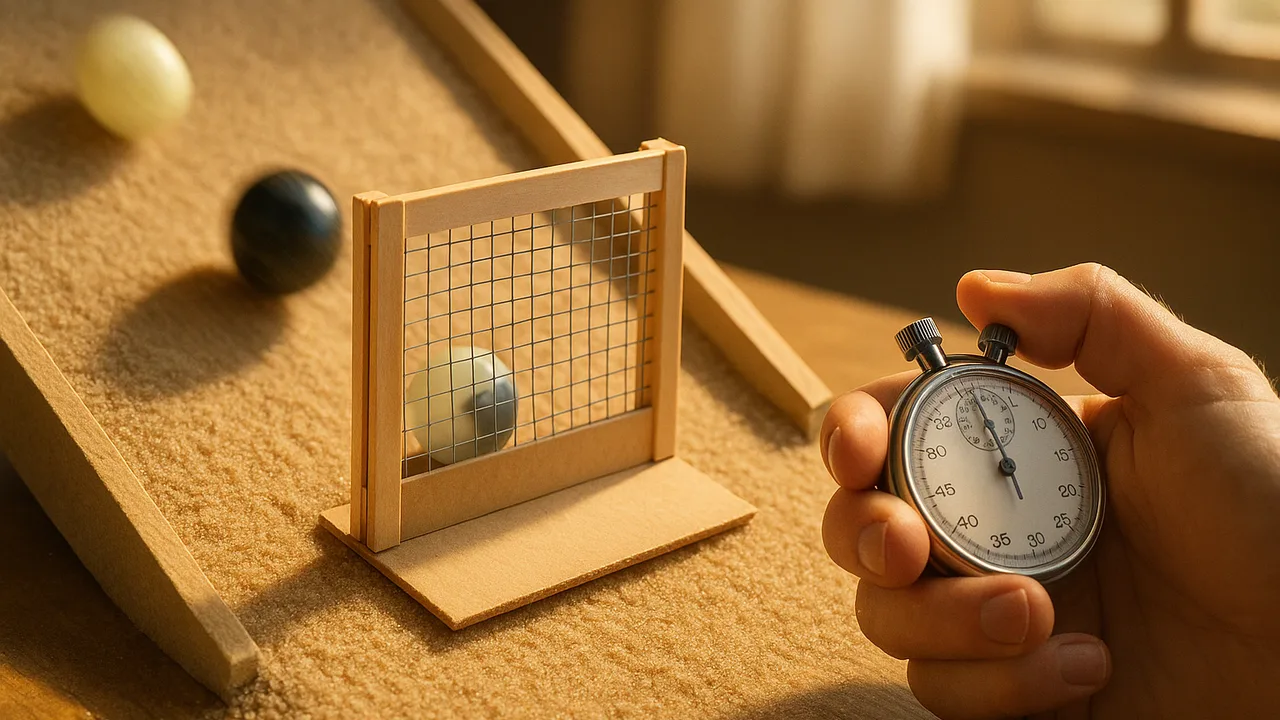
build a first barrier prototype and test it against light, heavy, slow and fast marble boulders, recording which ones it stops.
- I can use a systematic method, like a decision matrix, to find the strengths and weaknesses of each solution.
- I can evaluate each solution using the criteria and constraints we defined.
- I can compare the solutions based on how well they meet the criteria and constraints.
- I can describe that kinetic energy and mass have a linear relationship, so doubling the mass doubles the kinetic energy and halving the mass halves the kinetic energy.
- I can describe that kinetic energy and speed have a nonlinear (square) relationship, so doubling the speed makes the kinetic energy four times greater and cutting the speed in half makes the kinetic energy four times smaller.
- I can define the criteria for a solution that meet the needs of the people or groups affected by the problem.
- I can explain who the solution is meant to help and use criteria to compare different solutions, including using numbers when needed.
Phase 4: Build
Warm-Up ~5 min
Do Now. Look at your matrix winner. Which marble from 1.18 do you think will be hardest for it to stop, and why?
Which test boulder carries the MOST kinetic energy?
Instruction ~10 min
Engineers, today you build. Version 1 does not need to be perfect. It needs to be real, so you can test it and learn from it.
Our class criteria, from 1.09. A barrier must (1) stop at least 9 of 10 marble “boulders” released from the top of a 1 m ramp, (2) let water drain through, (3) cost no more than 10 sample “budget points,” and (4) fit a 30 cm wide channel.
| Material (sample price list) | Budget points |
|---|---|
| 5 craft sticks | 1 |
| 1 mesh square | 2 |
| 1 m of string | 1 |
| A bundle of pipe cleaners | 1 |
| A cardboard sheet | 1 |
Sample price list from 1.09. Tape for fixing a barrier to the channel is a free class supply.
The test plan. Clamp the barrier 10 cm from the bottom of the ramp. Release 10 marbles in this order: 3 light marbles from the middle mark, 3 light from the top, 2 heavy from the middle and 2 heavy from the top. Then pour one cup of water down the ramp and watch whether it passes. Record every result.
| Marble | Mass | Release mark | Stopped? (Y/N) | What happened to the barrier |
|---|---|---|---|---|
| 1–3 | light | middle | ||
| 4–6 | light | top | ||
| 7–8 | heavy | middle | ||
| 9–10 | heavy | top | ||
| Water | 1 cup poured | Drained? | ||
| Cost | budget points | |||
Worked example 1: a pattern in failures (sample data). Diego’s mesh fence stopped all 6 light marbles and both heavy marbles from the middle, but both heavy marbles from the top tore through: 8 of 10. He reasons: “The heavy top marbles had the most mass AND the most speed, so they carried several times the energy of the others. Our weak spot is the biggest, fastest boulders.”
Worked example 2: a cost problem. Priya’s posts-plus-basin stopped 10 of 10 and drained well, but it cost 12 points. It fails a constraint, so it is not yet a solution. Her team lists two parts to remove or replace.
Guided Exercises ~15 min
Build for about 20 minutes, then test. Answer these between trials.
Independent Practice ~10 min
Record and reflect.
Complete the test table. Compare your results with each of the four criteria and mark each one met or not met.
Name one change you will try in version 2 and predict how it will affect the fast, heavy marbles.
Closure ~5 min
Version 1 showed you where the weak spot is. Next class is a mid-build checkpoint on layers, resources, hazards and kinetic energy.
Exit ticket: in one sentence, explain why the heavy marble from the top was the hardest test.
How confident are you that you can I can evaluate a prototype using the criteria we defined.
Teacher notes
Materials: ramps and 30 cm channels from 1.18, price-list materials, scissors, tape, a pitcher and a tray to catch water, towels, goggles.
Setup: run a “store” where each team’s Materials Manager buys parts with a 10-point card. Give 20 minutes to build and 15 to test. Save each team’s test table for 1.22 and 1.23.
Listen for: blaming the marble instead of the design; teams that skip the water test.
Support / stretch: offer a pre-cut mesh panel. Stretch: add a third marble mass and predict the result before testing.