1.03 Reading the Road Cut: Layers, Fossils and Clues
use superposition, fossils, ash and impact layers, and cross-cutting features to put the events in a rock sequence in order.
- I can explain that newer rock layers are usually found on top of older layers unless something has disturbed them.
- I can describe how features like faults or igneous intrusions are younger than the rocks they cut through.
- I can use the fossil record to compare the ages of rock layers based on which organisms are found in them.
- I can identify the types and order of rock layers needed to explain Earth’s history.
- I can describe how the fossil record is used as evidence for the timing of events.
- I can identify evidence of major events in Earth’s history, such as volcanic eruptions or asteroid impacts, that help explain the order of events.
- I can describe how scientists use patterns in rock layers to figure out the order of events in Earth’s history.
- I can explain how changes in fossils and evidence of major events, like volcanic eruptions or extinctions, help determine when those events happened compared to others.
Phase 2: Investigate
Warm-Up ~5 min
Do Now. Your laundry pile grows all week. On Friday you find a sock at the very bottom. When was it probably dropped there: Monday or Thursday? Explain your thinking in one sentence.
A dark band of igneous rock cuts straight up through three flat layers. Which is older?
Instruction ~10 min
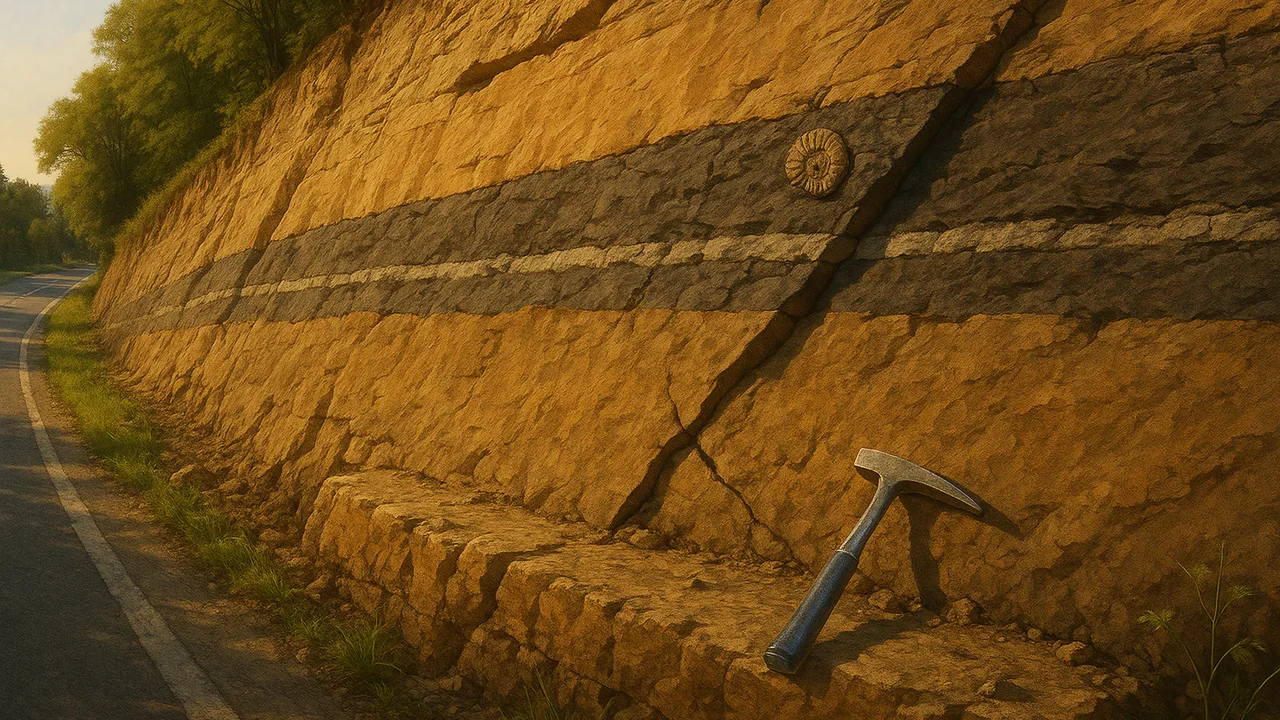
Explore first: the layer cake. Each team gets a clear cup of sand, soil and gravel layers poured by another class, plus a card of a road-cut drawing. Without reading ahead, decide which layer was poured first, and write how you know. Then fill in the table for the road-cut drawing, layer by layer from the bottom.
| Layer (bottom = 1) | What it looks like | Fossils or clues inside | What the environment was like | Order formed |
|---|---|---|---|---|
| 1 Gray limestone | ||||
| 2 Black coal | ||||
| 3 Pale ash band | ||||
| 4 Red sandstone | ||||
| Dark dike cutting 1–3 | ||||
| Fault offsetting 1–4 |
Name the ideas. Superposition: in undisturbed layers, each layer is younger than the one below it. Cross-cutting: a dike, which is a sheet of cooled magma, or a fault is younger than the layers it cuts. Fossils record what lived when a layer formed, and fossil groups change upward through the rock record. Some layers mark single events. A volcanic ash layer forms in days and can blanket a huge area, so the same ash in two places marks the same moment. A thin clay layer rich in iridium, a metal rare in Earth’s crust but common in asteroids, marks an impact. Fossils of many groups that stop at one level record a mass extinction.
Worked example 1: the road cut, in order. Limestone with shells formed first, in a shallow sea. Coal formed next, from swamp plants. Then ash fell from an eruption, and red sandstone was laid down on top. The dike cuts layers 1 to 3 but not 4, so magma pushed in after the ash and before the sandstone. The fault breaks all four layers, so it is the youngest event.
Worked example 2: matching two cliffs. Diego compared two cliffs on opposite sides of the valley. Both have the same pale ash band. Below it, both have shell fossils; above it, neither does. He concluded the ash fell on both sides at the same time, and the shell-bearing animals disappeared from both areas after it.
Worked example 3: an impact layer. About 66 million years ago, an asteroid struck Earth. In rock from many places, a thin iridium-rich clay layer marks that moment. Dinosaur fossils (other than birds) appear below that layer but never above it. That pattern helps scientists link the impact to a mass extinction.
Guided Exercises ~15 min
Use your road-cut table. Explain every answer to a teammate.
Independent Practice ~10 min
Read the second road cut on your card.
Write the story of road cut 2 from oldest to youngest event. Use the words superposition, cross-cutting and fossil at least once each.
Explain how a geologist could use one ash layer to compare the ages of rocks on both sides of the valley.
Closure ~5 min
Rock layers give us an order of events, but not yet a sense of how long ago. Next time we build a timeline to scale.
Exit ticket: draw three layers and a fault that cuts only the bottom two. Number the four events from oldest to youngest.
Teacher notes
Materials (per team): a clear cup with lid holding 3–4 poured layers of sand, soil and gravel; road-cut drawing cards 1 and 2; colored pencils.
Setup: pour layer cups a day ahead; a different class’s cups make the “which came first” question real.
Listen for: “the thickest layer is oldest” and “igneous rock is always oldest.” Do not ask students to memorize era or period names; describe events instead. Present the impact and extinction pattern as a well-supported scientific explanation.
Support / stretch: give a strip of event labels to arrange. Stretch: a tilted-layer card, where layers were tipped and then eroded before new flat layers were laid on top.