1.24 Barrier Trial Day: Testing Against the Criteria
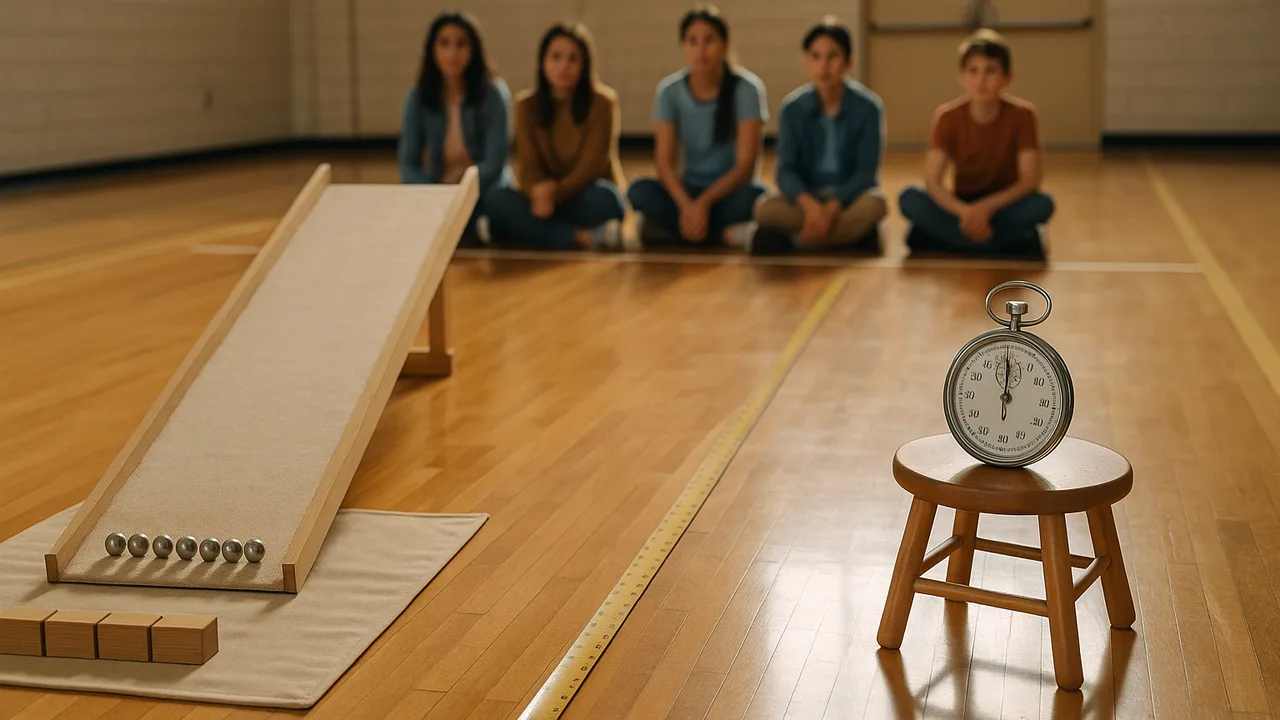
run the official barrier trial, compare the results with every criterion, and use class data to judge which designs work best.
- I can use a systematic method, like a decision matrix, to find the strengths and weaknesses of each solution.
- I can evaluate each solution using the criteria and constraints we defined.
- I can compare the solutions based on how well they meet the criteria and constraints.
- I can define the criteria for a solution that meet the needs of the people or groups affected by the problem.
- I can explain who the solution is meant to help and use criteria to compare different solutions, including using numbers when needed.
- I can use a graph to identify that kinetic energy increases when mass or speed increases, and decreases when mass or speed decreases.
Phase 5: Prove It
Warm-Up ~5 min
Do Now. Today is official. Write down the four criteria from memory, then check them against the poster.
In the official trial, all 10 marbles are released from the top of the 1 m ramp.
Instruction ~10 min
Engineers, welcome to Barrier Trial Day. A planning board member, or a teacher playing one, watches each trial. The rules are the same for every team, so the results can be compared fairly.
Our class criteria, from 1.09. A barrier must (1) stop at least 9 of 10 marble “boulders” released from the top of a 1 m ramp, (2) let water drain through, (3) cost no more than 10 sample “budget points,” and (4) fit a 30 cm wide channel.
Official procedure. 1. The Inspector measures the barrier’s width in the 30 cm channel. 2. The Accountant shows the receipt of budget points. 3. The Tester releases 10 marbles from the top of the 1 m ramp: 5 light and 5 heavy, in a random order drawn from a cup. 4. The Recorder pours one cup of water and times how long until water stops pooling. 5. An optional stress round uses one extra-heavy steel ball, beyond the criteria, to find the limit.
| Team | Width fits (Y/N) | Points | Light stopped (of 5) | Heavy stopped (of 5) | Total (of 10) | Drains (Y/N) | All criteria met? |
|---|---|---|---|---|---|---|---|
Worked example 1: reading class data (sample data). Across 8 teams, light marbles were stopped 39 of 40 times, but heavy marbles only 31 of 40 times. Mei writes: “Heavy marbles at the same speed carry about twice the energy of light ones (twice the mass), and they caused 9 of the 10 misses. Our class bar graph shows the pattern clearly.”
Worked example 2: which design type won? (sample data). All 3 mesh-with-posts hybrids met every criterion; 1 of 3 plain fences and 1 of 2 basins did. Malik claims: “Hybrids that slow boulders before catching them are the best-supported design, because slowing a boulder removes energy fast and the mesh still drains.”
Guided Exercises ~15 min
Answer after your trial, using your table and the class data.
Independent Practice ~10 min
Make sense of the trial.
Make a bar graph of your team's light and heavy results, or of the class success rate by design type. Describe the pattern in two sentences.
Write a claim about how well your barrier meets the criteria. Include every criterion, one limitation and one piece of class data that supports your claim.
Closure ~5 min
The data is in. Next class is Planning Board Night, where you present the map, the barrier and the warning plan.
Exit ticket: what is the single most important result you will tell the planning board, and why?
How confident are you that you can I can compare solutions based on how well they meet the criteria and constraints.
Teacher notes
Materials: version 2 barriers, ramps, 5 light and 5 heavy marbles per lane, a cup of numbered slips for random order, a steel ball for the stress round, water, trays, towels, goggles, class data chart.
Setup: run two lanes at once with an adult or trained student observer at each. Assign roles: Inspector, Accountant, Tester, Recorder. Post class results live.
Listen for: teams quietly re-running failed trials; “heavy marbles fall faster.”
Support / stretch: give a pre-made bar graph frame. Stretch: compute each design type’s success rate as a percent.