1.14 Ideate: Brainstorming the Debris Barrier
generate several science-based barrier designs and compare them against the class criteria and constraints.
- I can define the criteria for a solution that meet the needs of the people or groups affected by the problem.
- I can explain who the solution is meant to help and use criteria to compare different solutions, including using numbers when needed.
- I can define the constraints for a solution, including time, materials, costs, and scientific or other important issues.
- I can explain how the needs and wants of people involved, safety, and effects on others limit possible solutions.
- I can analyze how solutions or not solving the problem could negatively affect the environment.
Phase 3: Make Sense
Warm-Up ~5 min
Do Now. Return to the Wonder Board from 1.01. Move every question we can now answer to the “We know” side. Pick one and answer it in a sentence.
During a brainstorm, what should a team do with an idea that sounds unusual?
Instruction ~10 min
Reading: from science to design. We know five things. Debris flows are wet and fast. Kinetic energy grows with mass and even more with speed. Barriers face less energy where flows slow down. A good barrier catches rocks but lets water through. And every design must stay within cost and size limits. Each idea today should use at least one of these. Recall the class criteria: stop at least 9 of 10 marbles from the top of a 1 m ramp, and let water drain through. The constraints: no more than 10 budget points, and fit a 30 cm wide channel.
Brainstorm rules. Aim for quantity. Build on others with “Yes, and…”. Sketch, do not just write. Judge later.
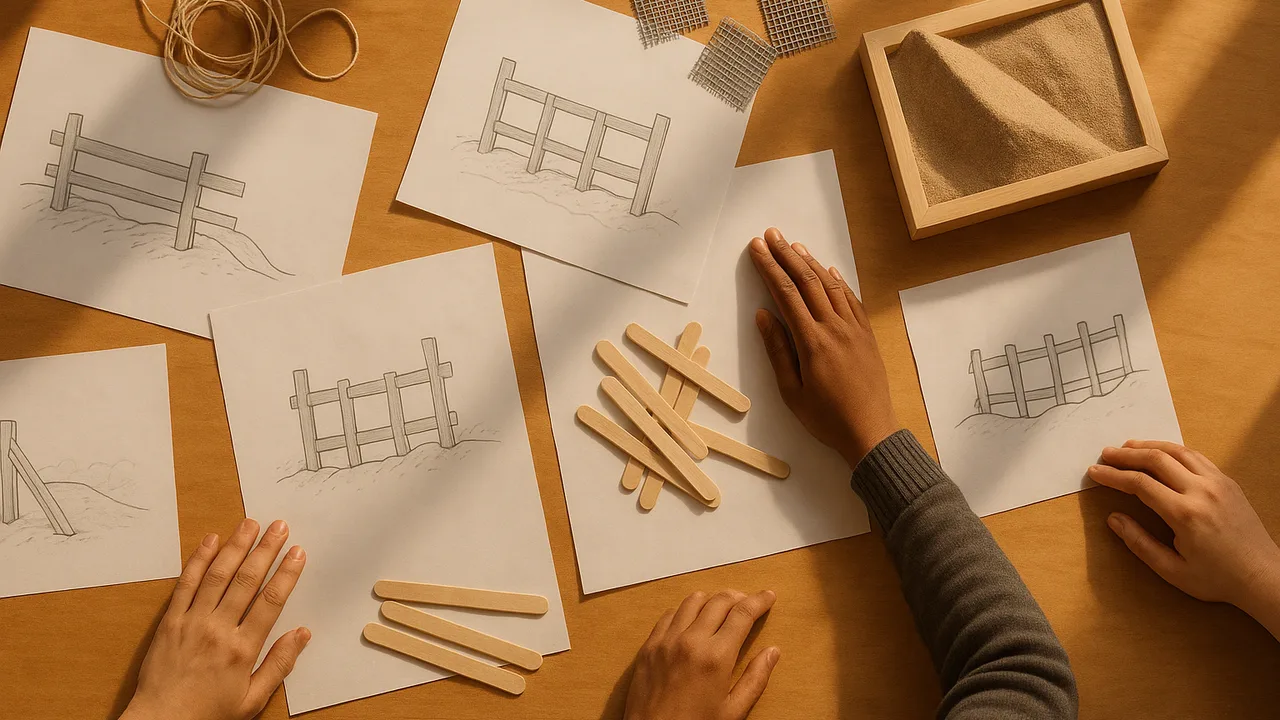
Worked example 1: a science-based idea. Ava sketched a “comb and net” barrier: a row of craft-stick posts with mesh across the front. Science reason: gaps let water drain while the mesh catches marbles. She placed it at the foot of the ramp’s steep part, where she expected flows to slow most, and estimated 8 budget points.
Worked example 2: comparing ideas with a decision table. Malik scored ideas from 1 to 3 on each criterion. The comb-and-net scored 3 for drainage and 2 for stopping. A solid cardboard wall scored 3 for stopping but 1 for drainage. The table made the trade-off visible.
| Idea | Stops 9 of 10 marbles | Water drains | ≤ 10 budget points | Fits 30 cm channel | Gentle on the stream | Total |
|---|---|---|---|---|---|---|
| 1: | ||||||
| 2: | ||||||
| 3: |
Who else is affected? Score at least one idea for its effect on the stream and downstream neighbors, such as whether fish and water can still pass.
Guided Exercises ~15 min
Brainstorm first, then work through these cards with your team.
Independent Practice ~10 min
Sketch and score.
Sketch at least three barrier designs. Label materials, the budget points each uses, the width, where on the ramp it goes, and the science reason behind it.
Score your designs in the decision table. Explain which you would prototype first, and name the constraint that most shaped your choice.
Closure ~5 min
We have many science-based ideas. Next phase, teams build prototypes, test them and revise them for the planning board.
Exit ticket: name your team's top design, the criterion it meets best and the constraint you worry about most.
Teacher notes
Materials: chart paper, markers, the Wonder Board, the class criteria and constraints from 1.09, the sample price list, decision table handouts.
Setup: run a timed silent sketch (5 min), then a team “Yes, and” round (8 min) before scoring.
Listen for: designs that block water, ignore the budget or width, and ideas with no science reason. Decision tables carry into part 2, where MS-ETS1-2 is developed formally.
Support / stretch: give a ramp-outline template. Stretch: design a two-stage system, such as a small upper net to slow the flow plus a main barrier below.