2.17 Saving Tomorrow’s Seeds: Seed Banks and Drought-Tolerant Crops
explain how seed banks and plant breeders use natural variation, including gene changes, to develop drought-tolerant crops.
- I can create a model that shows genes on chromosomes, proteins, and traits of organisms to help explain how mutations can affect an organism.
- I can use my model to describe how changes in genes (mutations) might change the structure and function of proteins.
- I can explain how these changes in proteins can affect the traits of an organism.
- I can describe how these changes in traits can be helpful, harmful, or have no effect on the organism.
- I can use my model to explain how changes in how proteins work can lead to helpful, harmful, or neutral changes in an organism’s structure or function.
Phase 4: Build
Warm-Up ~5 min
Do Now. Why might a scientist store seeds of an old bean variety that no farm grows anymore? Write one reason.
Every change in a gene is harmful to the organism.
Instruction ~10 min
Breeders, where do drought-tolerant traits come from in the first place? Remember the chain from Part 1: a gene on a chromosome is an instruction for making a protein. Proteins do jobs in cells, and those jobs build traits. Some proteins help roots grow deeper, and others help leaves close their tiny pores to save water.
Mutations make new variants. A mutation is a change in a gene. It can change the protein’s shape, so the protein works better, worse or the same. That is why a mutation can be helpful (roots that reach deeper water), harmful (a plant that grows stunted) or neutral (no change you can see). Whether a change helps can depend on the environment: deep roots matter in a drought but hardly matter in a wet year.
Worked example 1: one change, three outcomes. Jamal draws a model: gene → protein → root trait. “If a change makes the root protein work better, roots grow deeper: helpful in drought. If it breaks the protein, roots stay short: harmful. If the protein still has the same shape and job, nothing changes: neutral.”
Worked example 2: why diversity is treasure. Aisha explains: “Over thousands of years, mutations and natural selection gave old varieties and wild relatives many different gene variants. Some of those plants grew in dry places, so they carry drought-helping variants. If those seeds are lost, those variants are gone too.”
Guided Exercises ~15 min
Read the case study first, then work through these with your team.
Independent Practice ~10 min
Connect the case study to our farm.
Use your model to explain to the farm why a drought-tolerant donor bean might exist at all. Use the words mutation, protein, variant and environment.
🔎 Mini case study: Mini case study: seed banks and the search for drought-tolerant crops ~8 min
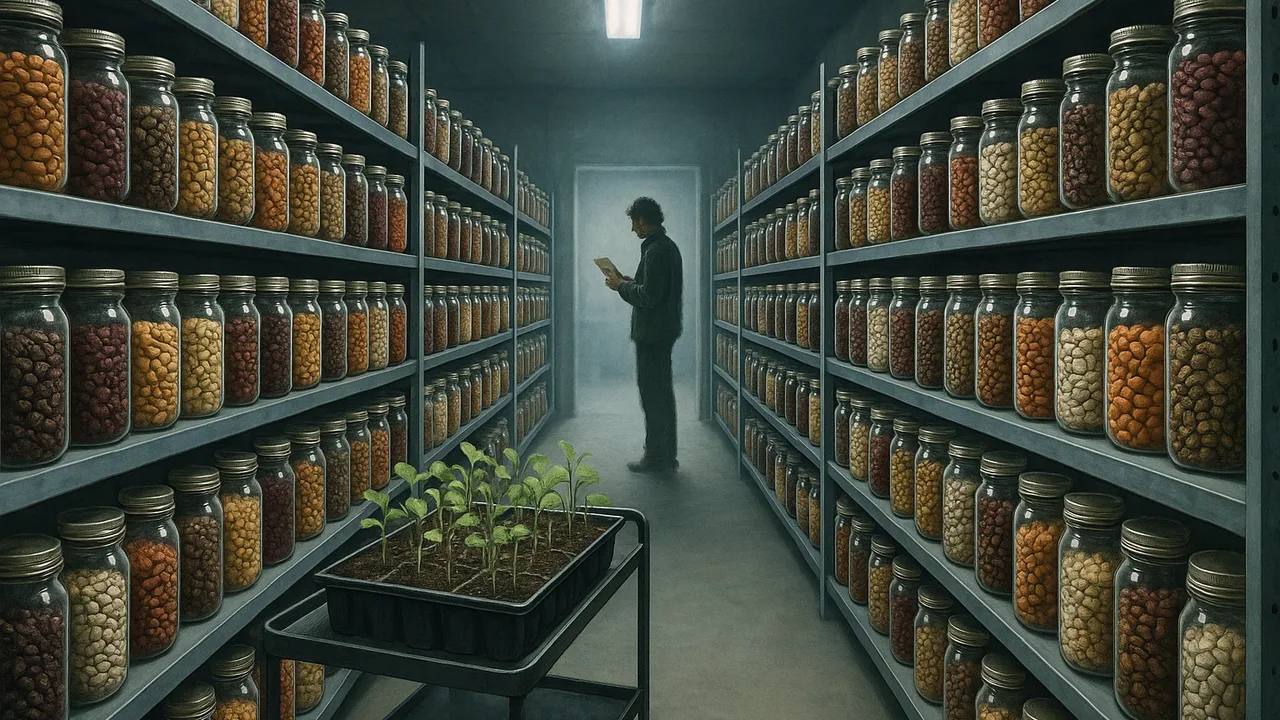
Around the world, seed banks (also called gene banks) store seeds of thousands of crop varieties. Many are old farm varieties and wild relatives. Seeds are dried and kept cold, which lets many kinds stay alive for years or even decades. Some banks also send backup copies to a secure vault built inside a frozen mountain in the Arctic, in case a disaster destroys the originals.
Plant breeders use these collections like a library. When droughts become a bigger problem, they grow many stored varieties in dry test plots and look for plants that stay green, root deeply or finish making seeds before the driest weeks. Then they cross those plants with high-yielding varieties and select the best offspring for several generations, testing them in dry fields year after year.
Public breeding programs have released drought-tolerant varieties of crops such as corn, beans and rice for farmers in dry regions, mostly through crossing and selection. At least one genetically modified drought-tolerant corn has also been approved in some countries. Breeders warn that when every farm plants the same variety, one new disease or stress can harm all of them, so keeping diversity in storage and in fields matters.
Think about it: Which steps of the breeders’ work match our Plans A and B, and what does the case study suggest our farm should protect?
Closure ~5 min
Diversity is the raw material of every breeding plan. Next class, Punnett squares will tell us what our crosses can produce.
Exit ticket: explain how one mutation could be helpful to a bean plant in a drought year but neutral in a wet year.
How confident are you that you can I can use a model to explain how mutations can be helpful, harmful or neutral.
Teacher notes
Materials: case study copies, model template (chromosome, gene, protein, trait boxes), several varieties of dry beans to compare (wash hands after).
Setup: keep MS-LS3-1 inside its boundary: no protein synthesis steps, no DNA bases and no named mutation types. The case study is kept general on purpose; do not add statistics.
Listen for: “plants mutate on purpose to survive drought” (mutations happen by chance; selection then favors helpful ones); “all mutations are bad.”
Support / stretch: give a partly drawn model with arrows. Stretch: explain why a harmful mutation might still be passed on if its variant is recessive.