1.25 Planning Board Night: Presenting the Hazard-Ready Plan
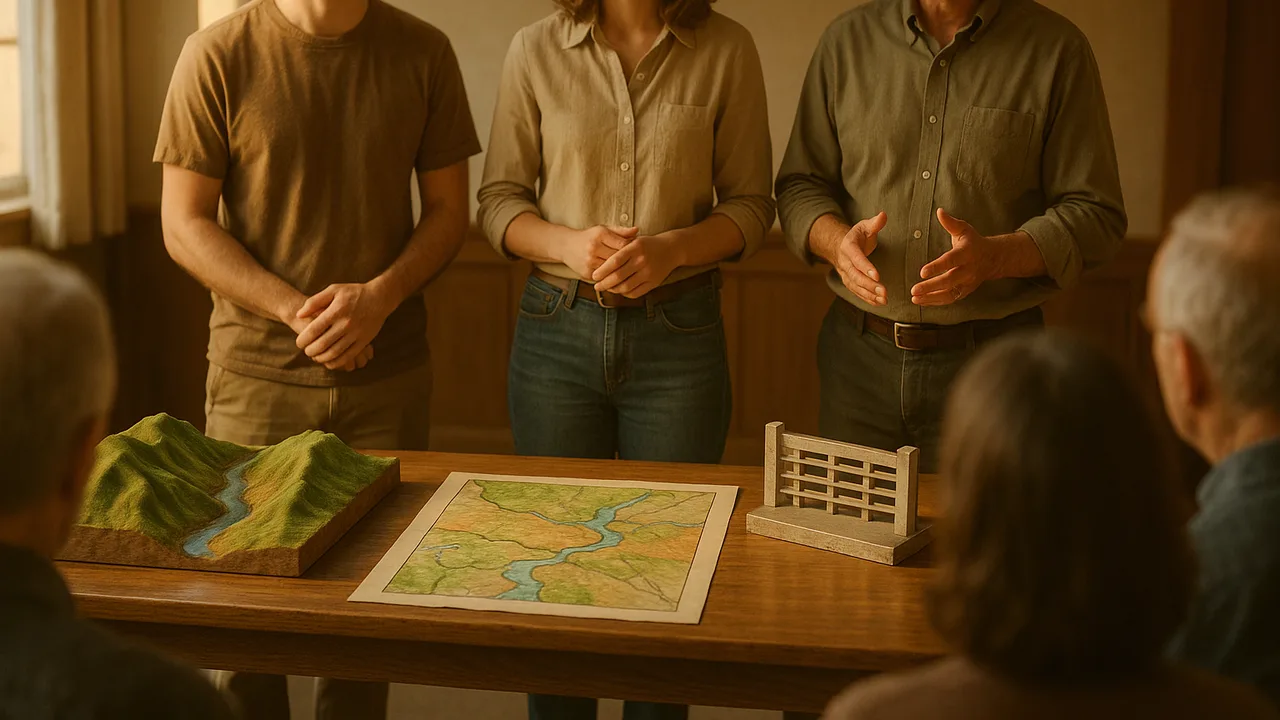
present our hazard and resource map, barrier and early-warning plan to the planning board and defend our recommendation with evidence.
- I can use evidence and reasoning to make a claim about which solution works best, based on their strengths and weaknesses.
- I can use patterns in the data to forecast the chance, frequency, severity, and likely location of a future natural hazard event, and what warning signs might come first.
- I can use evidence and reasoning to construct a scientific explanation for how Earth’s resources are unevenly distributed.
Phase 5: Prove It
Warm-Up ~5 min
Do Now. The board has six minutes for your team. What three things must they hear before they vote?
Which opening best fits the planning board?
Instruction ~10 min
Engineers, tonight the town is listening. Planning board members, or family and staff playing them, visit in person or by video. They will decide which ideas to study further for the east gully.
Your six-minute presentation. 1. The problem, who it affects and the system. 2. The hazard and resource map, and why the town’s coal, groundwater and hazards are where they are. 3. Your concepts and decision matrix. 4. How your barrier works, explained with kinetic energy, and your Trial Day data against every criterion. 5. Your early-warning plan and the rainfall data behind it. 6. Your honest recommendation, including limitations.
Worked example 1: the science, simply. Priya said: “A boulder moving twice as fast hits with about four times the energy. So our posts slow boulders first, and the mesh catches them while water drains through.” Short, accurate and tied to the design.
Worked example 2: honest trade-offs. Jamal said: “Our barrier met every criterion, but the steel ball in our stress test tore the mesh. A real barrier would need steel nets and an engineer’s design. Barriers also fill up, so the town must budget for cleaning. That’s why we pair it with a warning plan.” Boards trust teams that name limits.
Guided Exercises ~15 min
Rehearse with your team before the board arrives.
Independent Practice ~10 min
After all the presentations, reflect.
What did a board member ask or suggest? Name one idea from another team that you would borrow, and explain why.
Write a one-paragraph recommendation to the planning board: which barrier design and warning plan should the town study further? Use evidence from at least two teams.
Project task: The Hazard-Ready River Town
Advise a river-valley town’s planning board on its hazards and resources. Build a hazard and resource map from data, design and test a debris barrier for the east gully, write an early-warning plan from rainfall data, and present a recommendation. The barrier must stop at least 9 of 10 marble “boulders” released from the top of a 1 m ramp, let water drain through, cost no more than 10 sample budget points, and fit a 30 cm wide channel.
Submission workflow
- Map the valley: read the rock layers and data to place hazards, coal and groundwater, and explain why each is where it is.
- Define the problem, system, criteria and constraints, then sketch a mesh fence, staggered posts and a catch basin.
- Choose a concept with a weighted decision matrix, and measure how mass and speed change a boulder’s kinetic energy.
- Build and test version 1, write the early-warning plan, take peer critique, and build and retest version 2.
- Run Barrier Trial Day and present the map, barrier and plan to the planning board with an honest recommendation.
How it is scored
| Criterion | What proficient looks like |
|---|---|
| Defining the problem | The problem, the people affected, the system and measurable criteria and constraints (9 of 10 boulders, drainage, 10 budget points, 30 cm channel, cleaning, creek effects) are stated clearly. |
| Evaluating designs | The three concepts are scored in a weighted decision matrix; the claim names strengths, weaknesses and evidence, and uses what real debris nets and warning systems show. |
| Earth science and energy | The map explains resources and hazards with past processes and rock-layer evidence; the warning thresholds come from rainfall data; the barrier is explained with kinetic energy rising with mass and with the square of speed. |
| Testing and communication | Trial Day data is graphed and compared with every criterion; one limitation is named; every member speaks; the recommendation is honest and clear. |
Closure ~5 min
You gave a town real, evidence-based advice, engineers. Next: the unit checkpoint, then two catch-up and stretch days.
Exit ticket: which question from our Wonder Board can you now answer? Write the question and your answer.
How confident are you that you can I can use evidence and reasoning to make a claim about which solution works best.
Teacher notes
Materials: barriers on ramps (no live trials during presentations), maps and graphs on posters or slides, rubric copies for visitors, a timer.
Setup: invite family members, staff or a local official to role-play the planning board; a video call works. Visitors can score the “Testing and communication” row. Keep the town and its data generic.
Listen for: talks that skip the data; “our barrier will stop any landslide”; one student doing all the talking. Some families may have lived through floods or landslides; keep the tone calm and solutions-focused.
Support / stretch: give a six-box presentation frame and allow note cards. Stretch: estimate the yearly cleaning cost in budget points and add it to the recommendation.