1.04 4.6 Billion Years on a Tape: A Scaled Timeline
build a scaled timeline of Earth’s history and use it to compare when major events happened relative to each other.
- I can explain how scientists use the geologic time scale to organize and compare events in Earth’s 4.6-billion-year history.
- I can use information from multiple reliable sources, including my own investigations, to support my explanation of Earth’s history.
Phase 2: Investigate
Warm-Up ~5 min
Do Now. Earth is about 4.6 billion years old. If you counted one number every second without stopping, a billion would take you over 30 years. Write how you might show 4.6 billion years on something you could hold.
On a timeline where all of Earth's history is 4.6 m long, how much tape would all of human history take?
Instruction ~10 min
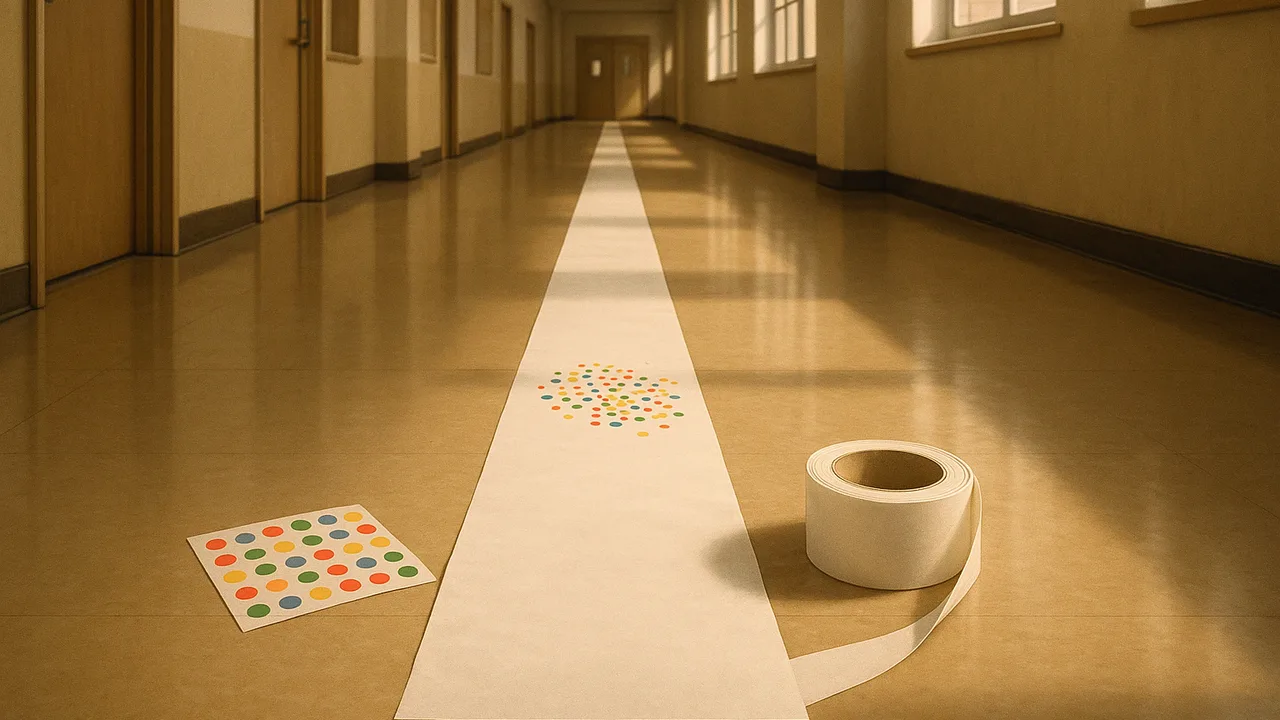
Explore first: build the tape. Each team unrolls 4.6 m of register tape. Our scale is 1 m = 1 billion years, so 1 mm = 1 million years. Mark “Earth forms” at one end and “today” at the other. Then place each event card where you guess it goes, in pencil, before you measure.
| Event (approximate) | Years ago | Guess: distance from today | Scaled distance from today | Surprised? Why? |
|---|---|---|---|---|
| Earth forms | 4.6 billion | |||
| Oldest evidence of life (microbes) | about 3.5 billion | |||
| Many animals with shells appear | about 540 million | |||
| Swamp forests that later became coal | about 300 million | |||
| Asteroid impact; non-bird dinosaurs die out | about 66 million | |||
| Our species appears | about 300,000 |
Name the ideas. Scientists organize Earth’s history on the geologic time scale. It divides time using big changes in the rock and fossil record, such as mass extinctions. You do not need to memorize its names. You need to compare events: which came first, and how far apart they were. Rock layers give the relative order. Lab measurements of certain rocks, especially volcanic ash, give approximate ages in years. Together they pin events to the timeline.
Worked example 1: scaling an event. The impact was about 66 million years ago. At 1 mm per million years, it sits 66 mm, or 6.6 cm, from the “today” end. Ava was shocked: almost the whole tape is before the dinosaurs’ end.
Worked example 2: comparing gaps. Shelled animals appear about 540 million years ago, at 54 cm from today. That leaves about 4 m of tape with no animals with shells or skeletons in the record. For most of Earth’s history, life was microscopic.
Worked example 3: using two kinds of evidence. Our road-cut ash layer was dated, in a sample report, to about 300 million years. The coal is just below it, so it is a bit older. The red sandstone above is younger. One dated layer turns an order into an approximate age range. Combining sources makes the story stronger.
Guided Exercises ~15 min
Use your finished tape. Measure before you answer.
Independent Practice ~10 min
Reflect on your timeline.
Pick two events on the tape. Describe which came first, how far apart they are in years, and what evidence would tell a scientist that order.
Explain why scientists use both rock-layer order and dated ash layers, instead of just one.
Closure ~5 min
Deep time is enormous. Next time, we ask why the past left coal, oil and metal in some places and not others.
Exit ticket: what surprised you most on the tape, and what does it tell you about how long Earth's processes have had to work?
Teacher notes
Materials (per team): 4.6 m of register tape or string, meter sticks, event cards, tape. A hallway works well.
Facts used: Earth about 4.6 billion years; impact and non-bird dinosaur extinction about 66 million years ago. Other dates are rounded, widely cited approximations; the road-cut ash date is labeled sample data.
Listen for: “people and dinosaurs lived together” and evenly spaced events. Keep to comparisons; do not teach radiometric dating mechanics.
Support / stretch: give pre-measured event positions to check against guesses. Stretch: add one more event from a reliable source and cite it.