2.28 Catch-up and Stretch: Energy and Better Designs
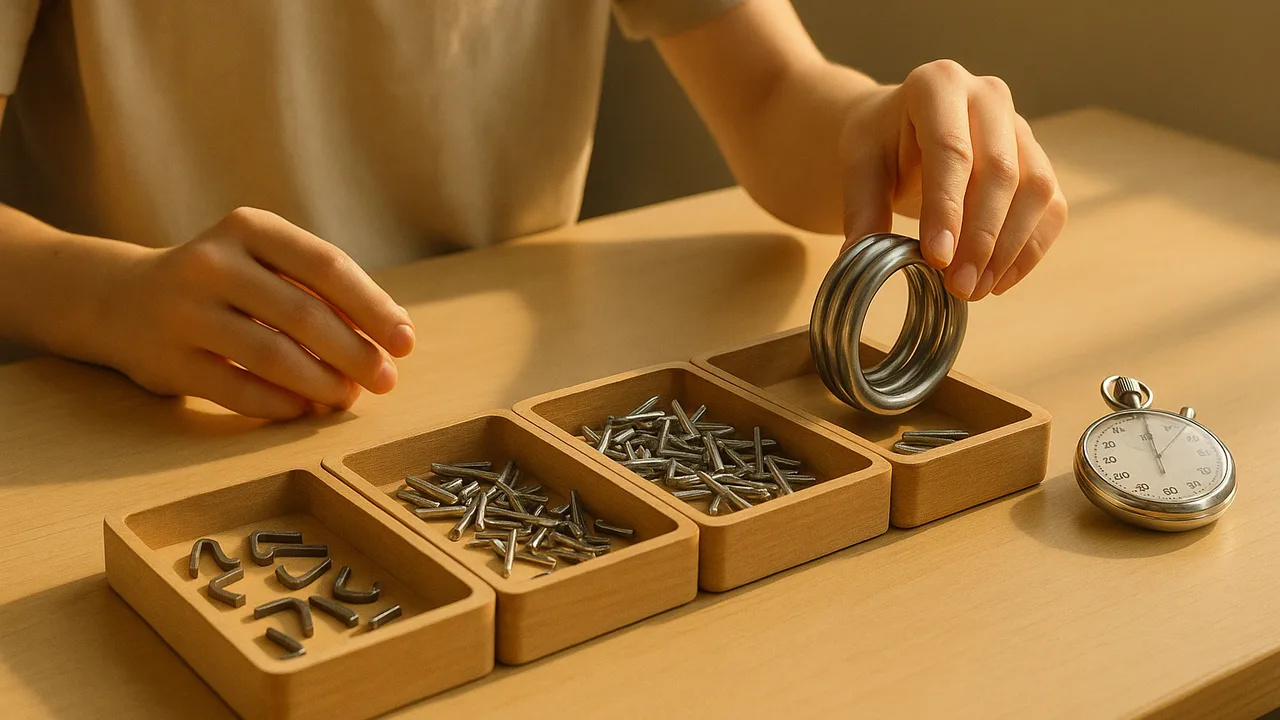
practice energy and design ideas I found hardest, and stretch my thinking by improving a design for a new client.
- I can use my model to explain that moving two objects that attract each other farther apart requires a force and adds energy to the system.
- I can use my model to explain that moving two objects that repel each other closer together requires a force and adds energy to the system.
- I can use reasoning to explain how changes in observable features, like motion or temperature, show that an object’s kinetic energy changed.
- I can explain how changes in the energy of other objects or the surroundings show that energy was transferred to or from the object.
- I can describe how the data from my model, along with the criteria and constraints, can help me improve my design through testing and making changes.
Phase 5: Prove It
Warm-Up ~5 min
Do Now. Hold a magnet a little above a paperclip, then slowly lower it. At what moment does the clip jump? Where did the energy for that jump come from?
How confident are you that you can I can explain how energy is stored and transferred when objects interact at a distance.
Instruction ~10 min
Sorting engineers, one more choice board. Catch-up stations rebuild the energy story. The Stretch station takes on a new client.
Re-teach: the stretched rubber band picture. Think of two attracting objects as joined by an invisible rubber band. Pull them apart and you “stretch” it: you use a force and store energy. Let go and they snap together, speeding up. For repelling objects, picture a spring squeezed between them: pushing closer stores energy.
Worked example 1: a can on the line. A steel cap is pulled up to the coil (stored energy becomes kinetic energy), clicks (kinetic energy goes to sound and warming), is lifted higher by the arm (energy stored against gravity), then falls into the bin when switched off (stored energy becomes kinetic energy) and clinks to a stop.
Worked example 2: a new client. A community makerspace wants a sorter for spilled steel screws mixed with brass screws. Brass is not attracted to magnets. Diego’s team uses their model: the screws are heavier than caps, so they predict needing more turns and a closer arm, and they name a limit: screws can tangle.
Guided Exercises ~15 min
Work at your station, then answer the blocks.
Independent Practice ~10 min
Choose ONE.
Catch-up: explain, with a drawing, why pulling a steel cap away from a magnet adds energy to the system, and what happens to that energy when you let go.
Stretch: design a sorter for the makerspace. Combine two features from class designs, describe the model data you would collect and how you would use it, within the criteria and constraints, to improve your design.
Closure ~5 min
Unit 2 complete, sorting engineers. Your Prove It field trip, Recycling Center Demo Day, comes after this lesson.
Exit ticket: answer our driving question in three sentences. How do objects push and pull without touching, and how did we use that to sort steel?
Teacher notes
Materials: paperclips, bar magnets, rubber bands for the analogy, coils and cells, a small mix of steel and brass screws (brass is not attracted by magnets; check with a magnet first).
Setup: group by 2.26 results. Ten minutes of re-teach, then 30 minutes at stations. The rubber band picture is an analogy; tell students no real band exists.
Listen for: “energy is used up” (it is transferred, for example to sound and warming); “closer always means more stored energy” (only for repelling objects).
Support / stretch: give the four-box life-of-a-cap template. Stretch: add an aluminum station to the makerspace line and explain how a changing magnetic field could move it.